Department of Structures for Engineering and Architectures, University of Napoli Federico II, Naples, Italy.
Department of Mathematics, Computer Science, and Economics, University of Basilicata, Potenza, Italy.
Appl Health Econ Health Policy. 2020 Aug;18(4):509-517. doi: 10.1007/s40258-020-00596-3.
There has been much debate about the effectiveness of lockdown measures in containing COVID-19, and their appropriateness given the economic and social cost they entail. To the best of our knowledge, no existing contribution to the literature has attempted to gauge the effectiveness of lockdown measures over time in a longitudinal cross-country perspective.
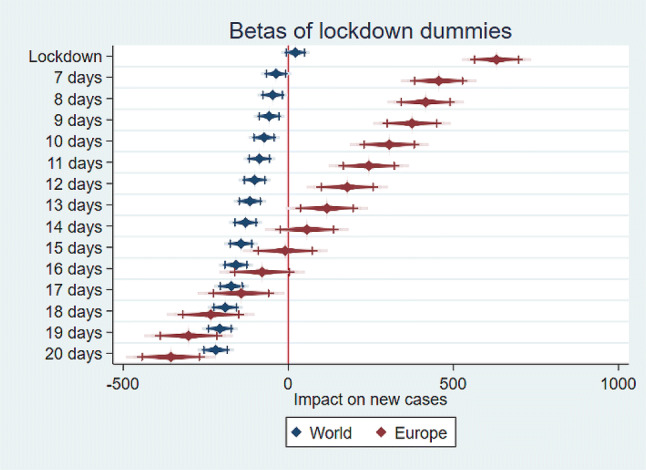
This paper aims to fill the gap in the literature by assessing, at an international level, the effect of lockdown measures (or the lack of such measures) on the numbers of new infections. Given this policy's expected change in effectiveness over time, we also measure the effect of having a lockdown implemented over a given number of days (from 7 to 20 days).
We pursue our objectives by means of a quantitative panel analysis, building a longitudinal dataset with observations from countries all over the world, and estimating the impact of lockdown via feasible generalized least squares fixed effect, random effects, generalized estimating equation, and hierarchical linear models.
Our results show that lockdown is effective in reducing the number of new cases in the countries that implement it, compared with those countries that do not. This is especially true around 10 days after the implementation of the policy. Its efficacy continues to grow up to 20 days after implementation.
Results suggest that lockdown is effective in reducing the R0, i.e. the number of people infected by each infected person, and that, unlike what has been suggested in previous analyses, its efficacy continues to hold 20 days after the introduction of the policy.
关于封锁措施在遏制 COVID-19 方面的有效性,以及考虑到它们带来的经济和社会成本,这些措施是否合适,一直存在很多争议。据我们所知,文献中尚无任何现有贡献试图从纵向跨国角度来衡量封锁措施随时间推移的有效性。
本文旨在通过在国际层面上评估封锁措施(或缺乏此类措施)对新感染人数的影响,填补文献中的空白。鉴于该政策的预期有效性会随时间发生变化,我们还衡量了在给定天数(7 至 20 天)内实施封锁的效果。
我们通过定量面板分析来实现我们的目标,构建了一个包含来自世界各地国家的观察结果的纵向数据集,并通过可行的广义最小二乘固定效应、随机效应、广义估计方程和层次线性模型来估计封锁的影响。
我们的结果表明,与未实施封锁的国家相比,实施封锁的国家新病例数量减少。这在政策实施后约 10 天左右尤其明显。其功效在实施后 20 天内持续增长。
结果表明,封锁措施在降低 R0(即每个感染者感染的人数)方面是有效的,而且与之前的分析所表明的不同,其效果在政策实施 20 天后仍然存在。