Department of Neuroscience, Brown University, Providence, United States.
Department of Molecular Pharmacology and Physiology, Brown University, Providence, United States.
Elife. 2020 Jun 4;9:e48730. doi: 10.7554/eLife.48730.
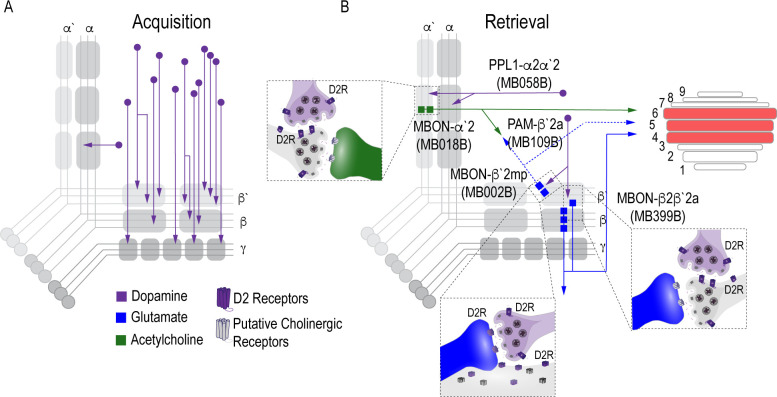
A powerful feature of adaptive memory is its inherent flexibility. Alcohol and other addictive substances can remold neural circuits important for memory to reduce this flexibility. However, the mechanism through which pertinent circuits are selected and shaped remains unclear. We show that circuits required for alcohol-associated preference shift from population level dopaminergic activation to select dopamine neurons that predict behavioral choice in . During memory expression, subsets of dopamine neurons directly and indirectly modulate the activity of interconnected glutamatergic and cholinergic mushroom body output neurons (MBON). Transsynaptic tracing of neurons important for memory expression revealed a convergent center of memory consolidation within the mushroom body (MB) implicated in arousal, and a structure outside the MB implicated in integration of naïve and learned responses. These findings provide a circuit framework through which dopamine neuronal activation shifts from reward delivery to cue onset, and provide insight into the maladaptive nature of memory.
自适应记忆的一个强大特征是其固有的灵活性。酒精和其他成瘾物质可以重塑对记忆很重要的神经回路,从而降低这种灵活性。然而,相关回路如何被选择和塑造的机制尚不清楚。我们表明,与酒精相关的偏好转变所必需的回路从群体水平的多巴胺能激活转变为选择预测行为选择的多巴胺神经元在. 在记忆表达过程中,多巴胺神经元的亚群直接和间接调节相互连接的谷氨酸能和胆碱能蘑菇体输出神经元(MBON)的活性。对记忆表达中重要神经元的突触追踪揭示了一个与觉醒有关的蘑菇体(MB)内记忆巩固的收敛中心,以及一个与幼稚和习得反应整合有关的 MB 外结构。这些发现为多巴胺神经元激活从奖励传递到线索开始的转变提供了一个电路框架,并深入了解了记忆的适应不良性质。