Institute for Health and Sport, Victoria University, Western Centre for Health, Research and Education, Sunshine Hospital, Melbourne, Victoria, Australia.
Department of Pediatric Surgery, Massachusetts General Hospital, Harvard Medical School, Boston, Massachusetts, USA.
Stem Cells Transl Med. 2020 Sep;9(9):985-1006. doi: 10.1002/sctm.19-0446. Epub 2020 Jun 4.
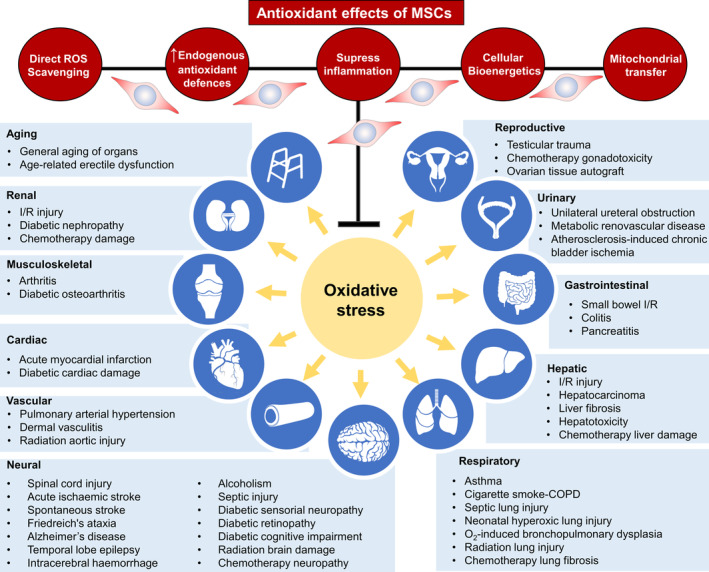
Mesenchymal stem cells (multipotent stromal cells; MSCs) have been under investigation for the treatment of diverse diseases, with many promising outcomes achieved in animal models and clinical trials. The biological activity of MSC therapies has not been fully resolved which is critical to rationalizing their use and developing strategies to enhance treatment efficacy. Different paradigms have been constructed to explain their mechanism of action, including tissue regeneration, trophic/anti-inflammatory secretion, and immunomodulation. MSCs rarely engraft and differentiate into other cell types after in vivo administration. Furthermore, it is equivocal whether MSCs function via the secretion of many peptide/protein ligands as their therapeutic properties are observed across xenogeneic barriers, which is suggestive of mechanisms involving mediators conserved between species. Oxidative stress is concomitant with cellular injury, inflammation, and dysregulated metabolism which are involved in many pathologies. Growing evidence supports that MSCs exert antioxidant properties in a variety of animal models of disease, which may explain their cytoprotective and anti-inflammatory properties. In this review, evidence of the antioxidant effects of MSCs in in vivo and in vitro models is explored and potential mechanisms of these effects are discussed. These include direct scavenging of free radicals, promoting endogenous antioxidant defenses, immunomodulation via reactive oxygen species suppression, altering mitochondrial bioenergetics, and donating functional mitochondria to damaged cells. Modulation of the redox environment and oxidative stress by MSCs can mediate their anti-inflammatory and cytoprotective properties and may offer an explanation to the diversity in disease models treatable by MSCs and how these mechanisms may be conserved between species.
间充质干细胞(多能基质细胞;MSCs)已被广泛研究用于治疗多种疾病,在动物模型和临床试验中取得了许多有前景的结果。MSC 疗法的生物学活性尚未得到充分解决,这对于合理利用 MSC 并开发增强治疗效果的策略至关重要。已经构建了不同的范式来解释其作用机制,包括组织再生、营养/抗炎分泌和免疫调节。MSC 在体内给药后很少植入并分化为其他细胞类型。此外,是否通过分泌许多肽/蛋白配体发挥作用尚不确定,因为它们的治疗特性在异种移植障碍中被观察到,这表明涉及物种间保守的介质的机制。氧化应激伴随着细胞损伤、炎症和代谢失调,这些都与许多病理有关。越来越多的证据支持 MSC 在多种疾病的动物模型中具有抗氧化特性,这可以解释它们的细胞保护和抗炎特性。在这篇综述中,探讨了 MSC 在体内和体外模型中抗氧化作用的证据,并讨论了这些作用的潜在机制。这些机制包括直接清除自由基、促进内源性抗氧化防御、通过抑制活性氧抑制免疫调节、改变线粒体生物能学以及将功能性线粒体捐赠给受损细胞。MSC 对氧化还原环境和氧化应激的调节可以介导其抗炎和细胞保护特性,并为 MSC 可治疗的疾病模型的多样性以及这些机制如何在物种间保守提供解释。