Kim Hyung-Ju, Hwang Hyun-Seong, Choi Yong-Hyuk, Song Hye-Yeon, Park Ji-Seong, Yun Chae-Young, Ryu Sukhyun
Department of Preventive Medicine, Konyang University College of Medicine, Daejeon, Korea.
J Prev Med Public Health. 2020 May;53(3):164-167. doi: 10.3961/jpmph.20.088. Epub 2020 Apr 8.
As of March 3, 2020, the Shincheonji religious group accounted for the majority of Korean cases of coronavirus disease 2019 (COVID-19). Nonetheless, the most likely cause of the broad spread of COVID-19 among members of the Shincheonji religious group remains largely unknown.
We obtained data of laboratory-confirmed cases related to the Shincheonji religious group from press releases by Korean public health authorities and news reports. We measured the period from the date of illness onset to the date of COVID-19 confirmation.
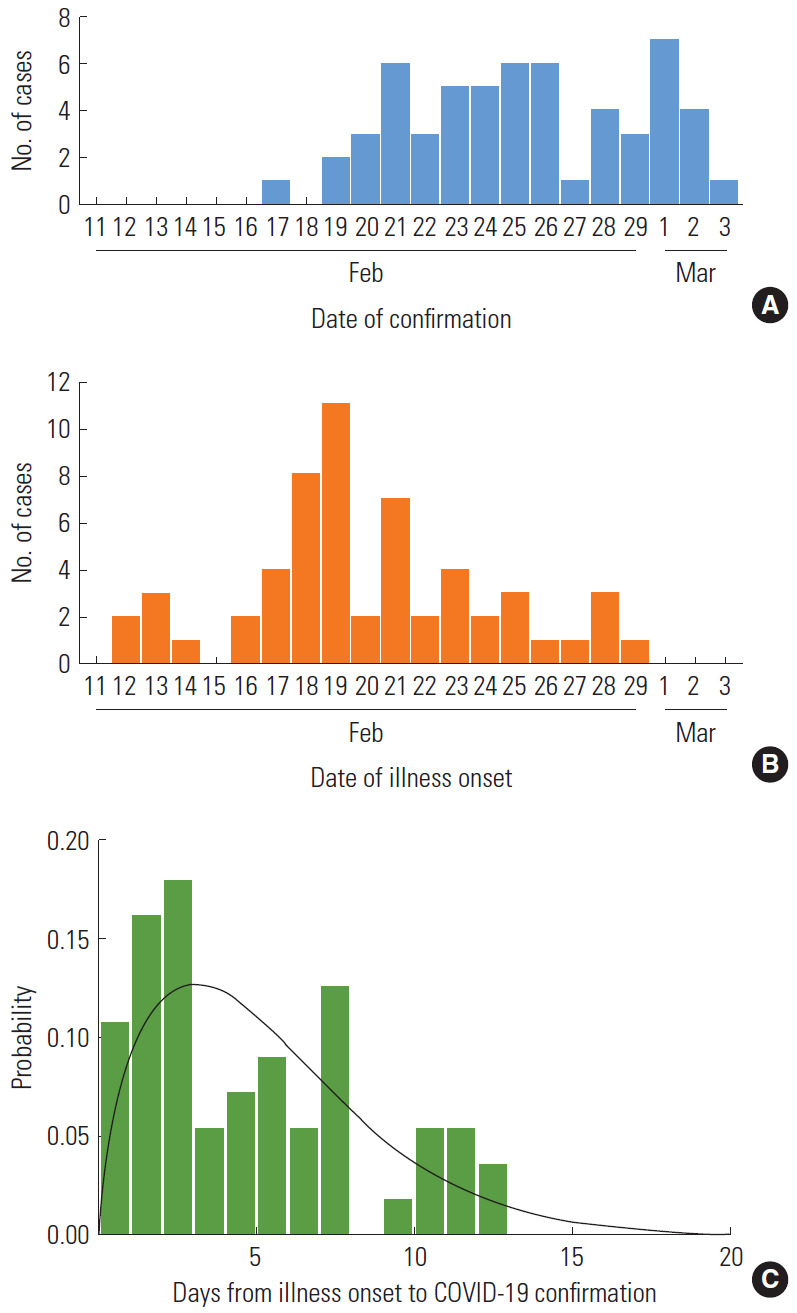
We analysed data from 59 cases (median age, 30 years). The estimated median period between the date of symptom onset and the date of COVID-19 confirmation was 4 days (95% confidence interval, 1-12).
There was a delay in COVID-19 confirmation from the date of illness onset among the cases linked to the Shincheonji religious group. This delay likely contributed to the occurrence of many cases of COVID-19 in the group.
截至2020年3月3日,新天地宗教团体占韩国2019冠状病毒病(COVID-19)病例的大多数。尽管如此,COVID-19在新天地宗教团体成员中广泛传播的最可能原因在很大程度上仍不清楚。
我们从韩国公共卫生当局的新闻稿和新闻报道中获取了与新天地宗教团体相关的实验室确诊病例数据。我们测量了从发病日期到COVID-19确诊日期的时间段。
我们分析了59例病例的数据(中位年龄30岁)。症状出现日期与COVID-19确诊日期之间的估计中位时间为4天(95%置信区间,1-12天)。
与新天地宗教团体相关的病例从发病日期到COVID-19确诊存在延迟。这种延迟可能导致了该团体中许多COVID-19病例的发生。