Department of NanoEngineering, University of California San Diego, 9500 Gilman Drive, La Jolla, CA, 92093, USA.
Division of Regenerative Medicine, Department of Medicine, University of California, San Diego, La Jolla, CA, 92037, USA.
Cell Res. 2020 Oct;30(10):833-853. doi: 10.1038/s41422-020-0338-1. Epub 2020 Jun 4.
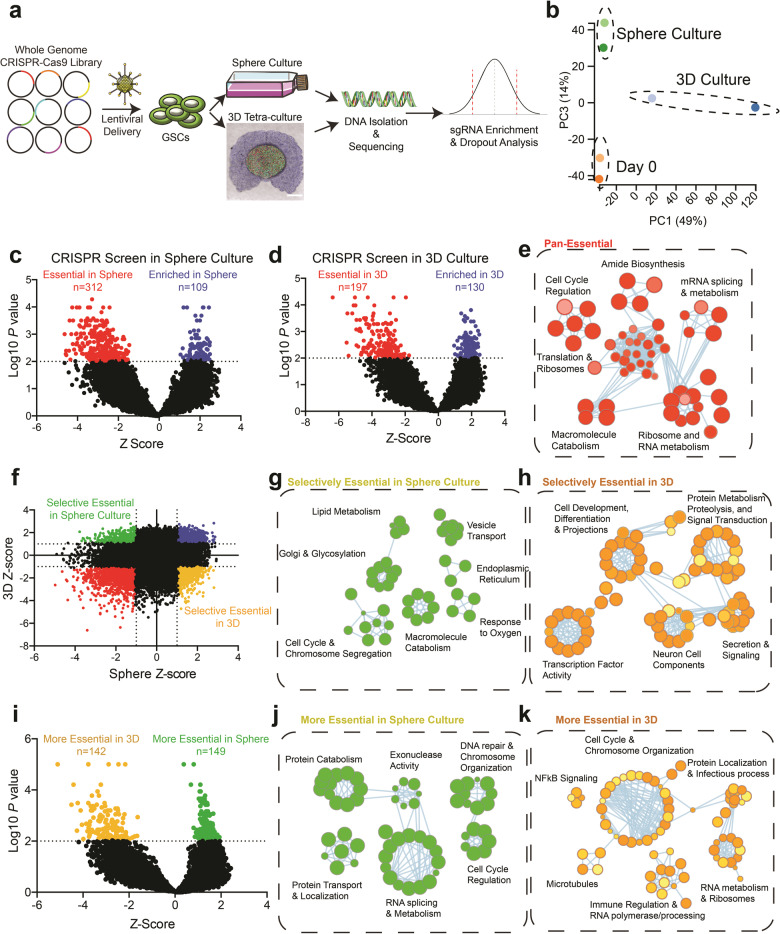
Brain tumors are dynamic complex ecosystems with multiple cell types. To model the brain tumor microenvironment in a reproducible and scalable system, we developed a rapid three-dimensional (3D) bioprinting method to construct clinically relevant biomimetic tissue models. In recurrent glioblastoma, macrophages/microglia prominently contribute to the tumor mass. To parse the function of macrophages in 3D, we compared the growth of glioblastoma stem cells (GSCs) alone or with astrocytes and neural precursor cells in a hyaluronic acid-rich hydrogel, with or without macrophage. Bioprinted constructs integrating macrophage recapitulate patient-derived transcriptional profiles predictive of patient survival, maintenance of stemness, invasion, and drug resistance. Whole-genome CRISPR screening with bioprinted complex systems identified unique molecular dependencies in GSCs, relative to sphere culture. Multicellular bioprinted models serve as a scalable and physiologic platform to interrogate drug sensitivity, cellular crosstalk, invasion, context-specific functional dependencies, as well as immunologic interactions in a species-matched neural environment.
脑肿瘤是具有多种细胞类型的动态复杂生态系统。为了在可重复和可扩展的系统中对脑肿瘤微环境进行建模,我们开发了一种快速的三维(3D)生物打印方法来构建具有临床相关性的仿生组织模型。在复发性脑胶质瘤中,巨噬细胞/小胶质细胞显著促进肿瘤生长。为了解析巨噬细胞在 3D 中的功能,我们比较了单独培养或与星形胶质细胞和神经前体细胞共培养的脑胶质瘤干细胞(GSCs)在富含透明质酸的水凝胶中的生长情况,有无巨噬细胞。整合巨噬细胞的生物打印构建体再现了预测患者生存、维持干性、侵袭和耐药性的患者衍生转录谱。对生物打印的复杂系统进行全基因组 CRISPR 筛选,确定了相对于球体培养的 GSCs 中独特的分子依赖性。多细胞生物打印模型是一种可扩展的生理平台,可用于在种间匹配的神经环境中检测药物敏感性、细胞串扰、侵袭、特定功能依赖性以及免疫相互作用。