Center for Brain and Cognition, University Pompeu Fabra, Barcelona, Spain.
Neuropsychology and Functional Neuroimaging Group, University Jaume I, Castellón, Spain.
Sci Rep. 2020 Jun 4;10(1):9137. doi: 10.1038/s41598-020-66100-y.
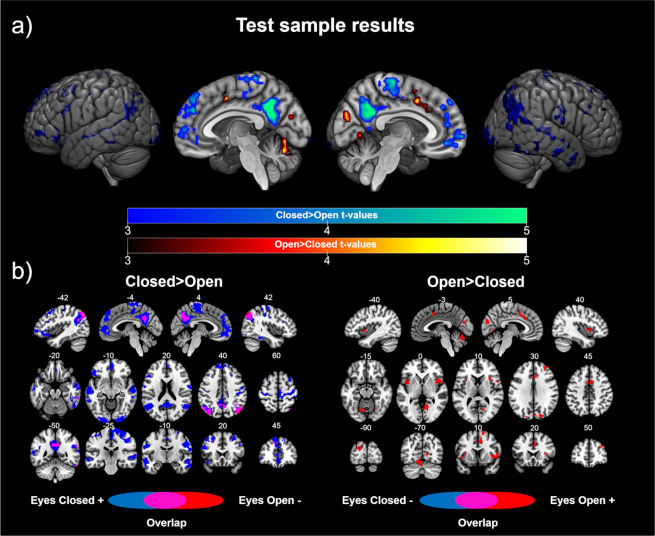
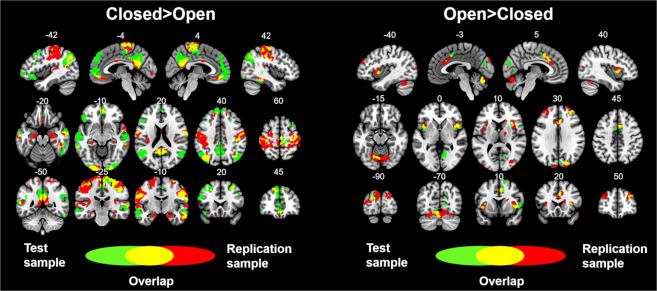
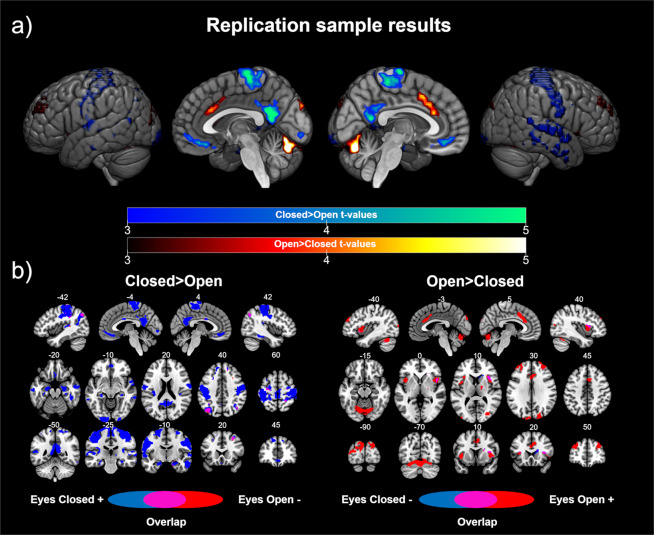
Current evidence suggests that volitional opening or closing of the eyes modulates brain activity and connectivity. However, how the eye state influences the functional connectivity of the primary visual cortex has been poorly investigated. Using the same scanner, fMRI data from two groups of participants similar in age, sex and educational level were acquired. One group (n = 105) performed a resting state with eyes closed, and the other group (n = 63) performed a resting state with eyes open. Seed-based voxel-wise functional connectivity whole-brain analyses were performed to study differences in the connectivity of the primary visual cortex. This region showed higher connectivity with the default mode and sensorimotor networks in the eyes closed group, but higher connectivity with the salience network in the eyes open group. All these findings were replicated using an open source shared dataset. These results suggest that opening or closing the eyes may set brain functional connectivity in an interoceptive or exteroceptive state.
目前的证据表明,自愿睁开或闭上眼睛会调节大脑活动和连接。然而,眼睛状态如何影响初级视觉皮层的功能连接仍未得到充分研究。使用相同的扫描仪,我们从年龄、性别和教育程度相似的两组参与者中获取了 fMRI 数据。一组(n=105)闭眼进行静息状态,另一组(n=63)睁眼进行静息状态。我们进行了基于种子的全脑功能连接体素分析,以研究初级视觉皮层连接的差异。在闭眼组中,该区域与默认模式和感觉运动网络的连接更高,而在睁眼组中,与显着性网络的连接更高。所有这些发现都使用开源共享数据集得到了复制。这些结果表明,睁开或闭上眼睛可能会使大脑的功能连接处于内感受或外感受状态。