Olsen Sharon, Signal Nada, Niazi Imran K, Rashid Usman, Alder Gemma, Mawston Grant, Nedergaard Rasmus B, Jochumsen Mads, Taylor Denise
Health and Rehabilitation Research Institute, Auckland University of Technology, Auckland, New Zealand.
Centre for Chiropractic Research, New Zealand College of Chiropractic, Auckland, New Zealand.
Front Hum Neurosci. 2020 May 15;14:156. doi: 10.3389/fnhum.2020.00156. eCollection 2020.
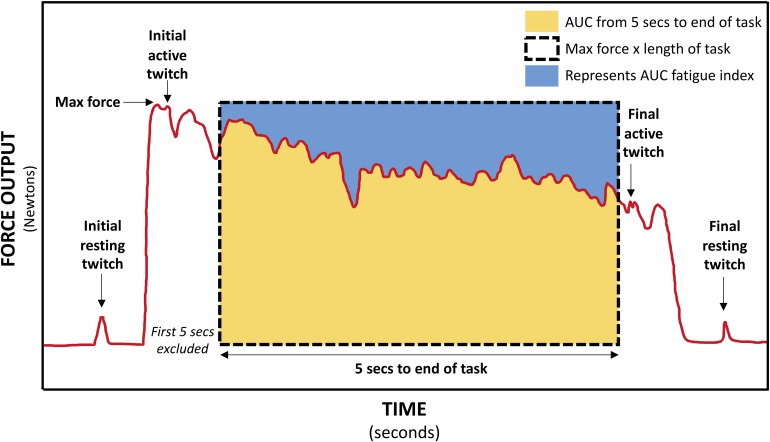
Endogenous paired associative stimulation (ePAS) is a neuromodulatory intervention that has potential to aid stroke recovery. ePAS involves pairing endogenous electroencephalography (EEG) signals known as movement-related cortical potentials (MRCPs), with peripheral electrical stimulation. Previous studies have used transcranial magnetic stimulation (TMS) to demonstrate changes in corticomotor excitability following ePAS. However, the use of TMS as a measure in stroke research is limited by safety precautions, intolerance, and difficulty generating a measurable response in more severely affected individuals. We were interested in evaluating the effect of ePAS using more feasible measures in people with stroke. This study asks whether ePAS produces immediate improvements in the primary outcomes of maximal voluntary isometric contraction (MVIC) and total neuromuscular fatigue of the dorsiflexor muscles, and in the secondary outcomes of muscle power, voluntary activation (VA), central fatigue, peripheral fatigue, and electromyography activity.
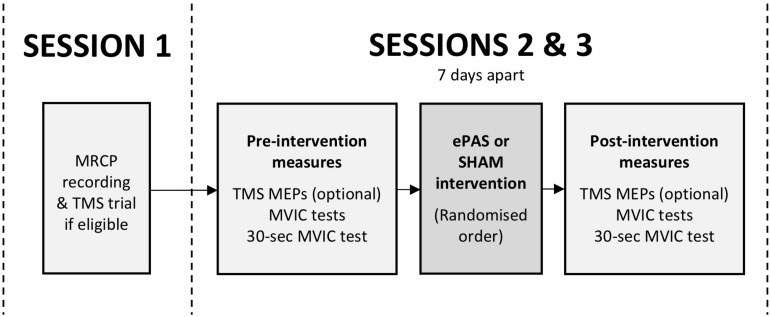
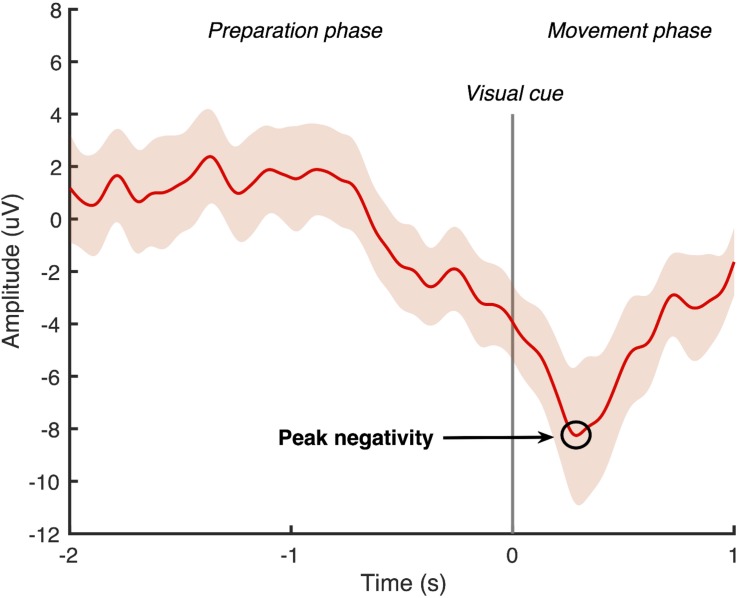
In this repeated-measures cross-over study, 15 participants with chronic stroke completed two interventions, ePAS and sham, in a randomized order. During ePAS, 50 repetitions of visually cued dorsiflexion were completed, while single pulses of electrical stimulation were delivered to the deep branch of the common peroneal nerve. Each somatosensory volley was timed to arrive in the primary motor cortex at the peak negativity of the MRCP. Univariate and multivariate linear mixed models were used to analyze the primary and secondary data, respectively.
There was a statistically significant increase in dorsiflexor MVIC immediately following the ePAS intervention (mean increase 7 N), compared to the sham intervention (mean change 0 N) (univariate between-condition analysis = 0.047). The multivariate analysis revealed a statistically significant effect of ePAS on VA of the tibialis anterior muscle, such that ePAS increased VA by 7 percentage units (95% confidence interval 1.3-12.7%). There was no statistically significant effect on total neuromuscular fatigue, muscle power, or other secondary measures.
A single session of ePAS can significantly increase isometric muscle strength and VA in people with chronic stroke. The findings confirm that ePAS has a central neuromodulatory mechanism and support further exploration of its potential as an adjunct to stroke rehabilitation. In addition, the findings offer alternative, feasible outcome measures for future research.
Australia New Zealand Clinical Trials Registry ACTRN12617000838314 (www.anzctr.org.au), Universal Trial Number U111111953714.
内源性配对联想刺激(ePAS)是一种神经调节干预措施,具有促进中风恢复的潜力。ePAS包括将被称为运动相关皮层电位(MRCPs)的内源性脑电图(EEG)信号与外周电刺激配对。先前的研究已使用经颅磁刺激(TMS)来证明ePAS后皮质运动兴奋性的变化。然而,在中风研究中使用TMS作为一种测量方法受到安全预防措施、不耐受性以及在受影响更严重的个体中难以产生可测量反应的限制。我们有兴趣使用更可行的测量方法来评估ePAS对中风患者的影响。本研究探讨ePAS是否能立即改善最大自主等长收缩(MVIC)和背屈肌总神经肌肉疲劳的主要结局,以及肌肉力量、自主激活(VA)、中枢疲劳、外周疲劳和肌电图活动的次要结局。
在这项重复测量交叉研究中,15名慢性中风患者以随机顺序完成了两项干预,即ePAS和假刺激。在ePAS期间,完成了50次视觉提示的背屈重复动作,同时将单个电刺激脉冲施加到腓总神经深支。每个体感冲动的时间设定为在MRCP的负峰时到达初级运动皮层。分别使用单变量和多变量线性混合模型分析主要和次要数据。
与假刺激干预(平均变化0 N)相比,ePAS干预后立即出现背屈肌MVIC有统计学意义的增加(平均增加7 N)(单变量组间分析P = 0.047)。多变量分析显示ePAS对胫前肌VA有统计学意义的影响,即ePAS使VA增加7个百分点(95%置信区间1.3 - 12.7%)。对总神经肌肉疲劳、肌肉力量或其他次要测量指标没有统计学意义的影响。
单次ePAS可以显著增加慢性中风患者的等长肌肉力量和VA。这些发现证实ePAS具有中枢神经调节机制,并支持进一步探索其作为中风康复辅助手段的潜力。此外,这些发现为未来研究提供了替代的、可行的结局测量方法。
澳大利亚新西兰临床试验注册中心ACTRN12617000838314(www.anzctr.org.au),通用试验编号U111111953714。