Alder Gemma, Signal Nada, Olsen Sharon, Taylor Denise
Health and Rehabilitation Research Institute, Auckland University of Technology, Auckland, New Zealand.
Front Neurosci. 2019 Aug 27;13:895. doi: 10.3389/fnins.2019.00895. eCollection 2019.
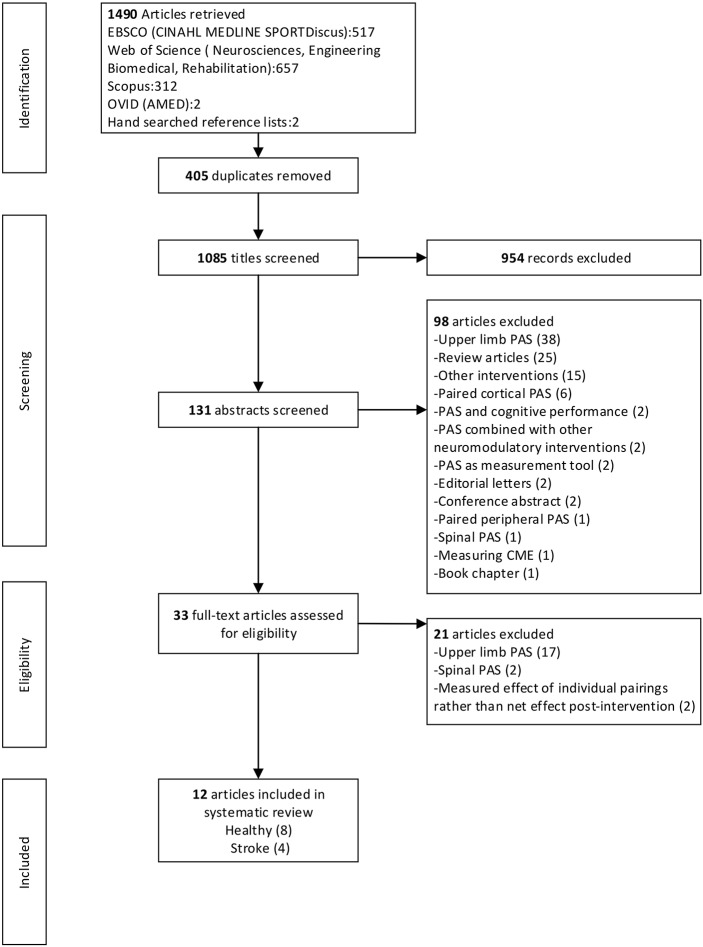
Non-invasive neuromodulatory interventions have the potential to influence neural plasticity and augment motor rehabilitation in people with stroke. Paired associative stimulation (PAS) involves the repeated pairing of single pulses of electrical stimulation to a peripheral nerve and single pulses of transcranial magnetic stimulation over the contralateral primary motor cortex. Efficacy of PAS in the lower limb of healthy and stroke populations has not been systematically appraised. Optimal protocols including stimulation parameter settings have yet to be determined. This systematic review (a) examines the efficacy of PAS on lower limb corticomotor excitability in healthy and stroke populations and (b) evaluates the stimulation parameters employed. Five databases were searched for randomized, non-randomized, and pre-post experimental studies evaluating lower limb PAS in healthy and stroke populations. Two independent reviewers identified eligible studies and assessed methodological quality using a modified Downs and Blacks Tool and the TMS Checklist. Intervention stimulation parameters and TMS measurement details were also extracted and compared. Twelve articles, comprising 24 experiments, met the inclusion criteria. Four articles evaluated PAS in people with stroke. Following a single session of PAS, 21 experiments reported modulation of corticomotor excitability, lasting up to 60 min; however, the research lacked methodological rigor. Intervention stimulation parameters were highly variable across experiments, and whilst these appeared to influence efficacy, variations in the intervention and outcome assessment methods hindered the ability to draw conclusions about optimal parameters. Lower limb PAS research requires further investigation before considering its translation into clinical practice. Eight key recommendations serve as guide for enhancing future research in the field.
非侵入性神经调节干预有可能影响神经可塑性并增强中风患者的运动康复。配对联想刺激(PAS)包括将外周神经的单脉冲电刺激与对侧初级运动皮层的单脉冲经颅磁刺激重复配对。PAS在健康人群和中风人群下肢的疗效尚未得到系统评估。包括刺激参数设置在内的最佳方案尚未确定。本系统评价(a)研究PAS对健康人群和中风人群下肢皮质运动兴奋性的疗效,(b)评估所采用的刺激参数。检索了五个数据库,以查找评估健康人群和中风人群下肢PAS的随机、非随机和前后对照实验研究。两名独立评审员确定了符合条件的研究,并使用改良的唐斯和布莱克工具及经颅磁刺激检查表评估方法学质量。还提取并比较了干预刺激参数和经颅磁刺激测量细节。12篇文章,包括24项实验,符合纳入标准。4篇文章评估了中风患者的PAS。在单次PAS治疗后,21项实验报告了皮质运动兴奋性的调节,持续长达60分钟;然而,该研究缺乏方法学严谨性。各实验的干预刺激参数差异很大,虽然这些参数似乎会影响疗效,但干预和结果评估方法的差异阻碍了得出关于最佳参数结论的能力。在考虑将下肢PAS转化为临床实践之前,需要进一步研究。八项关键建议为加强该领域未来研究提供了指导。