Huang Cheng-Kai, Bär Christian, Thum Thomas
Institute of Molecular and Translational Therapeutic Strategies, Hannover Medical School, Hannover, Germany.
REBIRTH Center for Translational Regenerative Medicine, Hannover Medical School, Hannover, Germany.
Front Pharmacol. 2020 May 15;11:726. doi: 10.3389/fphar.2020.00726. eCollection 2020.
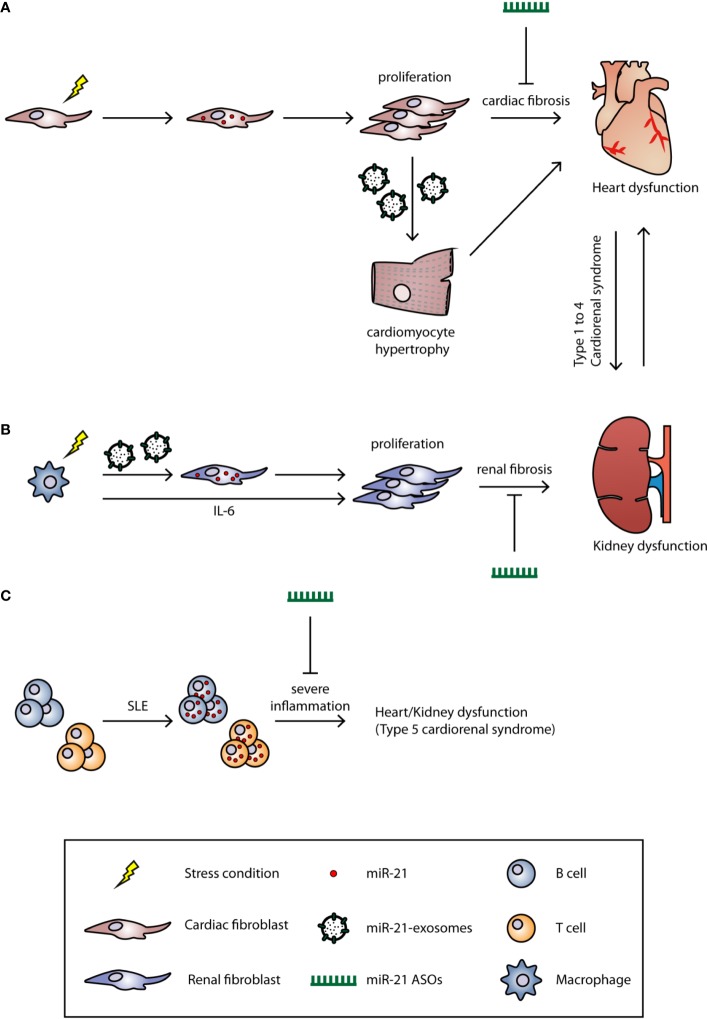
Oligonucleotide-based therapies are currently gaining attention as a new treatment option for relatively rare as well as common diseases such as cardiovascular disease. With the remarkable progression of new sequencing technologies, a further step towards personalized precision medicine to target a disease at a molecular level was taken. Such therapies may employ antisense oligonucleotides to modulate the expression of both protein coding and non-coding RNAs, such as microRNAs. The cardiorenal syndrome (CRS) is a complex and severe clinical condition where heart and renal dysfunction mutually affect one another. The underlying mechanisms remain largely unknown and current treatments of CRS are mainly supportive therapies which slow down the progression of the disease, but hardly improve the condition. The small non-coding RNA, microRNA-21 (miR-21), is dysregulated in various heart and kidney diseases and has been repeatedly suggested as therapeutic target for the treatment of CRS. Impressive preclinical results have been achieved by an antisense oligonucleotide-based therapy to effectively block the pro-fibrotic traits of miR-21. Since microRNA-mediated pathways are generally very well-conserved, there is considerable commercial interest with regards to clinical translation. In this review, we will summarize the role of miR-21 within the heart-kidney axis and discuss the advantages and pitfalls of miR-21 targeting therapeutic strategies in CRS.
基于寡核苷酸的疗法目前正作为一种新的治疗选择受到关注,可用于治疗相对罕见以及常见的疾病,如心血管疾病。随着新测序技术的显著进步,在分子水平针对疾病的个性化精准医学又向前迈进了一步。此类疗法可能采用反义寡核苷酸来调节蛋白质编码RNA和非编码RNA(如微小RNA)的表达。心肾综合征(CRS)是一种复杂而严重的临床病症,其中心脏和肾脏功能障碍相互影响。其潜在机制在很大程度上仍不明确,目前CRS的治疗主要是支持性疗法,这些疗法虽能减缓疾病进展,但几乎无法改善病情。小非编码RNA微小RNA-21(miR-21)在各种心脏和肾脏疾病中表达失调,并多次被提议作为治疗CRS的靶点。基于反义寡核苷酸的疗法有效阻断了miR-21的促纤维化特性,取得了令人瞩目的临床前研究成果。由于微小RNA介导的途径通常高度保守,因此在临床转化方面具有相当大的商业价值。在这篇综述中,我们将总结miR-21在心脏-肾脏轴中的作用,并讨论miR-21靶向治疗策略在CRS中的优势和缺陷。