Institute of Heart Failure, Shanghai East Hospital, Tongji University School of Medicine, 200120, Shanghai, China.
Key Laboratory of Arrhythmias of the Ministry of Education of China, Shanghai East Hospital, Tongji University School of Medicine, 200120, Shanghai, China.
Cell Death Dis. 2018 Jul 10;9(7):769. doi: 10.1038/s41419-018-0805-5.
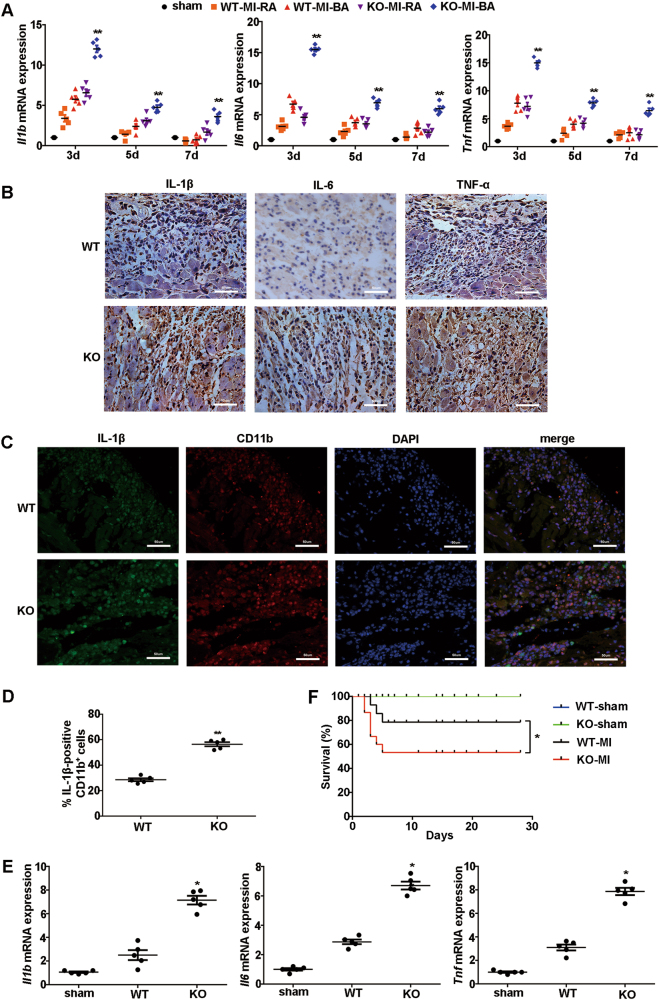
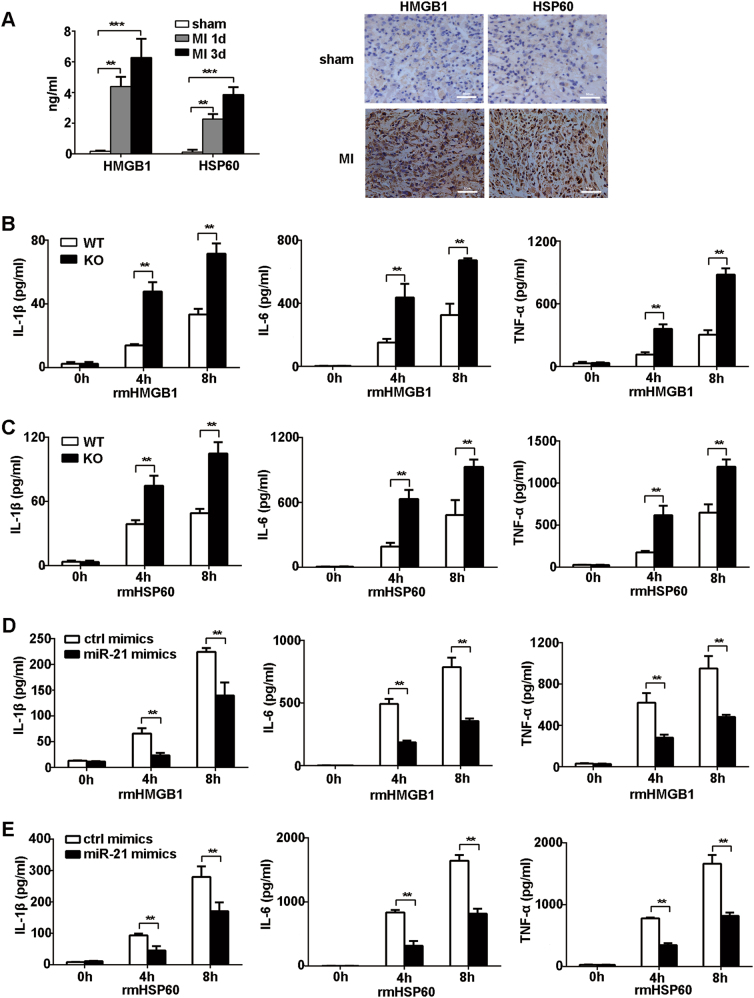
The excessive inflammation triggered by damage-associated molecular patterns (DAMPs) after myocardial infarction (MI) is responsible for the development of cardiac dysfunction and adverse remodeling, while the mechanisms by which inflammation is fine tuned remain to be fully elucidated. MicroRNA-21 (miR-21) has been shown to function in cardiovascular diseases, while its role in inflammatory responses and cardiac function post MI in mice remains unknown. Here, we found that miR-21 expression was markedly increased in border and infarct areas of cardiac tissues during the early inflammatory phase of MI model established by ligating the left-anterior descending coronary artery. MiR-21 knockout mice had decreased survival rates, worse cardiac dysfunction, and increased infarct and scar areas after MI compared with WT mice. MiR-21 knockout mice showed significantly higher levels of inflammatory cytokines including IL-1β, IL-6, and TNF-α in cardiac tissues, as well as infiltration of CD11b monocytes/macrophages with higher expression level of inflammatory cytokines. MI induced the great release of high mobility group protein B1 (HMGB1) and heat shock protein 60 (HSP60) in cardiac tissue. MiR-21 deficiency significantly promoted the inflammatory cytokine production triggered by DAMPs in macrophages, whereas, miR-21 overexpression markedly inhibited the inflammatory cytokine production. Mechanistically, miR-21 deficiency enhanced p38 and NF-κB signaling activation in cardiac tissue post MI and macrophages treated with DAMPs. MiR-21 was found to directly target kelch repeat and BTB (POZ) domain containing 7 (KBTBD7), which promoted DAMP-triggered inflammatory responses in macrophages. Furthermore, KBTBD7 interacted with MKK3/6 and promoted their activation, which in turn enhanced the activation of downstream p38 and NF-κB signaling induced by DAMPs. Therefore, our findings demonstrate that miR-21 attenuates inflammation, cardiac dysfunction, and maladaptive remodeling post MI through targeting KBTBD7 and inhibiting p38 and NF-κB signaling activation, suggesting that miR-21 may function as a novel potential therapeutic target for MI.
心肌梗死后,损伤相关分子模式(DAMPs)引发的过度炎症反应是导致心脏功能障碍和不良重构的原因,而炎症如何被精细调节的机制仍有待充分阐明。MicroRNA-21(miR-21)已被证明在心血管疾病中发挥作用,但其在小鼠心肌梗死后炎症反应和心脏功能中的作用尚不清楚。在这里,我们发现,在结扎左前降支冠状动脉建立的心肌梗死模型的早期炎症阶段,miR-21 在心脏组织的边缘和梗死区表达明显增加。与 WT 小鼠相比,miR-21 敲除小鼠的存活率降低,心脏功能障碍恶化,心肌梗死后梗死和疤痕面积增加。miR-21 敲除小鼠心脏组织中炎症细胞因子(包括 IL-1β、IL-6 和 TNF-α)水平以及浸润的 CD11b 单核/巨噬细胞中炎症细胞因子的表达水平明显升高。心肌梗死后,心脏组织中大量释放高迁移率族蛋白 B1(HMGB1)和热休克蛋白 60(HSP60)。miR-21 缺乏显著促进 DAMPs 触发的巨噬细胞中炎症细胞因子的产生,而 miR-21 过表达则显著抑制炎症细胞因子的产生。机制上,miR-21 缺乏增强了心肌梗死后心脏组织和 DAMPs 处理的巨噬细胞中 p38 和 NF-κB 信号的激活。发现 miR-21 直接靶向 kelch 重复和 BTB(POZ)结构域包含 7(KBTBD7),促进了 DAMPs 触发的巨噬细胞中的炎症反应。此外,KBTBD7 与 MKK3/6 相互作用并促进其激活,进而增强 DAMPs 诱导的下游 p38 和 NF-κB 信号的激活。因此,我们的研究结果表明,miR-21 通过靶向 KBTBD7 抑制 p38 和 NF-κB 信号的激活,减轻心肌梗死后的炎症、心脏功能障碍和适应性重构,这表明 miR-21 可能成为心肌梗死的一种新的潜在治疗靶点。