Di Ciccio Pierluigi, Rubiola Selene, Grassi Maria Ausilia, Civera Tiziana, Abbate Francesco, Chiesa Francesco
Department of Veterinary Science, University of Turin, Turin, Italy.
Department of Veterinary Sciences, University of Messina, Polo Universitario della Annunziata, Messina, Italy.
Front Microbiol. 2020 May 15;11:830. doi: 10.3389/fmicb.2020.00830. eCollection 2020.
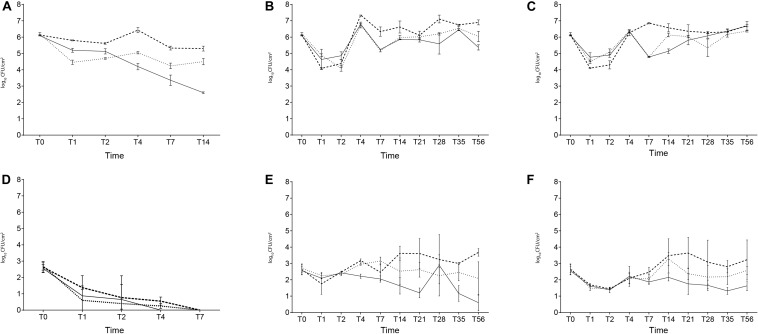
Literature data regarding the survival of microorganisms on materials used for food package purposes are scarce. The aim of the current study is to assess the survival of on different packaging materials for dairy products during extended storage at different temperatures. Three packaging materials (5 × 5 cm) were contaminated with a cocktail of five strains of suspended in a cheese homogenate, including the cheese's native microbial population. Contaminated samples were incubated at 37°, 12°, and 4°C and periodically analyzed up to 56 days. The evolution of the total viable count and pathogen population was evaluated. At 37°C, the results showed that was no longer detected on polyethylene-coated nylon (B) by day 4 and on polyethylene-coated parchment (A) and greaseproof paper (C) by day 7. Interestingly, the initial cell population (ranging between 2.5 and 2.7 log CFU/cm) of increased to 3 log CFU/cm within 4 days of storage at 12°C on A and C. During storage, the number remained fairly constant at 12°C and 4°C on two materials (A-C) and decreased slowly on the third one (B). This study shows that survival of on packaging materials for dairy products will be higher when stored at 4 or 12°C compared to 37°C. The survival of on the packaging materials raises concerns of cross-contamination during food handling and preparation at catering and retail premises and within the home, highlighting the importance of treating the packaging materials as a potential source of cross-contamination. These initial findings may aid in quantifying risks associated with contamination of food packaging materials.
关于用于食品包装目的的材料上微生物存活情况的文献数据很少。本研究的目的是评估在不同温度下长期储存期间,[具体微生物名称]在不同乳制品包装材料上的存活情况。三种包装材料(5×5厘米)被悬浮在奶酪匀浆中的五种[具体微生物名称]菌株的混合物污染,其中包括奶酪的天然微生物群落。受污染的样品在37°C、12°C和4°C下培养,并定期分析长达56天。评估了总活菌数和病原菌数量的变化。在37°C下,结果表明,到第4天,在聚乙烯涂层尼龙(B)上已检测不到[具体微生物名称],到第7天,在聚乙烯涂层羊皮纸(A)和防油纸(C)上也检测不到。有趣的是,在12°C下储存4天内,[具体微生物名称]的初始细胞数量(在2.5至2.7 log CFU/cm之间)在A和C上增加到3 log CFU/cm。在储存期间,在两种材料(A - C)上,数量在12°C和4°C下保持相当稳定,在第三种材料(B)上缓慢下降。这项研究表明,与37°C相比,在4°C或12°C下储存时,[具体微生物名称]在乳制品包装材料上的存活率会更高。[具体微生物名称]在包装材料上的存活引发了对餐饮和零售场所以及家庭食品处理和制备过程中交叉污染的担忧,凸显了将包装材料视为潜在交叉污染源的重要性。这些初步发现可能有助于量化与食品包装材料污染相关的风险。