Huang Yi, Huang Jicheng, Xia Han, Shi Yongxia, Ma Haixia, Yuan Zhiming
National Biosafety (Level 4) Laboratory in Wuhan, Wuhan Institute of Virology, Chinese Academy of Sciences, 430200, China.
Guangdong Inspection and Quarantine Technology Center, Guangzhou, 510700, China.
J Biosaf Biosecur. 2019 Mar;1(1):46-49. doi: 10.1016/j.jobb.2018.12.004. Epub 2019 Feb 20.
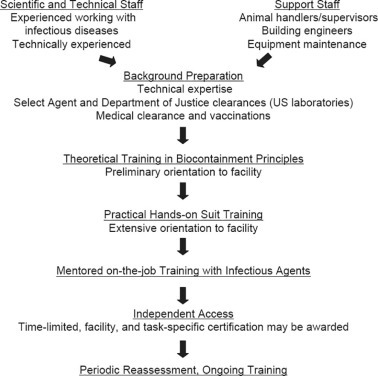
Worldwide, public health systems are continually challenged by emerging and re-emerging viruses. It is therefore important that high-containment labs coordinate and communicate globally to share their experiences and lessons to improve their capacity to respond to threats. The National Biosafety (Level 4) Laboratory in Wuhan, CAS, which is the first Level 4 biosafety laboratory (BSL-4) in China, has been certified recently and it is expected to play an important role in the prevention and control of highly infectious agents in future. Trained and experienced staff in such organizations is the most important factor contributing to safety and security. Therefore, it is imperative to develop a standard training program. Accordingly, in the present study, we developed an improved training program and assessment system based on policies and practices developed by BSL-3/4s in other countries. It included the following three components: (1) A flexible modularized theoretical training: This training comprised 14 modularized theoretical topics such that staffs with different backgrounds could take this theoretical training with different topic combinations according to their knowledge and skill levels; (2) A standardized practical training assessment: This comprehensive assessment, which could be used with biosafety laboratory staff before, during, and after training, included standard operation procedures to meet the special requirements of trainees with different scores; and (3) An applicable documentation system: A certification system was established to evaluate the ability of all staff working inside or outside the laboratory, implemented by a special committee. This certification was approved and authorized by the director of the laboratory and was classified into three grades with corresponding minimal requirements. Further, the present study examined the importance of and need for networking for training BSL-3/4 staff. The establishment of rigorous standards for training BSL-3/4 staff will instill confidence in the public, policy makers, and security officials. Additionally, the expanded international network of BSL-3/4s will continue to be operated safely and will pose no risk to scientific staff, local communities, surrounding environment, and host nations. The clarification and coordination of training standards will help develop a highly-qualified biocontainment workforce and will result in a series of programs that will enable scientists to develop measures to deal with existing threat agents and new diseases that emerge.
在全球范围内,公共卫生系统不断受到新出现和再次出现的病毒的挑战。因此,高防护实验室进行全球范围内的协调与沟通以分享经验教训,从而提高应对威胁的能力非常重要。中国科学院武汉国家生物安全(四级)实验室是中国首个四级生物安全实验室(BSL-4),最近已获得认证,预计未来在高传染性病原体的预防和控制方面将发挥重要作用。这类机构中训练有素且经验丰富的工作人员是保障安全的最重要因素。因此,制定标准培训计划势在必行。据此,在本研究中,我们基于其他国家BSL-3/4实验室制定的政策和实践,开发了一个改进的培训计划和评估系统。它包括以下三个部分:(1)灵活的模块化理论培训:该培训包含14个模块化理论主题,不同背景的工作人员可根据自身知识和技能水平选择不同的主题组合参加此理论培训;(2)标准化的实践培训评估:这种全面评估可在培训前、培训期间和培训后用于生物安全实验室工作人员,包括满足不同分数学员特殊要求的标准操作程序;(3)适用的文档系统:建立了一个认证系统来评估实验室内外所有工作人员的能力,由一个特别委员会实施。该认证经实验室主任批准和授权,分为三个等级并设有相应的最低要求。此外,本研究探讨了对BSL-3/4工作人员进行网络培训的重要性和必要性。建立严格的BSL-3/4工作人员培训标准将增强公众、政策制定者和安全官员的信心。此外,不断扩大的国际BSL-3/4实验室网络将继续安全运行,不会对科研人员、当地社区、周边环境和东道国构成风险。培训标准的明确和协调将有助于培养高素质的生物防护工作人员,并将产生一系列计划,使科学家能够制定应对现有威胁病原体和新出现疾病的措施。