Regional Centre for Child and Youth Mental Health and Child Welfare, NORCE Norwegian Research Centre, Bergen, Norway.
Department of Psychosocial Science, Faculty of Psychology, University of Bergen, Bergen, Norway.
PLoS One. 2020 Jun 5;15(6):e0234109. doi: 10.1371/journal.pone.0234109. eCollection 2020.
Depression is a public health concern among youth, and it is pertinent to identify factors that can help prevent development of depressive symptoms in adolescence. This study aimed to investigate the association between negative life events and depressive symptoms among adolescents, and to examine the influence and relative contributions of personal, social and family protective factors related to resilience.
Data stem from the cross-sectional youth@hordaland-survey, conducted in Hordaland, Norway. In all, 9,546 adolescents, aged 16-19 years old (52.8% girls) provided self-report information on depressive symptoms, negative life events and protective factors related to resilience.
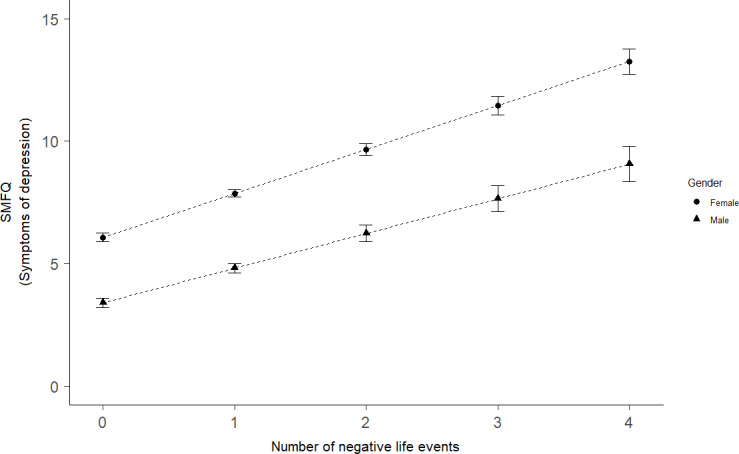
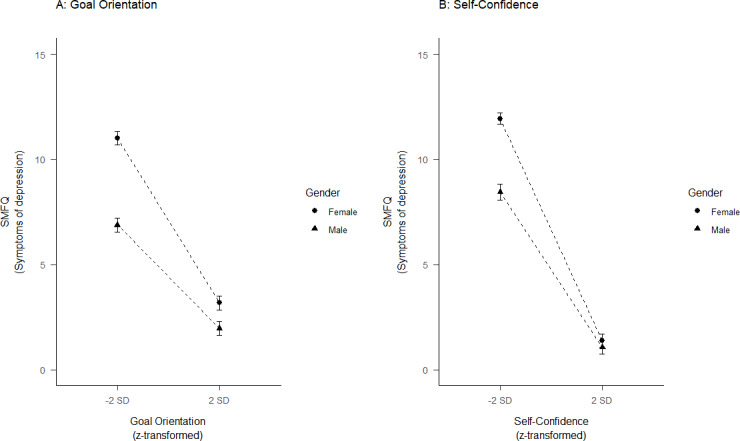
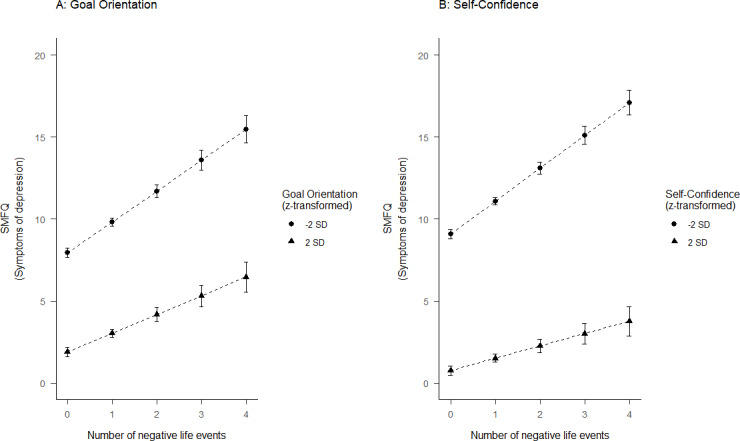
Experiencing a higher number of negative life events was related to increases in depressive symptoms, while the potential protective factors goal orientation, self-confidence, social competence, social support, and family cohesion individually were associated with fewer symptoms. Although there were small moderating effects of goal orientation and self-confidence, the results mainly supported a compensatory resilience model. When considering the potential protective factors jointly, only self-confidence and family cohesion were significantly associated with fewer depressive symptoms for both genders, with the addition of social support for girls. There were significant interactions between all the potential protective factors and gender, indicating a greater reduction of depressive symptoms with higher levels of protective factors among girls.
Interventions aimed at fostering self-confidence and family cohesion could be effective in preventing depressive symptoms for adolescent boys and girls, regardless of their exposure to negative events. Results further indicate that preventive interventions targeting these potential protective factors could be especially beneficial for adolescent girls.
抑郁是青少年群体的公共卫生问题,因此有必要确定哪些因素可以帮助预防青少年抑郁症状的发展。本研究旨在调查消极生活事件与青少年抑郁症状之间的关系,并探讨与韧性相关的个人、社会和家庭保护因素的影响和相对贡献。
数据来自于挪威霍达兰的青少年@霍达兰调查的横断面研究。共有 9546 名 16-19 岁的青少年(52.8%为女孩)提供了关于抑郁症状、消极生活事件和与韧性相关的保护因素的自我报告信息。
经历更多的消极生活事件与抑郁症状的增加有关,而目标导向、自信、社会能力、社会支持和家庭凝聚力等潜在保护因素则与较少的症状有关。尽管目标导向和自信存在较小的调节作用,但结果主要支持了补偿性的韧性模型。当考虑到潜在的保护因素时,只有自信和家庭凝聚力与男女两性的抑郁症状较少显著相关,而对于女孩来说,社会支持也起到了一定的作用。所有潜在保护因素与性别之间存在显著的交互作用,这表明对于女孩来说,较高水平的保护因素可以显著减少抑郁症状。
培养自信和家庭凝聚力的干预措施可能对预防青少年男孩和女孩的抑郁症状有效,无论他们是否经历了消极事件。结果进一步表明,针对这些潜在保护因素的预防干预措施可能对青少年女孩特别有益。