Department of Developmental Psychology and Education, Faculty of Psychology, University of Málaga, Campus de Teatinos s/n, 29071 Málaga, Spain.
Department of Personality, Evaluation and Psychological Treatment, Faculty of Psychology, University of Málaga, Campus de Teatinos s/n, 29071 Málaga, Spain.
Int J Environ Res Public Health. 2020 Jun 3;17(11):3967. doi: 10.3390/ijerph17113967.
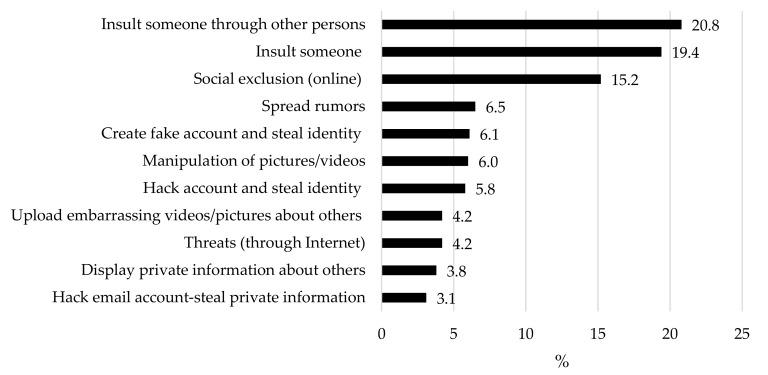
(1) Cyberbullying has gained increased attention from society and researchers due both to its negative psychosocial consequences and the problems that have risen relating to the misuse of technology. Despite the growing number of scientific studies, most research has focused on victims of cyberbullying rather than on the cyberbullies. This study examines the predictive value of personal resources (emotional intelligence, gratitude, and core self-evaluations) and risk factors (cybervictimization, problematic Internet use), and parental control in online activities on adolescents' involvement in cyberbullying perpetration. (2) A total of 2039 Spanish adolescents between 12 and 18 years of age took part in this research (53.9% females). (3) Twenty-two percent of the sample was engaged in cyberbullying behaviors (more male adolescents). Insults and online social exclusion were the most frequent types of cyberbullying perpetration. Age, cybervictimization, problematic Internet use, and deficits in the use and regulation of emotions were the best predictors of cyberbullying perpetration. (4) Cyberbullying is a social reality in which personal and family variables converge on a particularly vulnerable age group. Our findings suggest that both well-known predictors of cyberbullying (cybervictimization and problematic Internet use) along with others less studied dimensions (i.e., emotional abilities) need to be taken into account in future school-based interventions aimed to prevent cyberbullying perpetration.
(1) 由于网络欺凌行为具有消极的社会心理后果,以及与技术滥用相关的问题不断出现,因此引起了社会和研究人员的广泛关注。尽管科学研究的数量不断增加,但大多数研究都集中在网络欺凌的受害者身上,而不是网络欺凌者身上。本研究考察了个人资源(情绪智力、感恩和核心自我评价)和风险因素(网络受害、网络问题使用)以及父母对青少年在线活动的控制对青少年参与网络欺凌行为的预测价值。(2) 共有 2039 名 12 至 18 岁的西班牙青少年参与了这项研究(女性占 53.9%)。(3) 样本中有 22%的青少年从事网络欺凌行为(更多的是男性青少年)。侮辱和网络社交排斥是最常见的网络欺凌行为。年龄、网络受害、网络问题使用以及情绪的使用和调节缺陷是网络欺凌行为的最佳预测因素。(4) 网络欺凌是一种社会现实,个人和家庭变量集中在一个特别脆弱的年龄群体。我们的研究结果表明,网络欺凌的已知预测因素(网络受害和网络问题使用)以及其他研究较少的维度(即情绪能力)需要在未来以学校为基础的干预措施中考虑,以预防网络欺凌行为。