Section of Molecular Physiology, Department of Nutrition, Exercise and Sports, Faculty of Science, University of Copenhagen, DK-2100, Copenhagen, Denmark.
Section of Molecular Physiology, Department of Nutrition, Exercise and Sports, Faculty of Science, University of Copenhagen, DK-2100, Copenhagen, Denmark.
Mol Metab. 2020 Oct;40:101028. doi: 10.1016/j.molmet.2020.101028. Epub 2020 Jun 3.
Evidence for AMP-activated protein kinase (AMPK)-mediated regulation of skeletal muscle metabolism during exercise is mainly based on transgenic mouse models with chronic (lifelong) disruption of AMPK function. Findings based on such models are potentially biased by secondary effects related to a chronic lack of AMPK function. To study the direct effect(s) of AMPK on muscle metabolism during exercise, we generated a new mouse model with inducible muscle-specific deletion of AMPKα catalytic subunits in adult mice.
Tamoxifen-inducible and muscle-specific AMPKα1/α2 double KO mice (AMPKα imdKO) were generated by using the Cre/loxP system, with the Cre under the control of the human skeletal muscle actin (HSA) promoter.
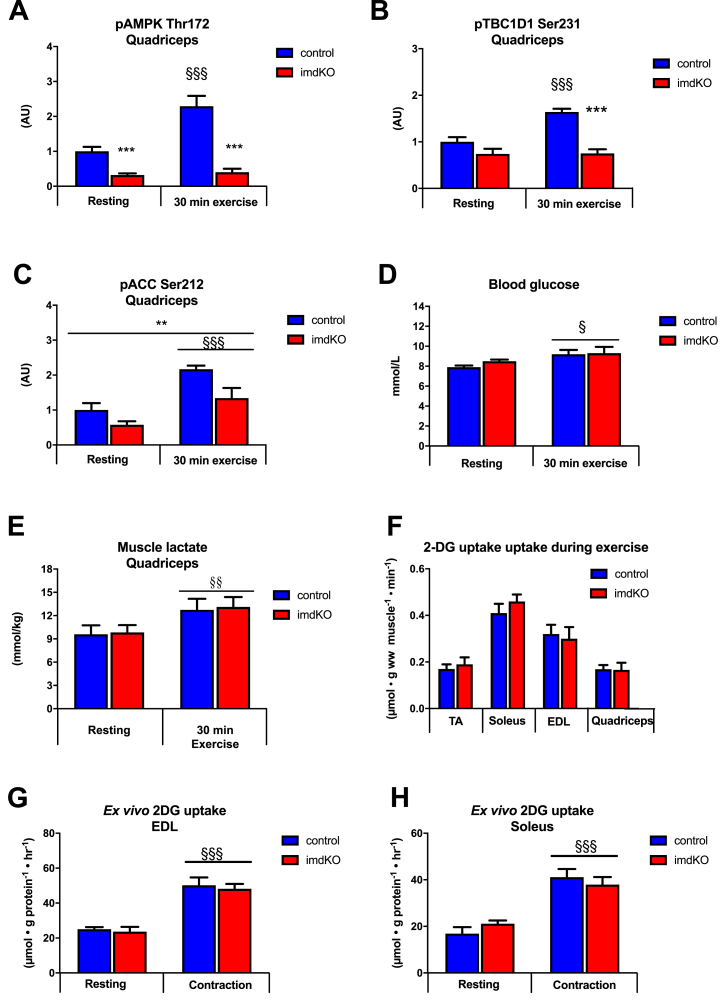
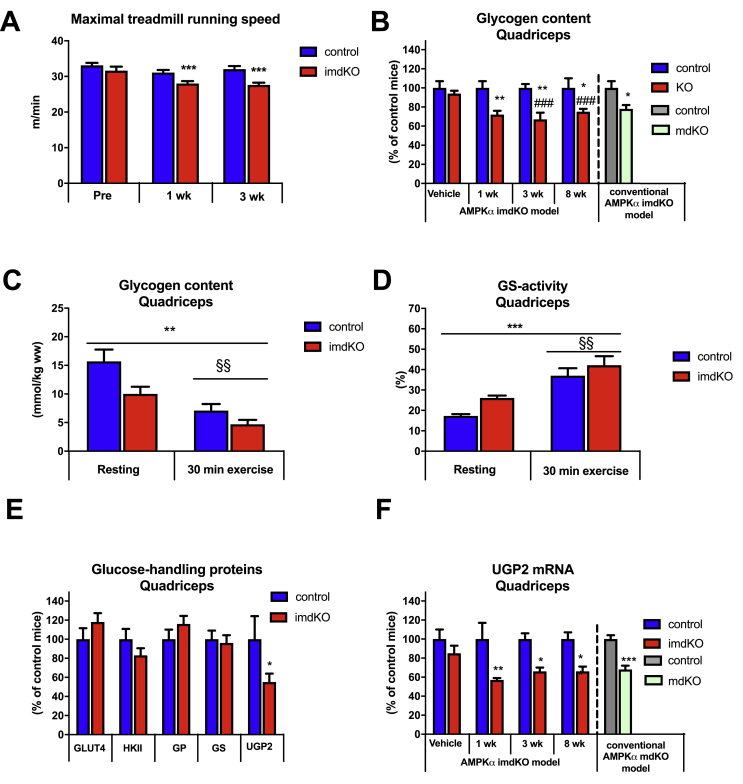
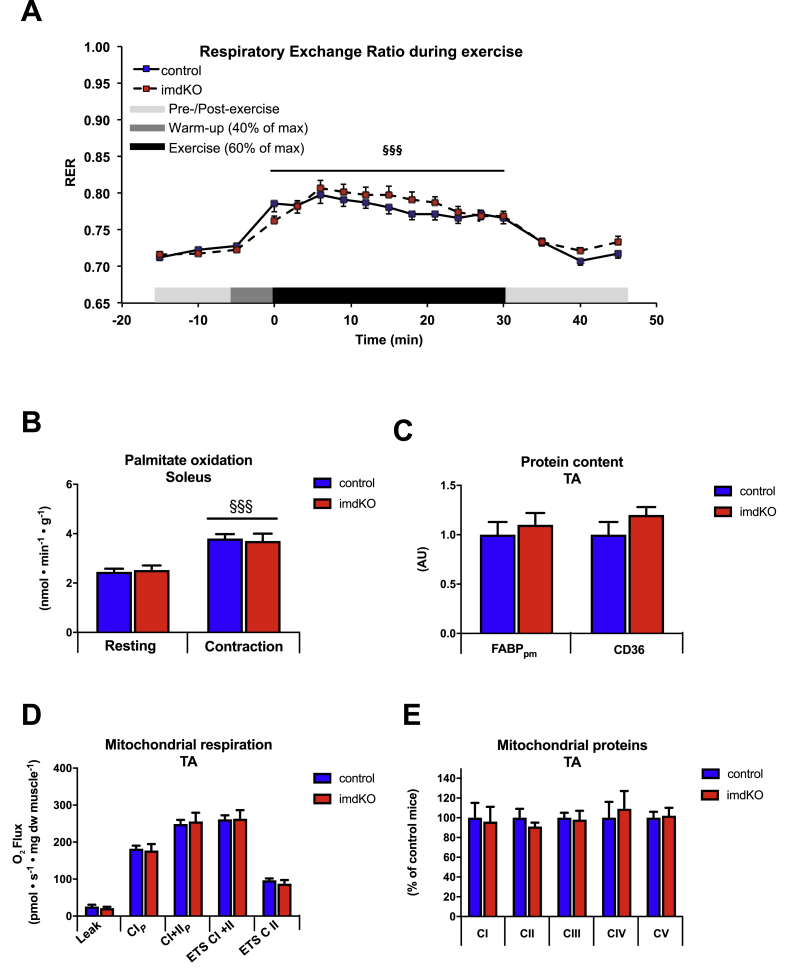
During treadmill running at the same relative exercise intensity, AMPKα imdKO mice showed greater depletion of muscle ATP, which was associated with accumulation of the deamination product IMP. Muscle-specific deletion of AMPKα in adult mice promptly reduced maximal running speed and muscle glycogen content and was associated with reduced expression of UGP2, a key component of the glycogen synthesis pathway. Muscle mitochondrial respiration, whole-body substrate utilization, and muscle glucose uptake and fatty acid (FA) oxidation during muscle contractile activity remained unaffected by muscle-specific deletion of AMPKα subunits in adult mice.
Inducible deletion of AMPKα subunits in adult mice reveals that AMPK is required for maintaining muscle ATP levels and nucleotide balance during exercise but is dispensable for regulating muscle glucose uptake, FA oxidation, and substrate utilization during exercise.
AMP 激活的蛋白激酶(AMPK)在运动过程中对骨骼肌代谢的调节作用的证据主要基于 AMPK 功能长期(终生)中断的转基因小鼠模型。基于这些模型的研究结果可能因与 AMPK 功能长期缺乏相关的次要效应而存在偏差。为了研究 AMPK 在运动过程中对肌肉代谢的直接影响,我们在成年小鼠中生成了一种新的具有 AMPKα 催化亚基诱导性肌肉特异性缺失的小鼠模型。
通过 Cre/loxP 系统生成了肌球蛋白特异性 AMPKα1/α2 双 KO 小鼠(AMPKα imdKO),其中 Cre 受人类骨骼肌肌动蛋白(HSA)启动子的控制。
在跑步机上以相同的相对运动强度跑步时,AMPKα imdKO 小鼠的肌肉 ATP 耗竭更多,这与脱氨酶产物 IMP 的积累有关。成年小鼠中 AMPKα 的肌肉特异性缺失立即降低了最大跑步速度和肌肉糖原含量,并与糖原合成途径的关键组成部分 UGP2 的表达降低有关。肌肉线粒体呼吸、全身底物利用以及肌肉收缩活动期间的葡萄糖摄取和脂肪酸(FA)氧化在成年小鼠中 AMPKα 亚基的肌肉特异性缺失后仍然不受影响。
成年小鼠中 AMPKα 亚基的诱导性缺失揭示了 AMPK 在运动过程中维持肌肉 ATP 水平和核苷酸平衡是必需的,但在调节运动过程中的肌肉葡萄糖摄取、FA 氧化和底物利用方面是可有可无的。