Chalkias Athanasios, Koutsovasilis Anastasios, Laou Eleni, Papalois Apostolos, Xanthos Theodoros
Department of Anesthesiology, Faculty of Medicine, School of Health Sciences, University of Thessaly, Larissa, Greece.
Hellenic Society of Cardiopulmonary Resuscitation, Athens, Greece.
Acute Crit Care. 2020 May;35(2):93-101. doi: 10.4266/acc.2019.00773. Epub 2020 Apr 20.
Mean systemic filling pressure (Pmsf) is a quantitative measurement of a patient's volume status and represents the tone of the venous reservoir. The aim of this study was to estimate Pmsf after severe hemorrhagic shock and cardiac arrest in swine anesthetized with propofol-based total intravenous anesthesia, as well as to evaluate Pmsf's association with vasopressor-free resuscitation.
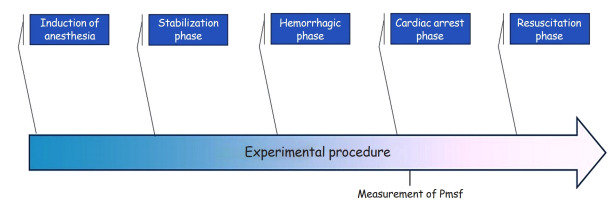
Ten healthy Landrace/Large-White piglets aged 10-12 weeks with average weight 20±1 kg were used in this study. The protocol was divided into four distinct phases: stabilization, hemorrhagic, cardiac arrest, and resuscitation phases. We measured Pmsf at 5-7.5 seconds after the onset of cardiac arrest and then every 10 seconds until 1 minute postcardiac arrest. During resuscitation, lactated Ringers was infused at a rate that aimed for a mean right atrial pressure of ≤4 mm Hg. No vasopressors were used.
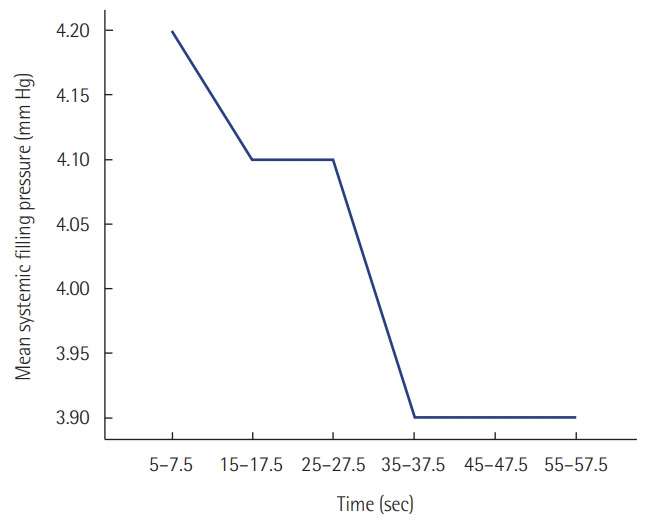
The mean volume of blood removed was 860±20 ml (blood loss, ~61%) and the bleeding time was 43.2±2 minutes while all animals developed pulseless electrical activity. Mean Pmsf was 4.09±1.22 mm Hg, and no significant differences in Pmsf were found until 1 minute postcardiac arrest (4.20±0.22 mm Hg at 5-7.5 seconds and 3.72±0.23 mm Hg at 55- 57.5 seconds; P=0.102). All animals achieved return of spontaneous circulation (ROSC), with mean time to ROSC being 6.1±1.7 minutes and mean administered volume being 394±20 ml.
For the first time, Pmsf was estimated after severe hemorrhagic shock. In this study, Pmsf remained stable during the first minute post-arrest. All animals achieved ROSC with goal-directed fluid resuscitation and no vasopressors.
平均体循环充盈压(Pmsf)是对患者容量状态的一种定量测量,代表静脉储血池的张力。本研究的目的是评估在使用丙泊酚全凭静脉麻醉的猪发生严重失血性休克和心脏骤停后Pmsf的情况,以及评估Pmsf与无血管活性药物复苏的相关性。
本研究使用了10只10 - 12周龄、平均体重20±1 kg的健康长白/大白仔猪。实验方案分为四个不同阶段:稳定期、出血期、心脏骤停期和复苏期。我们在心脏骤停开始后5 - 7.5秒测量Pmsf,然后每10秒测量一次,直至心脏骤停后1分钟。在复苏过程中,以维持平均右心房压力≤4 mmHg的速率输注乳酸林格液。未使用血管活性药物。
平均失血血量为860±20 ml(失血约61%),出血时间为43.2±2分钟,此时所有动物均出现无脉电活动。平均Pmsf为4.09±1.22 mmHg,在心脏骤停后1分钟内Pmsf无显著差异(5 - 7.5秒时为4.20±0.22 mmHg,55 - 57.5秒时为3.72±0.23 mmHg;P = 0.102)。所有动物均实现自主循环恢复(ROSC),平均自主循环恢复时间为6.1±1.7分钟,平均输注量为394±20 ml。
首次在严重失血性休克后评估了Pmsf。在本研究中,心脏骤停后第一分钟内Pmsf保持稳定。所有动物通过目标导向液体复苏且未使用血管活性药物实现了自主循环恢复。