Dai Weixing, Mo Shaobo, Han Lingyu, Xiang Wenqiang, Li Menglei, Wang Renjie, Tong Tong, Cai Guoxiang
Department of Colorectal Surgery, Fudan University Shanghai Cancer Center, Shanghai, China.
Department of Oncology, Shanghai Medical College, Fudan University, Shanghai, China.
Clin Transl Med. 2020 Jan;10(1):288-293. doi: 10.1002/ctm2.31.
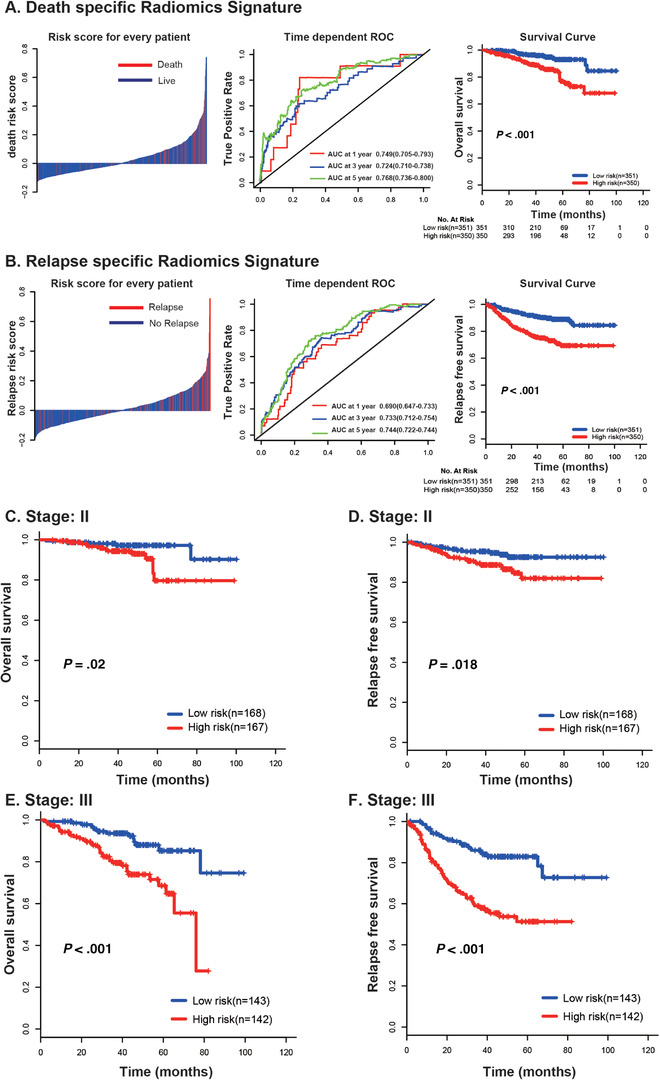
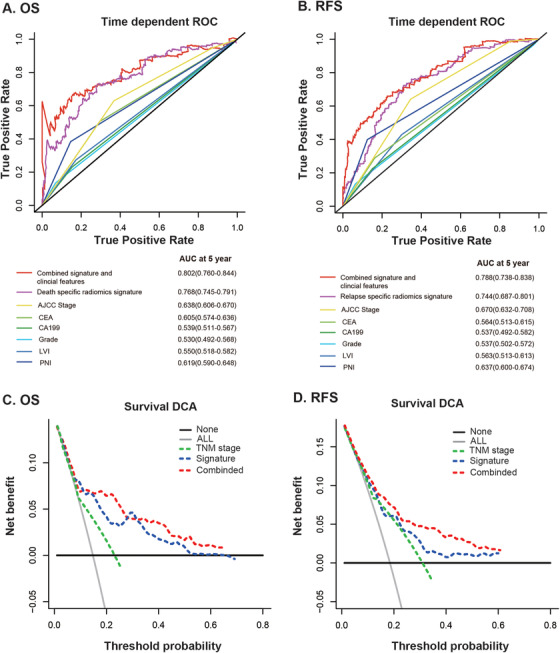
Accurate identification of patients with poor prognosis after radical surgery is essential for clinical management of colon cancer. Thus, we aimed to develop death and relapse specific radiomics signatures to individually estimate overall survival (OS) and relapse free survival (RFS) of colon cancer patients. In this study, 701 stage I-III colon cancer patients were identified from Fudan University Shanghai Cancer Center. A total of 647 three-dimensional features were extracted from computed tomography images. LASSO Cox was used to identify the significantly death- and relapse-associated features and to build death and relapse specific radiomics signatures, respectively. A total of 13 death-specific and 26 relapse-specific features were identified from 647 screened radiomics features. The developed signatures can divide patients into two groups with significantly different death (Hazard Ratio (HR): 3.053; 95% CI, 1.78-5.23; P < .001) or relapse risk (HR: 2.794; 95% CI, 1.87-4.16; P < .001). Time-dependent Relative operating characteristic curve showed that the signatures performed better than any other clinicopathological factors in predicting OS (AUC: 0.768; 95% CI, 0.745-0.791) and RFS (AUC: 0.744; 95% CI, 0.687-0.801). Further, survival decision curve analyses confirmed the good clinical utility of the two radiomics signatures. In conclusion, we successfully developed death- and relapse-specific radiomics signatures that can accurately predict OS and RFS, which may facilitate personalized treatment.
准确识别根治性手术后预后不良的患者对于结肠癌的临床管理至关重要。因此,我们旨在开发针对死亡和复发的特定放射组学特征,以单独估计结肠癌患者的总生存期(OS)和无复发生存期(RFS)。在本研究中,从复旦大学附属上海肿瘤中心识别出701例I-III期结肠癌患者。从计算机断层扫描图像中提取了总共647个三维特征。使用LASSO Cox分别识别与死亡和复发显著相关的特征,并构建针对死亡和复发的特定放射组学特征。从647个筛选出的放射组学特征中,共识别出13个死亡特异性特征和26个复发特异性特征。所开发的特征可以将患者分为两组,其死亡(风险比(HR):3.053;95%置信区间,1.78 - 5.23;P < 0.001)或复发风险(HR:2.794;95%置信区间,1.87 - 4.16;P < 0.001)有显著差异。时间依赖性相对操作特征曲线显示,在预测OS(AUC:0.768;95%置信区间,0.745 - 0.791)和RFS(AUC:0.744;95%置信区间,0.687 - 0.801)方面,这些特征的表现优于任何其他临床病理因素。此外,生存决策曲线分析证实了这两个放射组学特征具有良好的临床实用性。总之,我们成功开发了能够准确预测OS和RFS的针对死亡和复发的特定放射组学特征,这可能有助于个性化治疗。