Department of Diagnostic Radiology, Department of Oncology, Fudan University Shanghai Cancer Center, Shanghai Medical College, Fudan University, 270 DongAn Road, Shanghai, 200032, China.
State Key Laboratory for Oncogenes and Related Genes, Key Laboratory of Gastroenterology and Hepatology, Ministry of Health, Division of Gastroenterology and Hepatology, Renji Hospital, School of Medicine, Shanghai Jiao Tong University, Shanghai Cancer Institute, Shanghai Institute of Digestive Disease, Shanghai, China.
Cancer Imaging. 2023 Aug 3;23(1):74. doi: 10.1186/s40644-023-00588-1.
Our study aimed to explore the potential of radiomics features derived from CT images in predicting the prognosis and response to adjuvant chemotherapy (ACT) in patients with Stage II colorectal cancer (CRC).
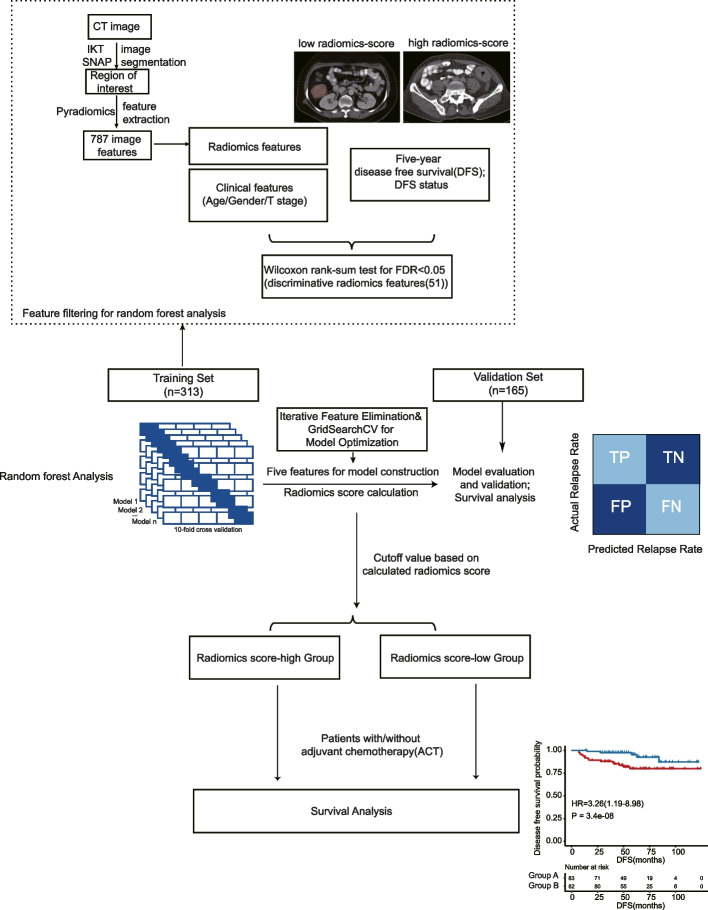
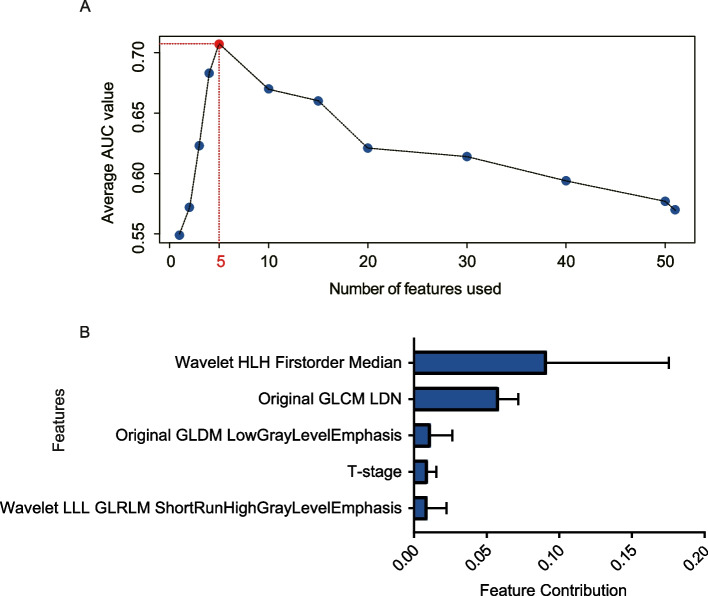
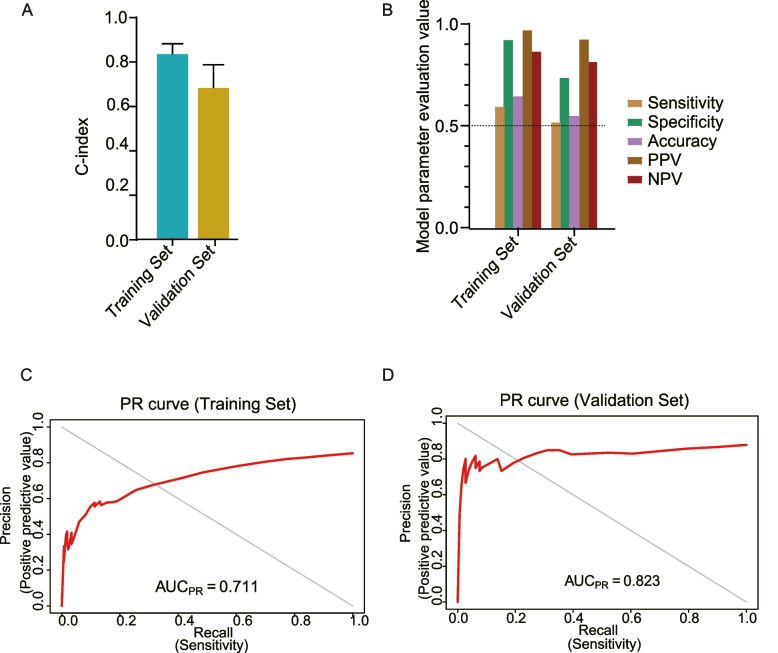
A total of 478 patients with confirmed stage II CRC, with 313 from Shanghai (Training set) and 165 from Beijing (Validation set) were enrolled. Optimized features were selected using GridSearchCV and Iterative Feature Elimination (IFE) algorithm. Subsequently, we developed an ensemble random forest classifier to predict the probability of disease relapse.We evaluated the performance of the model using the concordance index (C-index), precision-recall curves, and area under the precision-recall curves (AUC).
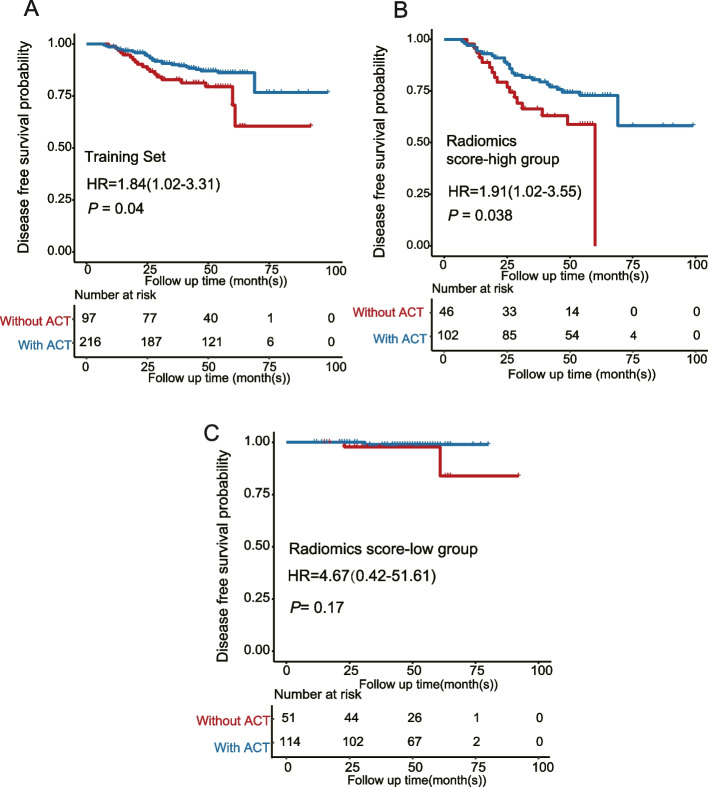
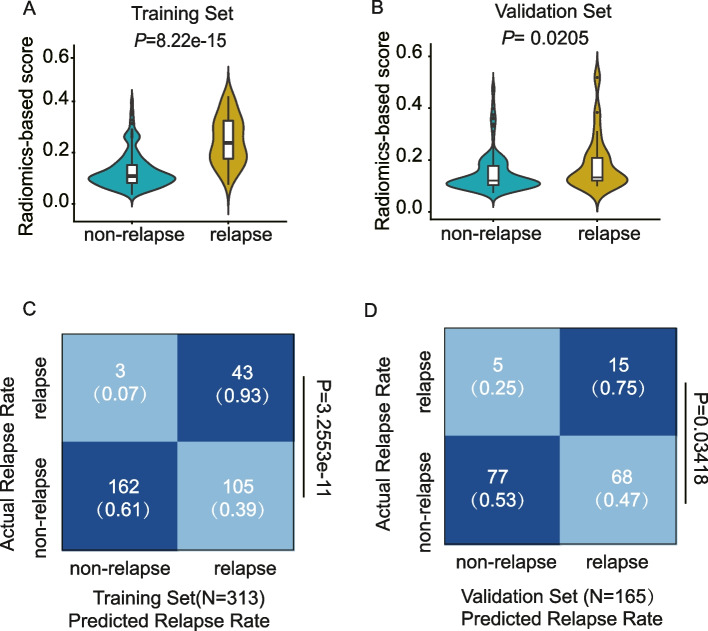
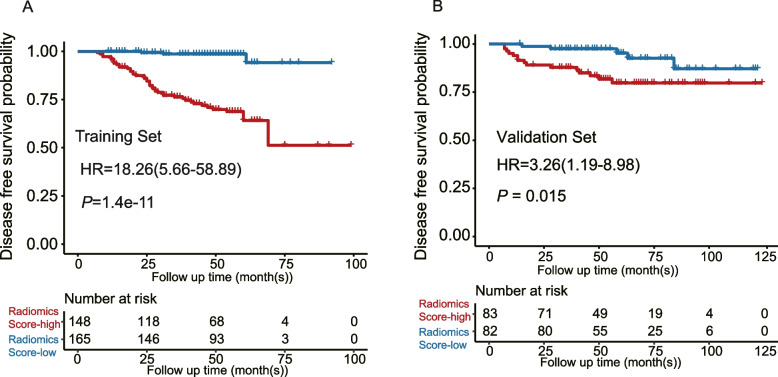
A radiomic model (namely the RF5 model) consisting of four radiomics features and T stage were developed. The RF5 model performed better than simple radiomics features or T stage alone, with higher C-index and AUC, as well as better sensitivity and specificity (C-index: 0.836; AUC = 0.711; Sensitivity = 0.610; Specificity = 0.935). We identified an optimal cutoff value of 0.1215 to split patients into high- or low-score subgroups, with those in the low-score group having better disease-free survival (DFS) (Training Set: P = 1.4e-11; Validation Set: P = 0.015). Furthermore, patients in the high-score group who received ACT had better DFS compared to those who did not receive ACT (P = 0.04). However, no statistical difference was found in low-score patients (P = 0.17).
The radiomic model can serve as a reliable tool for assessing prognosis and identifying the optimal candidates for ACT in Stage II CRC patients.
Retrospectively registered.
本研究旨在探讨 CT 图像衍生的放射组学特征在预测 II 期结直肠癌(CRC)患者预后和辅助化疗(ACT)反应中的潜力。
共纳入 478 例经病理证实的 II 期 CRC 患者,其中 313 例来自上海(训练集),165 例来自北京(验证集)。使用 GridSearchCV 和迭代特征消除(IFE)算法优化特征。随后,我们开发了一个集成随机森林分类器来预测疾病复发的概率。我们使用一致性指数(C-index)、精确召回曲线和精确召回曲线下面积(AUC)来评估模型的性能。
建立了一个包含四个放射组学特征和 T 分期的放射组学模型(即 RF5 模型)。RF5 模型的表现优于简单的放射组学特征或 T 分期,具有更高的 C-index 和 AUC,以及更好的灵敏度和特异性(C-index:0.836;AUC=0.711;灵敏度=0.610;特异性=0.935)。我们确定了一个最佳截断值为 0.1215,将患者分为高或低评分亚组,低评分亚组的无病生存率(DFS)更好(训练集:P=1.4e-11;验证集:P=0.015)。此外,在高评分组中接受 ACT 的患者的 DFS 优于未接受 ACT 的患者(P=0.04)。然而,在低评分患者中没有发现统计学差异(P=0.17)。
放射组学模型可以作为评估 II 期 CRC 患者预后和识别 ACT 最佳候选者的可靠工具。
回顾性注册。