Pan Yunbao, Ye Guangming, Zeng Xiantao, Liu Guohong, Zeng Xiaojiao, Jiang Xianghu, Zhao Jin, Chen Liangjun, Guo Shuang, Deng Qiaoling, Hong Xiaoyue, Yang Ying, Li Yirong, Wang Xinghuan
Department of Laboratory Medicine, Zhongnan Hospital of Wuhan University, Wuhan University, Wuhan, China.
Center for Evidence-Based and Translational Medicine, Zhongnan Hospital of Wuhan University, Wuhan, China.
Clin Transl Med. 2020 Jan;10(1):161-168. doi: 10.1002/ctm2.23.
The clinical presentation of SARS-CoV-2-infected pneumonia (COVID-19) resembles that of other etiologies of community-acquired pneumonia (CAP). We aimed to identify clinical laboratory features to distinguish COVID-19 from CAP.
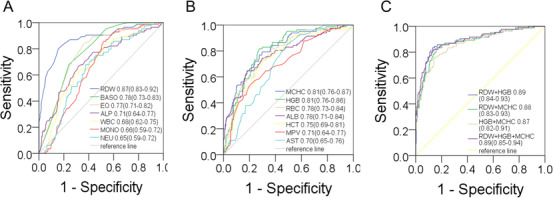
We compared the hematological and biochemical features of 84 patients with COVID-19 at hospital admission and 221 patients with CAP. Parameters independently predictive of COVID-19 were calculated by multivariate logistic regression. The receiver operating characteristic (ROC) curves were generated and the area under the ROC curve (AUC) was measured to evaluate the discriminative ability.
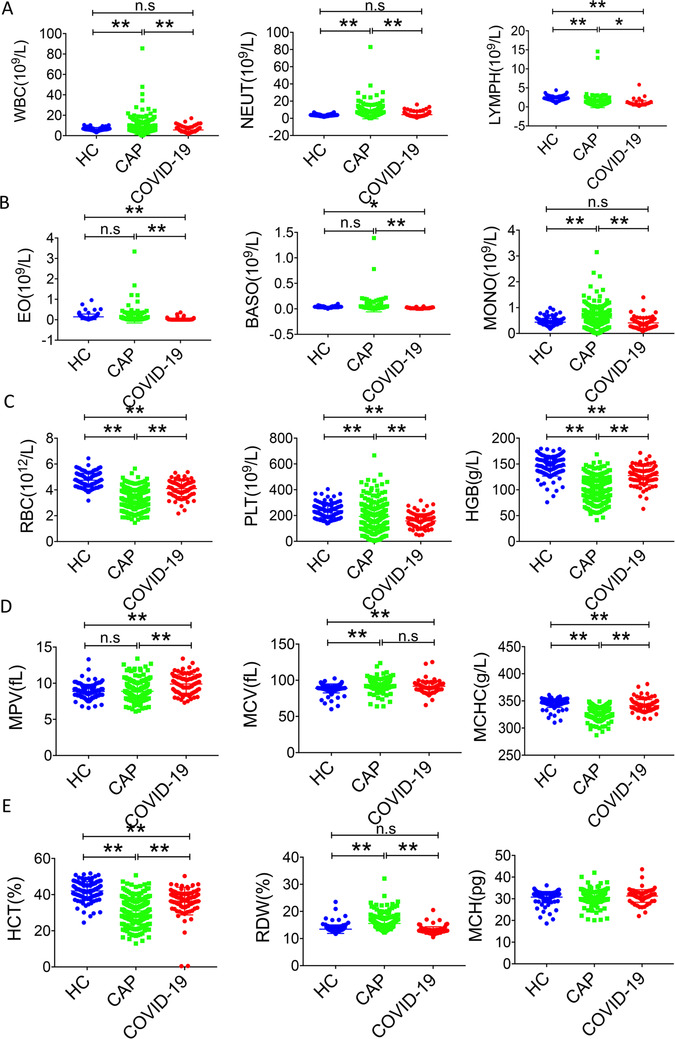
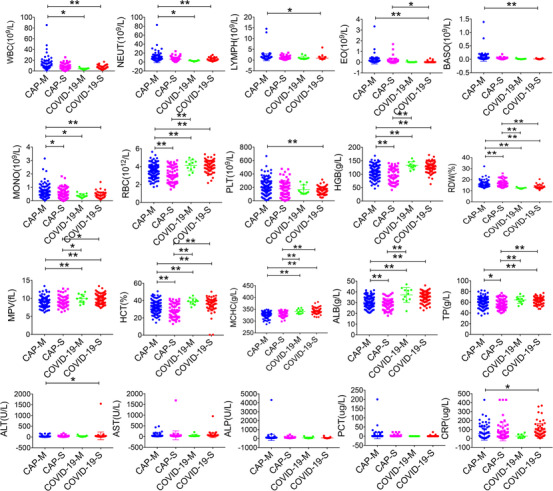
Most hematological and biochemical indexes of patients with COVID-19 were significantly different from patients with CAP. Nine laboratory parameters were identified to be predictive of a diagnosis of COVID-19. The AUCs demonstrated good discriminatory ability for red cell distribution width (RDW) with an AUC of 0.87 and hemoglobin with an AUC of 0.81. Red blood cell, albumin, eosinophil, hematocrit, alkaline phosphatase, and mean platelet volume had fair discriminatory ability. Combinations of any two parameters performed better than did the RDW alone.
Routine laboratory examinations may be helpful for the diagnosis of COVID-19. Application of laboratory tests may help to optimize the use of isolation rooms for patients when they present with unexplained febrile respiratory illnesses.
严重急性呼吸综合征冠状病毒2感染的肺炎(COVID-19)的临床表现与社区获得性肺炎(CAP)的其他病因相似。我们旨在确定区分COVID-19和CAP的临床实验室特征。
我们比较了84例COVID-19患者入院时的血液学和生化特征以及221例CAP患者的特征。通过多因素逻辑回归计算独立预测COVID-19的参数。绘制受试者工作特征(ROC)曲线并测量ROC曲线下面积(AUC)以评估鉴别能力。
COVID-19患者的大多数血液学和生化指标与CAP患者有显著差异。确定了9个实验室参数可预测COVID-19的诊断。AUC显示红细胞分布宽度(RDW)的鉴别能力良好,AUC为0.87,血红蛋白的AUC为0.81。红细胞、白蛋白、嗜酸性粒细胞、血细胞比容、碱性磷酸酶和平均血小板体积具有中等鉴别能力。任意两个参数的组合比单独使用RDW表现更好。
常规实验室检查可能有助于COVID-19的诊断。当患者出现不明原因的发热性呼吸道疾病时,应用实验室检查可能有助于优化隔离病房的使用。