Wei Yingfeng, Guo Sheng, Tang Jianhua, Wen Jianjun, Wang Huifen, Hu Xiaobo, Gu Qiuping
Department of Gastroenterology, Ganzhou People's Hospital, Ganzhou, Jiangxi 341000 China.
Department of Liver Diseases, The Fifth People's Hospital of Ganzhou, Ganzhou, Jiangxi 341000 China.
Cancer Cell Int. 2020 May 25;20:193. doi: 10.1186/s12935-020-01257-0. eCollection 2020.
Gastric cancer (GC) remains one of the most common digestive malignancies worldwide and ranked third causes of cancer-related death. Mounting evidence has revealed that miRNAs exert critical regulatory roles in GC development.
Immunohistochemistry (IHC) and western blot assay were performed to determine the protein expression levels of neuropilin-1 (NRP1) and mRNA levels were confirmed by quantitative RT-PCR (qRT-PCR) in GC tissues. Kaplan-Meier analysis was performed to evaluate the prognostic value of NRP1 in GC. Knockdown of NRP1 was conducted to analyse its function in vitro and Luciferase reporter assay, western blot and qRT-qPCR were employed to identify the miRNAs which directly targeted NRP1. Furthermore, Bioinformatics analysis and experimental verification were used to explore the potential molecular mechanism and signalling pathway.
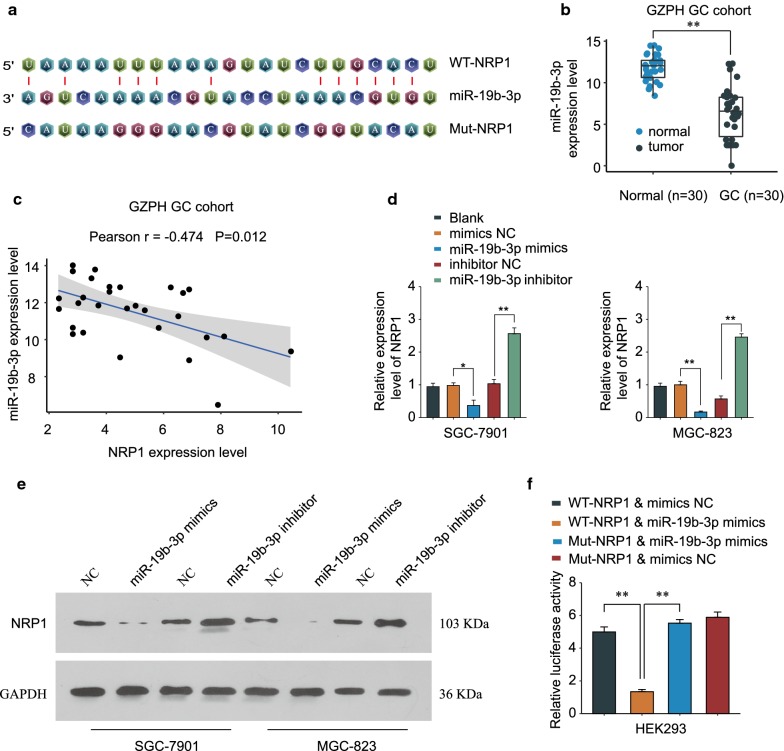
In the current study, we revealed that NRP1 was highly expressed in GC tumor tissues and was associated with poor prognosis in GC patients. NRP1 knockdown inhibited GC cell growth, migration and invasion in vitro, while suppressed GC xenograft tumor development in vivo. Bioinformatics analysis predicted that miR-19b-3p down-regulated NRP1 expression by targeting its 3'-UTR. Functional assay demonstrated that miR-19b-3p inhibited GC cell growth, migration and invasion via negatively regulating NRP1. Overexpression NRP1 partially reversed the regulatory effect of miR-19b-3p. Moreover, we showed that miR-19b-3p/NRP1 axis regulated the epithelial-to-mesenchymal transition and focal adhesion in GC, which might contribute the GC development and progression.
Taken together, our findings suggest a regulatory network of miR-19b-3p/NRP1 in GC development. The miR-19b-3p/NRP1 axis might be further explored as a potential diagnostic and therapeutic target in GC.
胃癌(GC)仍然是全球最常见的消化系恶性肿瘤之一,是癌症相关死亡的第三大原因。越来越多的证据表明,微小RNA(miRNA)在胃癌发生发展中发挥关键调控作用。
采用免疫组织化学(IHC)和蛋白质印迹法检测胃癌组织中神经纤毛蛋白-1(NRP1)的蛋白表达水平,通过定量逆转录聚合酶链反应(qRT-PCR)确定其mRNA水平。采用Kaplan-Meier分析评估NRP1在胃癌中的预后价值。通过敲低NRP1分析其体外功能,并采用荧光素酶报告基因检测、蛋白质印迹法和qRT-qPCR鉴定直接靶向NRP1的miRNA。此外,利用生物信息学分析和实验验证来探索潜在的分子机制和信号通路。
在本研究中,我们发现NRP1在胃癌肿瘤组织中高表达,且与胃癌患者的不良预后相关。敲低NRP1可在体外抑制胃癌细胞的生长、迁移和侵袭,同时在体内抑制胃癌异种移植瘤的生长。生物信息学分析预测miR-19b-3p通过靶向NRP1的3'-UTR下调其表达。功能分析表明,miR-19b-3p通过负向调节NRP1抑制胃癌细胞的生长、迁移和侵袭。过表达NRP1可部分逆转miR-19b-3p的调节作用。此外,我们发现miR-19b-3p/NRP1轴调节胃癌中的上皮-间质转化和粘着斑,这可能促进了胃癌的发生发展。
综上所述,我们的研究结果提示了miR-19b-3p/NRP1在胃癌发生发展中的调控网络。miR-19b-3p/NRP1轴可能作为胃癌潜在的诊断和治疗靶点被进一步探索。