McKendrick Greer, Garrett Hannah, Jones Holly E, McDevitt Dillon S, Sharma Sonakshi, Silberman Yuval, Graziane Nicholas M
Neuroscience Graduate Program, Penn State College of Medicine, Hershey, PA, United States.
Department of Anesthesiology and Perioperative Medicine, Penn State College of Medicine, Hershey, PA, United States.
Front Behav Neurosci. 2020 May 21;14:75. doi: 10.3389/fnbeh.2020.00075. eCollection 2020.
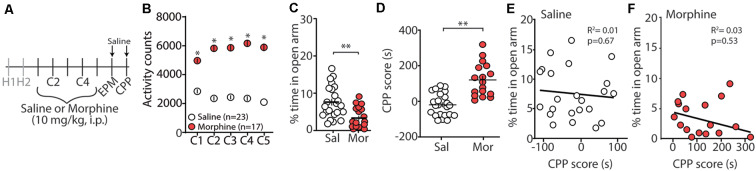
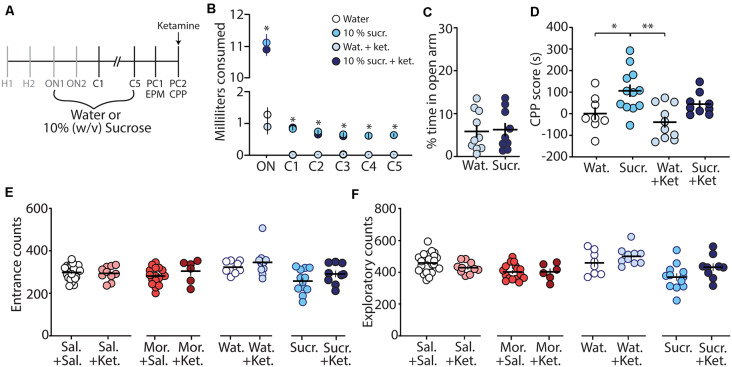
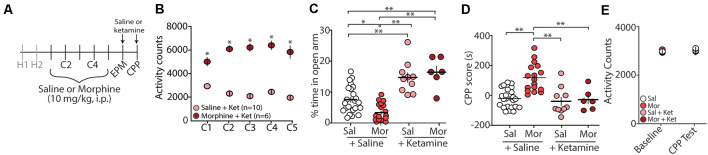
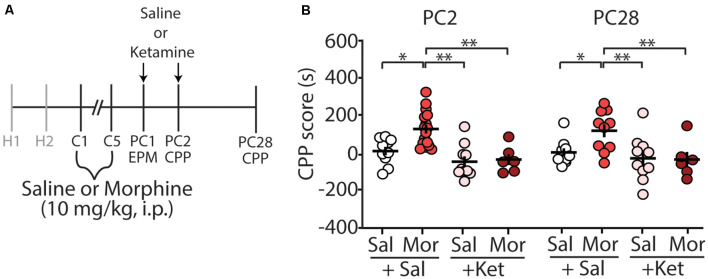
Patients suffering from opioid use disorder often relapse during periods of abstinence, which is posited to be caused by negative affective states that drive motivated behaviors. Here, we explored whether conditioning mice with morphine in a conditioned place preference (CPP) training paradigm evoked anxiety-like behavior during morphine abstinence. To do this, mice were conditioned with morphine (10 mg/kg, i.p.) for 5 days. Twenty-four hours following conditioning, anxiety levels were tested by measuring time in the open arms of the elevated plus-maze. The next day, mice were placed in the three-compartment chamber to measure morphine-induced CPP. Our results show that following morphine conditioning, mice spent significantly less time in the open arm of the elevated plus-maze and expressed robust morphine CPP on CPP test day. Furthermore, we found that an acute treatment with ()-ketamine (10 mg/kg, i.p.), a medication demonstrating promise for preventing anxiety-related phenotypes, 30 min before testing on post-conditioning day 1, increased time spent in the open arm of the elevated plus-maze in saline- and morphine-conditioned mice. Additionally, we found that the second injection of ketamine 30 min before CPP tests on post-conditioning day 2 prevented morphine-induced CPP, which lasted for up to 28 days post-conditioning. Furthermore, we found that conditioning mice with 10% (w/v) sucrose using an oral self-administration procedure did not evoke anxiety-like behavior, but elicited robust CPP, which was attenuated by ketamine treatment 30 min before CPP tests. Overall, our results suggest that the ketamine-induced block of morphine CPP may not be attributed solely to alleviating negative affective states, but potentially through impaired memory of morphine-context associations.
患有阿片类药物使用障碍的患者在禁欲期间经常复发,据推测这是由驱动动机行为的负面情绪状态引起的。在此,我们探讨了在条件性位置偏爱(CPP)训练范式中用吗啡对小鼠进行条件化处理是否会在吗啡戒断期间诱发焦虑样行为。为此,用吗啡(10mg/kg,腹腔注射)对小鼠进行5天的条件化处理。条件化处理后24小时,通过测量高架十字迷宫开放臂中的停留时间来测试焦虑水平。第二天,将小鼠置于三室箱中以测量吗啡诱导的CPP。我们的结果表明,吗啡条件化处理后,小鼠在高架十字迷宫开放臂中的停留时间显著减少,并且在CPP测试日表现出强烈的吗啡CPP。此外,我们发现,在条件化处理后第1天测试前30分钟,用()-氯胺酮(10mg/kg,腹腔注射)进行急性处理,这是一种显示出有望预防焦虑相关表型的药物,增加了生理盐水和吗啡条件化小鼠在高架十字迷宫开放臂中的停留时间。此外,我们发现,在条件化处理后第2天CPP测试前30分钟第二次注射氯胺酮可预防吗啡诱导的CPP,这种预防作用在条件化处理后可持续长达28天。此外,我们发现,使用口服自我给药程序用10%(w/v)蔗糖对小鼠进行条件化处理不会诱发焦虑样行为,但会引发强烈的CPP,在CPP测试前30分钟用氯胺酮处理可减弱这种CPP。总体而言,我们的结果表明,氯胺酮诱导的对吗啡CPP的阻断可能不仅仅归因于减轻负面情绪状态,还可能是通过损害对吗啡-环境关联的记忆。