Yang Yongtao, Peng Jing, Wang Suxia, Huang Jialu, Ran Hong, Chen Kangning, Zhou Zhenhua
Department of Neurology, Chongqing Renji Hospital, University of Chinese Academy of Sciences, Chongqing, China.
Department of Geriatrics, Sichuan Second Hospital of Traditional Chinese Medicine, Chengdu, China.
Front Neurol. 2020 May 19;11:352. doi: 10.3389/fneur.2020.00352. eCollection 2020.
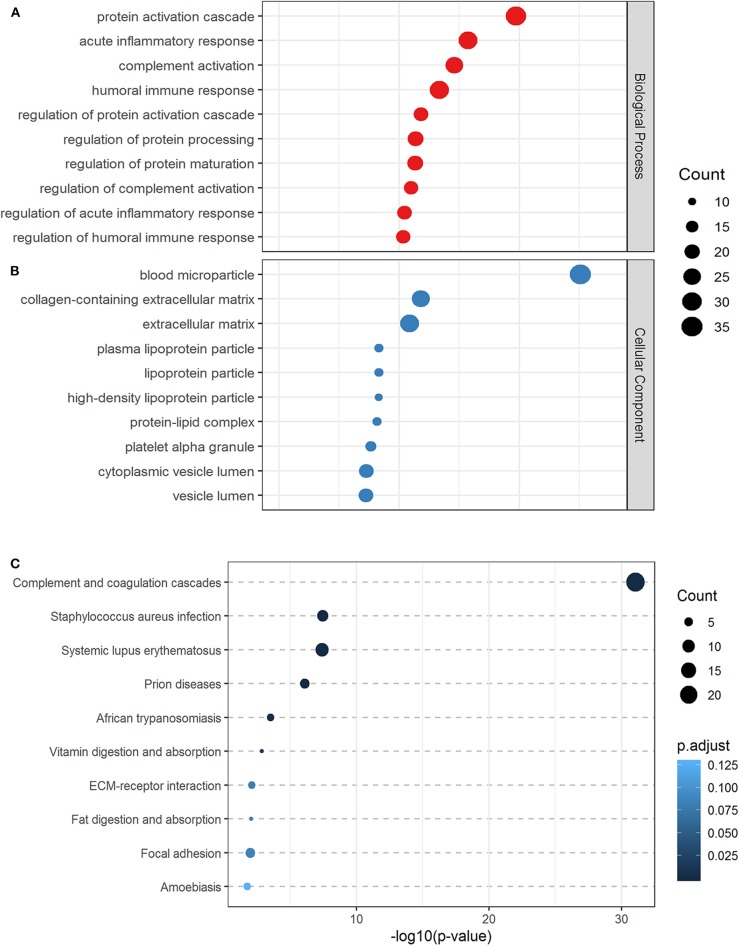
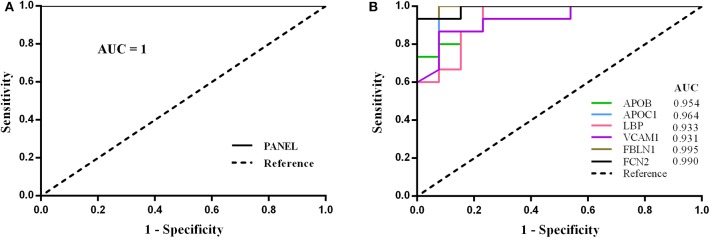
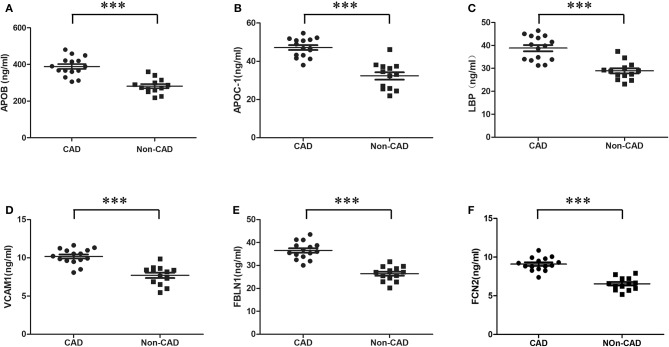
Cervical artery dissection (CAD) is an important causal factor for stroke in young and middle-aged individuals and presents a great burden to the individual stroke victim. However, the pathophysiological mechanisms underlying CAD remain unknown. Here, an iTRAQ (isobaric tagging for relative and absolute quantitation)-based quantitative proteomic approach was performed, to identify differentially expressed proteins in serum samples obtained from spontaneous CAD and non-CAD ischemic stroke subjects. Differential protein expression was analyzed for Kyoto Encyclopedia of Genes and Genomes (KEGG) pathway overrepresentation, and six differential proteins were selected for enzyme-linked immunosorbent assay validation. Through KEGG analysis, the significantly differentiated proteins were primarily involved in immunoregulation, blood coagulation, and lipid metabolism. For the first time, differential expressions of apolipoprotein B, apolipoprotein C-I, lipopolysaccharide-binding protein, vascular cell adhesion molecule 1, fibulin-1, and ficolin-2 were confirmed as being significantly upregulated in CAD as compared to non-CAD ischemic stroke subjects. In conclusion, proteomic analysis reveals that early perturbation of immunoregulation and lipid metabolism may be involved in the pathophysiology of CAD. Specifically, the panel of six proteins identified is promising as serum-based biomarkers for the detection of increased CAD risk in stroke subjects.
颈动脉夹层(CAD)是中青年个体发生中风的一个重要病因,给中风患者个体带来了巨大负担。然而,CAD潜在的病理生理机制仍不清楚。在此,我们采用基于iTRAQ(相对和绝对定量的等压标记)的定量蛋白质组学方法,以鉴定来自自发性CAD和非CAD缺血性中风患者血清样本中差异表达的蛋白质。分析差异蛋白表达在京都基因与基因组百科全书(KEGG)通路中的过度富集情况,并选择六种差异蛋白进行酶联免疫吸附测定验证。通过KEGG分析,显著差异的蛋白质主要参与免疫调节、血液凝固和脂质代谢。首次证实,与非CAD缺血性中风患者相比,载脂蛋白B、载脂蛋白C-I、脂多糖结合蛋白、血管细胞粘附分子1、纤连蛋白-1和纤维胶凝蛋白-2在CAD中的差异表达显著上调。总之,蛋白质组学分析表明,免疫调节和脂质代谢的早期紊乱可能参与了CAD的病理生理过程。具体而言,所鉴定的六种蛋白质有望作为基于血清的生物标志物,用于检测中风患者中CAD风险的增加。