Papenmeier Frank, Maurer Annika E, Huff Markus
Department of Psychology, Eberhard Karls Universität Tübingen, Tübingen, Germany1.
Department of Research Infrastructures, German Institute for Adult Education, Bonn, Germany2.
Adv Cogn Psychol. 2019 Mar 31;15(1):30-40. doi: 10.5709/acp-0254-9. eCollection 2019.
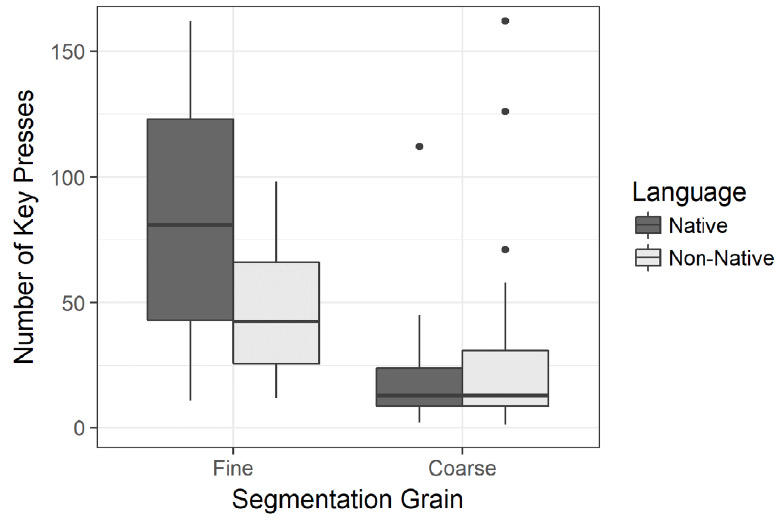
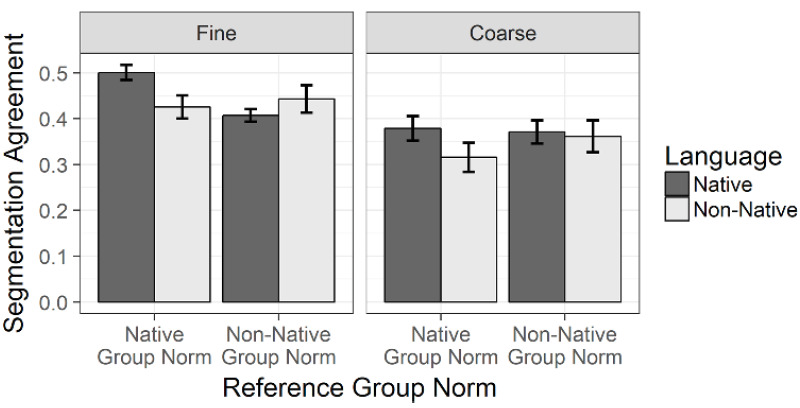
Human observers (comprehenders) segment dynamic information into discrete events. That is, although there is continuous sensory information, comprehenders perceive boundaries between two meaningful units of information. In narrative comprehension, comprehenders use linguistic, non-linguistic , and physical cues for this event boundary perception. Yet, it is an open question - both from a theoretical and an empirical perspective - how linguistic and non-linguistic cues contribute to this process. The current study explores how linguistic cues contribute to the participants' ability to segment continuous auditory information into discrete, hierarchically structured events. Native speakers of German and non-native speakers, who neither spoke nor understood German, segmented a German audio drama into coarse and fine events. Whereas native participants could make use of linguistic, non-linguistic, and physical cues for segmentation, non-native participants could only use non-linguistic and physical cues. We analyzed segmentation behavior in terms of the ability to identify coarse and fine event boundaries and the resulting hierarchical structure. Non-native listeners identified almost identical coarse event boundaries as native listeners, but missed some of the fine event boundaries identified by the native listeners. Interestingly, hierarchical event perception (as measured by hierarchical alignment and enclosure) was comparable for native and non-native participants. In summary, linguistic cues contributed particularly to the identification of certain fine event boundaries. The results are discussed with regard to the current theories of event cognition.
人类观察者(理解者)会将动态信息分割成离散的事件。也就是说,尽管存在连续的感官信息,但理解者能够感知到两个有意义信息单元之间的界限。在叙事理解中,理解者会利用语言、非语言和物理线索来进行这种事件边界感知。然而,从理论和实证的角度来看,语言和非语言线索如何促成这一过程仍是一个悬而未决的问题。当前的研究探讨了语言线索如何影响参与者将连续听觉信息分割成离散的、层次结构分明的事件的能力。以德语为母语的人和既不会说也听不懂德语的非母语者将一部德语广播剧分割成粗略和精细的事件。母语参与者在分割时可以利用语言、非语言和物理线索,而非母语参与者只能使用非语言和物理线索。我们从识别粗略和精细事件边界的能力以及由此产生的层次结构方面分析了分割行为。非母语听众识别出的粗略事件边界与母语听众几乎相同,但错过了母语听众识别出的一些精细事件边界。有趣的是,母语和非母语参与者在层次事件感知方面(通过层次对齐和包含来衡量)是相当的。总之,语言线索尤其有助于识别某些精细事件边界。我们将结合当前的事件认知理论对研究结果进行讨论。