National Health Research Authority, Lusaka, Zambia.
Department of Global Health, Boston University School of Public Health, Boston, Massachusetts, USA.
J Glob Health. 2020 Jun;10(1):010425. doi: 10.7189/jogh.10.010425.
Despite progress made over the past twenty years, child mortality remains high, with 5.3 million children under five years having died in 2018 globally. Pneumonia, diarrhoea, and malaria remain among the commonest causes of under-five mortality; contributing 15%, 8%, and 5% of global mortality respectively. Recent evidence shows that integrated community case management (iCCM) of pneumonia, diarrhoea, and malaria can reduce under-five mortality. However, despite growing evidence of the effectiveness of iCCM, there are implementation challenges, especially stock out of iCCM commodities and inadequate supportive supervision of community health workers (CHWs). This study aimed to address these two key challenges to successful iCCM implementation by using mobile health (mHealth) technology.
This cluster randomised controlled trial compared health centre catchment areas (clusters) where CHWs and their supervisors implemented mHealth-enhanced iCCM supportive supervision and supply chain management vs clusters implementing iCCM as per current Zambian guidelines. CHWs in intervention clusters used community DHIS2 platform on mobile phones to report on a weekly basis children with iCCM conditions and make requisitions for iCCM commodities. Their supervisors received electronic reports on disease caseloads and monthly automated supervision reminders. The supervisors on receipt of requisitions, organized the medical supplies and notified CHWs for collection. Intention-to-treat analysis on the primary outcome, the percentage of children aged 2-59 months receiving appropriate treatment for malaria, pneumonia, or diarrhoea from an iCCM trained CHW, was performed using a generalized linear model. Prevalence ratios and 95% confidence intervals comparing the prevalence of appropriate treatment in the intervention and control groups were calculated using log binomial regression with an exchangeable correlation matrix, adjusted for clustering by health facility.
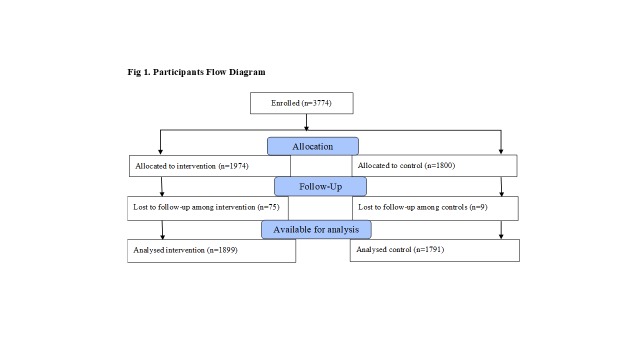
In the intervention clusters, 61.3% (98/160) of expected monthly supervision visits took place vs 52.0% (78/150) in the controls. A total of 3690 children 2-59 months old presented with malaria, diarrhoea, or pneumonia. In the intervention group, 65.9% (1,252/1,899) of children received appropriate care for iCCM conditions, compared to 63.3% (1,134/1,791) in the control group. The mHealth intervention was associated with 18.0% improvement in supportive supervision and 21.0% increase in appropriate treatment for pneumonia; these changes were not statistically significant. There was a 2-3-fold increase in the proportion of CHWs receiving supplies ordered: prevalence ratios ranged from 2.82 (confidence interval (CI) = 1.50, 5.30) to 3.01 (95% CI = 1.29, 7.00) depending on the particular commodity.
This study was unable to determine whether using mHealth technology would strengthen supervision and supply chain management of iCCM commodities for community-level workers. There was no statistically significant effect of mHealth enhanced iCCM on appropriate diagnosis and treatment for children with malaria, pneumonia, and diarrhoea in rural Zambia. Longer term longitudinal studies are required to determine the impact of mHealth enhanced iCCM on health outputs and outcomes.
ClinicalTrials.gov, NCT02866097.
尽管在过去二十年中取得了进展,但儿童死亡率仍然很高,全球有 530 万名五岁以下儿童死亡。肺炎、腹泻和疟疾仍然是五岁以下儿童死亡的最常见原因;分别占全球死亡率的 15%、8%和 5%。最近的证据表明,肺炎、腹泻和疟疾的综合社区病例管理(iCCM)可以降低五岁以下儿童的死亡率。然而,尽管 iCCM 的有效性证据越来越多,但仍存在实施挑战,特别是 iCCM 商品库存不足和社区卫生工作者(CHW)的支持性监督不足。本研究旨在通过使用移动医疗(mHealth)技术来解决成功实施 iCCM 的这两个关键挑战。
这是一项整群随机对照试验,比较了实施 mHealth 增强型 iCCM 支持性监督和供应链管理的 CHW 和其监督者的卫生中心集水区(群)与按照当前赞比亚指南实施 iCCM 的集水区。干预群中的 CHW 使用社区 DHIS2 平台在手机上每周报告患有 iCCM 疾病的儿童,并提出 iCCM 商品的要求。他们的监督者收到关于疾病负担的电子报告和每月自动监督提醒。使用广义线性模型对主要结局,即接受 iCCM 培训的 CHW 为 2-59 个月的儿童接受疟疾、肺炎或腹泻适当治疗的百分比,进行意向治疗分析。使用对数二项式回归比较干预组和对照组中适当治疗的患病率比和 95%置信区间,使用交换相关矩阵进行调整,按卫生设施进行聚类。
在干预群中,预计每月进行 61.3%(98/160)的监督访问,而对照组为 52.0%(78/150)。共有 3690 名 2-59 个月大的儿童出现疟疾、腹泻或肺炎。在干预组中,65.9%(1,252/1,899)的儿童接受了 iCCM 疾病的适当治疗,而对照组为 63.3%(1,134/1,791)。mHealth 干预措施与支持性监督的 18.0%改善和肺炎适当治疗的 21.0%增加相关;这些变化没有统计学意义。接受所订购供应品的 CHW 比例增加了 2-3 倍:患病率比范围从 2.82(置信区间(CI)=1.50,5.30)到 3.01(95%CI=1.29,7.00),具体取决于特定商品。
本研究无法确定使用移动医疗技术是否会加强社区一级工作人员对 iCCM 商品的监督和供应链管理。mHealth 增强型 iCCM 对赞比亚农村地区患有疟疾、肺炎和腹泻的儿童的适当诊断和治疗没有统计学意义的影响。需要进行更长期的纵向研究,以确定 mHealth 增强型 iCCM 对健康产出和结果的影响。
ClinicalTrials.gov,NCT02866097。
