Kaslow David C
PATH, 2201 Westlake Avenue, Suite 200, Seattle, WA 98121 USA.
NPJ Vaccines. 2020 May 25;5(1):42. doi: 10.1038/s41541-020-0193-6. eCollection 2020.
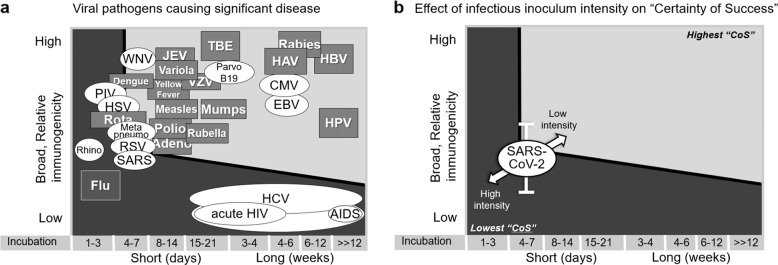
Vaccines for 17 viral pathogens have been licensed for use in humans. Previously, two critical biological parameters of the pathogen and the host-pathogen interaction- and -were proposed to account for much of the past successes in vaccine development, and to be useful in estimating the "certainty of success" of developing an effective vaccine for viral pathogens for which a vaccine currently does not exist. In considering the "certainty of success" in development of human coronavirus vaccines, particularly SARS-CoV-2, a third, related critical parameter is proposed-, at an individual-level, and , at a population-level. Reducing the (and , at a population-level) is predicted to lengthen the incubation period, which in turn is predicted to reduce the severity of illness, and increase the opportunity for an upon exposure to the circulating virus. Similarly, successfully implementing individual- and population-based behaviors that reduce the and , respectively, while testing and deploying COVID-19 vaccines is predicted to increase the "certainty of success" of demonstrating vaccine efficacy and controlling SARS-CoV-2 infection, disease, death, and the pandemic itself.
17种病毒病原体的疫苗已获许可用于人类。此前,有人提出病原体的两个关键生物学参数以及宿主与病原体的相互作用,是过去疫苗研发取得诸多成功的主要原因,并且有助于评估针对目前尚无疫苗的病毒病原体研发有效疫苗的“成功确定性”。在考虑人类冠状病毒疫苗(尤其是严重急性呼吸综合征冠状病毒2[SARS-CoV-2]疫苗)研发的“成功确定性”时,提出了第三个相关关键参数——在个体层面和在群体层面。预计降低(以及在群体层面)会延长潜伏期,这反过来又预计会降低疾病的严重程度,并增加接触传播病毒后产生的机会。同样,在测试和部署2019冠状病毒病(COVID-19)疫苗时,成功实施分别降低和的基于个体和群体的行为,预计会提高证明疫苗效力以及控制SARS-CoV-2感染、疾病、死亡和疫情本身的“成功确定性”。