Chaia-Semerena Genny Margarita, Vargas-Camaño María Eugenia, Alonso-Bello Cesar Daniel, Guillén-Toledo Jorge Javier, Guido-Bayardo Ricardo Leopoldo, Lozano-Patiño Fernando, Temix-Delfín Mariano Daniel, Castrejón-Vázquez María Isabel
Clinical Immunology and Allergy Service, National Medical Center 20 de Noviembre, Instituto de Seguridad y Servicios Sociales de Los Trabajadores del Estado, México City, Mexico.
Autoimmune Dis. 2020 May 18;2020:8719284. doi: 10.1155/2020/8719284. eCollection 2020.
Several studiesdemonstrated that the use of alternate-day corticosteroid therapy maintains control of autoimmune diseases due to the prolongation of their therapeutic effect beyond their metabolic effect, with a significant decrease in side effects in patients. For this reason, the current recommendation for the use of these medications is in a short cycle to avoid adverse effects when used frequently and for prolonged periods of time.
To learn variations in serum levels of autoantibodies in autoimmune diseases treated with steroids on alternate days, as well as whether there are differences in the response to them depending on the type of disease. . A descriptive, retrospective, and cross-sectional study was conducted in which serum autoantibody levels were compared at the time of diagnosis and three months after alternate-day corticosteroid therapy.
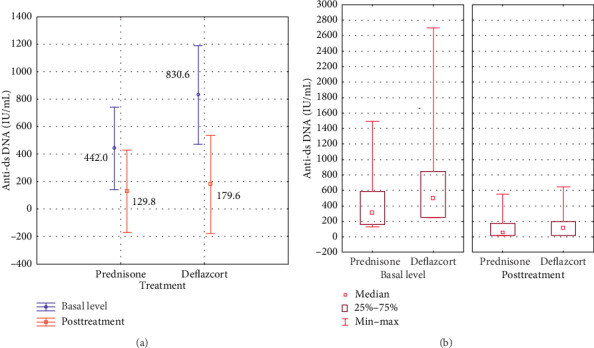
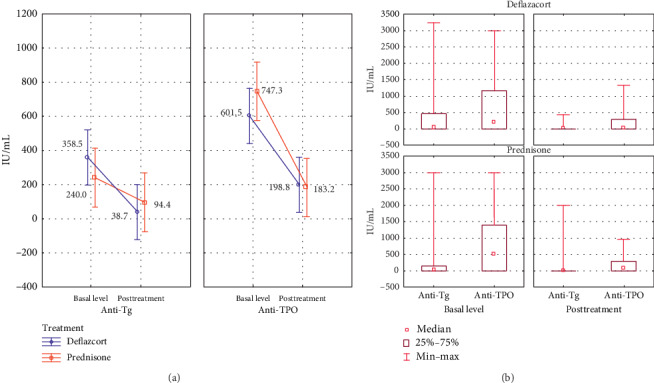
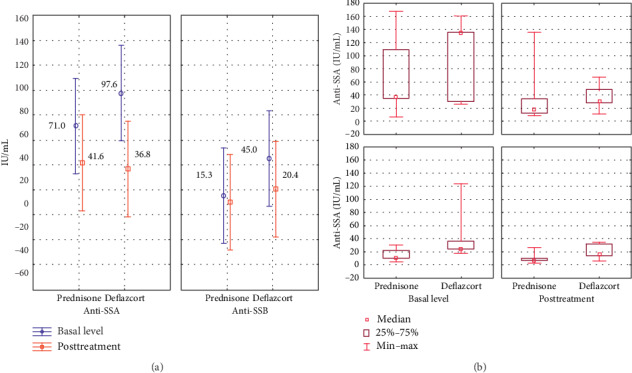
We included 106 patients from three autoimmune connective tissue diseases (systemic lupus erythematosus, Sjögren syndrome, and Hashimoto's thyroiditis) and observed a statistically significant decrease in serum autoantibody levels both in patients with lupus and those with Hashimoto's thyroiditis, regardless of the sex of the patients, as well as the type of steroids used.
Treatment with alternate-day corticosteroids achieved a statistically significant decrease in serum autoantibody levels in patients with systemic lupus erythematosus and Hashimoto's thyroiditis.
多项研究表明,隔日使用皮质类固醇疗法可维持对自身免疫性疾病的控制,因为其治疗效果的持续时间超过了代谢效果,且患者的副作用显著减少。因此,目前对这些药物的使用建议是采用短周期用药,以避免频繁且长期使用时产生不良反应。
了解隔日使用类固醇治疗的自身免疫性疾病患者血清自身抗体水平的变化,以及根据疾病类型对这些药物的反应是否存在差异。开展了一项描述性、回顾性横断面研究,比较了诊断时和隔日皮质类固醇治疗三个月后血清自身抗体水平。
我们纳入了来自三种自身免疫性结缔组织疾病(系统性红斑狼疮、干燥综合征和桥本甲状腺炎)的106例患者,观察到狼疮患者和桥本甲状腺炎患者的血清自身抗体水平均有统计学意义的下降,无论患者性别以及所使用的类固醇类型如何。
隔日使用皮质类固醇治疗使系统性红斑狼疮和桥本甲状腺炎患者的血清自身抗体水平有统计学意义的下降。