Shanta Kamrunnahar, Nakayama Kentaro, Ishikawa Masako, Ishibashi Tomoka, Yamashita Hitomi, Sato Seiya, Sasamori Hiroki, Sawada Kiyoka, Kurose Sonomi, Mahmud Hossain Mohammad, Razia Sultana, Iida Kouji, Ishikawa Noriyoshi, Kyo Satoru
Department of Obstetrics and Gynecology, Faculty of Medicine, Shimane University, Izumo 693-8501, Japan.
Department of Organ Pathology, Shimane University Faculty of Medicine, Izumo 693-8501, Japan.
Cancers (Basel). 2020 Jun 4;12(6):1469. doi: 10.3390/cancers12061469.
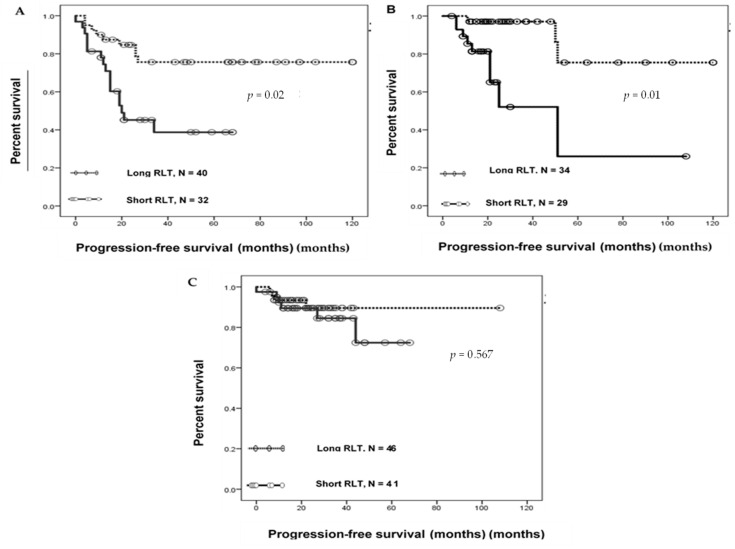
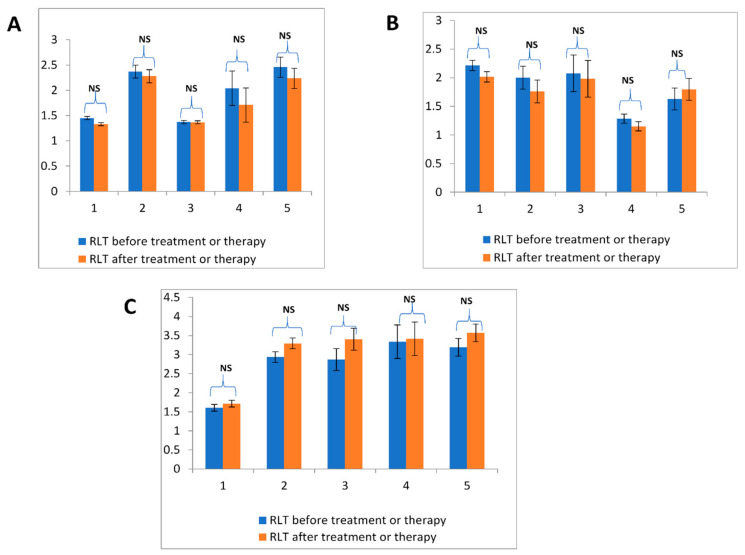
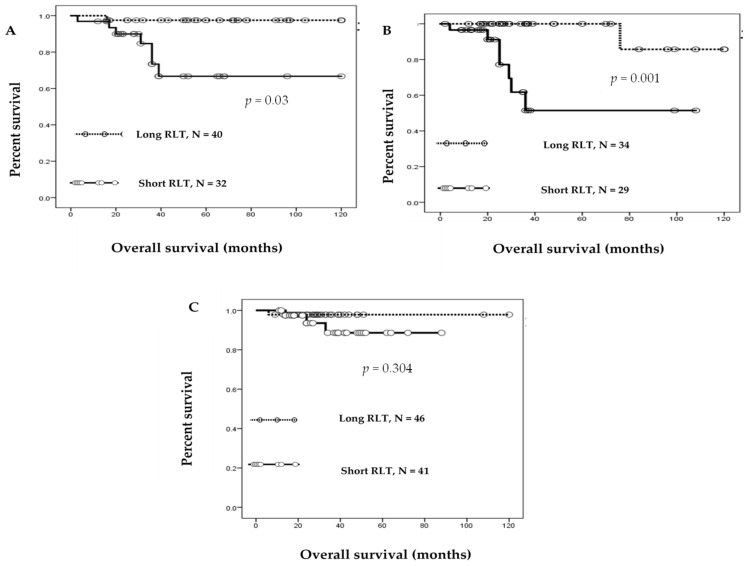
Lymphocyte telomere length is strongly correlated with patient prognosis in several malignant tumor types and is thought to be related to tumor immunity. However, this correlation has not been studied in gynecological cancers. We determined the prognostic significance of peripheral blood lymphocyte telomere length in gynecologic cancers. Telomere length of lymphocytes from patients with gynecological malignant tumors (ovarian cancer (OC), = 72; cervical cancer (CC), = 63; endometrial cancer (EC), = 87) was examined by quantitative reverse-transcription PCR of isolated mononuclear cells. Kaplan-Meier and Cox proportional hazard analyses were used to determine the association between lymphocyte telomere length and clinicopathological factors. The overall survival (OS) and progression-free survival (PFS) of patients were based on the dichotomized lymphocyte telomere length using the median as a threshold (OC: 0.75, CC: 1.94, and EC: 1.09). A short telomere length was significantly correlated with residual tumors (≥1 cm) in OC and with advanced stage (III and IV) of CC. In OC and CC, patients with shorter relative lymphocyte telomere length (RLT) had significantly poorer OS and PFS than patients with longer RLT ( = 0.002, = 0.003, and = 0.001, = 0.001, respectively). However, in EC, RLT was not significantly associated with OS or PFS ( = 0.567 and = 0.304, log-rank test). Multivariate analysis showed that shorter RLT was a significant independent prognostic factor of PFS and OS for OC ( = 0.03 and = 0.04, respectively) and CC ( = 0.02 and = 0.03, respectively). Patients with OC and CC with shorter lymphocyte telomeres have significantly reduced survival; therefore, the peripheral blood lymphocyte telomere length is a prognostic biomarker in OC and CC.
淋巴细胞端粒长度与多种恶性肿瘤类型患者的预后密切相关,并且被认为与肿瘤免疫有关。然而,这种相关性在妇科癌症中尚未得到研究。我们确定了外周血淋巴细胞端粒长度在妇科癌症中的预后意义。通过对分离的单核细胞进行定量逆转录聚合酶链反应,检测了妇科恶性肿瘤患者(卵巢癌(OC),n = 72;宫颈癌(CC),n = 63;子宫内膜癌(EC),n = 87)淋巴细胞的端粒长度。采用Kaplan-Meier法和Cox比例风险分析来确定淋巴细胞端粒长度与临床病理因素之间的关联。患者的总生存期(OS)和无进展生存期(PFS)基于以中位数为阈值对淋巴细胞端粒长度进行二分法划分(OC:0.75,CC:1.94,EC:1.09)。短端粒长度与OC中的残留肿瘤(≥1 cm)以及CC的晚期(III和IV期)显著相关。在OC和CC中,相对淋巴细胞端粒长度(RLT)较短的患者的OS和PFS明显比RLT较长的患者差(分别为P = 0.002,P = 0.003和P = 0.001,P = 0.001)。然而,在EC中,RLT与OS或PFS均无显著关联(对数秩检验,P = 0.567和P = 0.304)。多因素分析表明,较短的RLT是OC(分别为P = 0.03和P = 0.04)和CC(分别为P = 0.02和P = 0.03)PFS和OS的显著独立预后因素。OC和CC中淋巴细胞端粒较短的患者生存期显著缩短;因此,外周血淋巴细胞端粒长度是OC和CC中的一种预后生物标志物。