Shenzhen Grubbs Institute, Department of Chemistry and Guangdong Provincial Key Laboratory of Catalysis, Southern University of Science and Technology, Shenzhen, Guangdong, 518055, China.
College of Chemical Engineering, Department of Pharmaceutical Engineering, Northwest University, Taibai North Road 229, Xi'an, Shaanxi, 71009, China.
Nat Commun. 2020 Jun 8;11(1):2890. doi: 10.1038/s41467-020-16713-8.
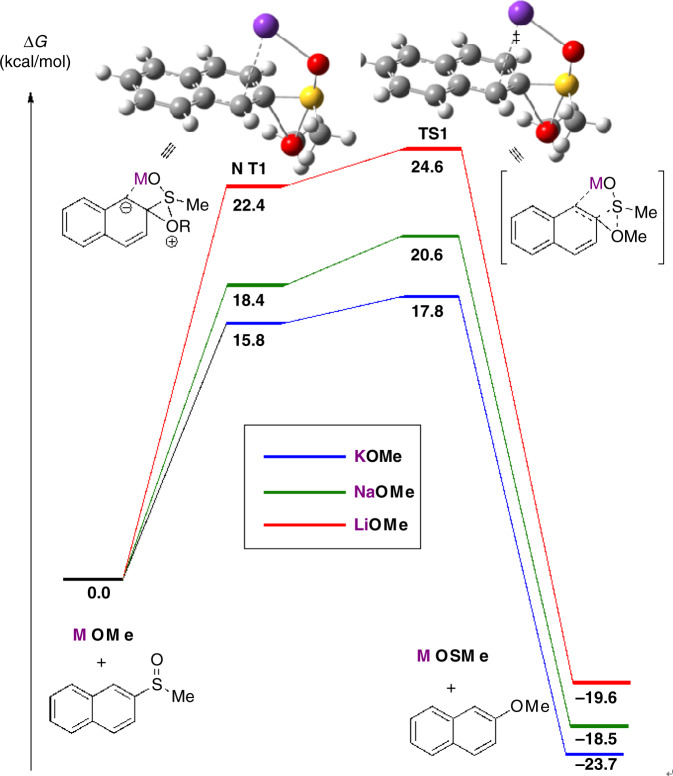
Employment of sulfoxides as electrophiles in cross-coupling reactions remains underexplored. Herein we report a transition-metal-free cross-coupling strategy utilizing aryl(heteroaryl) methyl sulfoxides and alcohols to afford alkyl aryl(heteroaryl) ethers. Two drug molecules were successfully prepared using this protocol as a key step, emphasizing its potential utility in medicinal chemistry. A DFT computational study suggests that the reaction proceeds via initial addition of the alkoxide to the sulfoxide. This adduct facilitates further intramolecular addition of the alkoxide to the aromatic ring wherein charge on the aromatic system is stabilized by the nearby potassium cation. Rate-determining fragmentation then delivers methyl sulfenate and the aryl or heteroaryl ether. This study establishes the feasibility of nucleophilic addition to an appended sulfoxide as a means to form a bond to aryl(heteroaryl) systems and this modality is expected to find use with many other electrophiles and nucleophiles leading to new cross-coupling processes.
亚砜作为亲电试剂在交叉偶联反应中的应用仍未得到充分探索。在此,我们报告了一种无需过渡金属的交叉偶联策略,利用芳基(杂芳基)甲基亚砜和醇来合成烷基芳基(杂芳基)醚。该协议可用作关键步骤,成功制备了两种药物分子,强调了其在药物化学中的潜在应用。DFT 计算研究表明,反应通过烷氧基首先加成到亚砜上进行。该加合物促进了烷氧基进一步的分子内加成到芳环上,其中芳体系上的电荷通过附近的钾阳离子稳定。然后,速率决定的断裂产生甲基亚磺酸盐和芳基或杂芳基醚。这项研究确立了在附加的亚砜上进行亲核加成以形成与芳基(杂芳基)体系的键的可行性,这种模式预计将与许多其他亲电试剂和亲核试剂一起使用,从而产生新的交叉偶联过程。