Marmol-Guijarro Andres, Nudds Robert, Folkow Lars, Codd Jonathan
Faculty of Biology, Medicine & Health, University of Manchester, Manchester, UK.
Department of Arctic and Marine Biology, University of Tromsø - The Arctic University of Norway, Tromsø, Norway.
Front Zool. 2020 May 27;17:17. doi: 10.1186/s12983-020-00363-z. eCollection 2020.
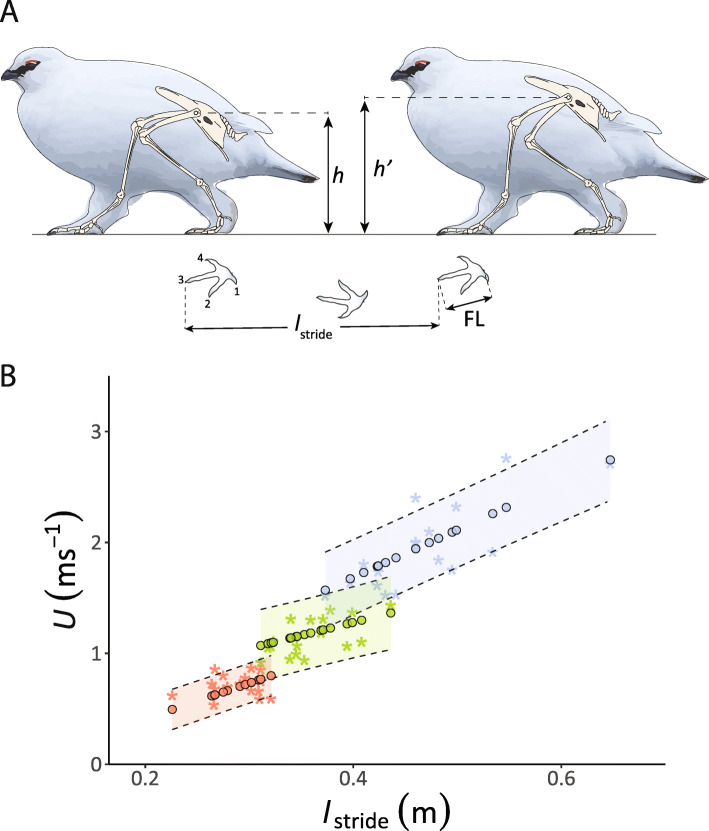
Using Froude numbers () and relative stride length (stride length: hip height), trackways have been widely used to determine the speed and gait of an animal. This approach, however, is limited by the ability to estimate hip height accurately and by the lack of information related to the substrate properties when the tracks were made, in particular for extinct fauna. By studying the Svalbard ptarmigan moving on snow, we assessed the accuracy of trackway predictions from a species-specific model and two additional based models by ground truthing data extracted from videos as the tracks were being made.
The species-specific model accounted for more than 60% of the variability in speed for walking and aerial running, but only accounted for 19% when grounded running, likely due to its stabilizing role while moving faster over a changing substrate. The error in speed estimated was 0-35% for all gaits when using the species-specific model, whereas based estimates produced errors up to 55%. The highest errors were associated with the walking gait. The transition between pendular to bouncing gaits fell close to the estimates using relative stride length described for other extant vertebrates. Conversely, the transition from grounded to aerial running appears to be species specific and highly dependent on posture and substrate.
Altogether, this study highlights that using trackways to derive predictions on the locomotor speed and gait, using stride length as the only predictor, are problematic as accurate predictions require information from the animal in question.
利用弗劳德数()和相对步幅长度(步幅长度:臀高),足迹道已被广泛用于确定动物的速度和步态。然而,这种方法受到准确估计臀高能力的限制,以及在足迹形成时缺乏与底物特性相关的信息的限制,特别是对于已灭绝的动物群。通过研究在雪地上移动的斯瓦尔巴德岩雷鸟,我们通过从视频中提取的实地数据评估了来自物种特异性模型和另外两个基于的模型对足迹道预测的准确性,这些数据是在足迹形成时获取的。
物种特异性模型解释了行走和空中奔跑速度变化的60%以上,但在地面奔跑时仅解释了19%,这可能是由于其在变化的底物上更快移动时的稳定作用。使用物种特异性模型时,所有步态的速度估计误差为0 - 35%,而基于的估计产生的误差高达55%。最高误差与行走步态相关。从摆动步态到弹跳步态的转变接近使用其他现存脊椎动物描述的相对步幅长度的估计值。相反,从地面奔跑过渡到空中奔跑似乎是物种特异性的,并且高度依赖于姿势和底物。
总之,这项研究强调,仅使用步幅长度作为唯一预测因子,利用足迹道来推导关于运动速度和步态的预测是有问题的,因为准确的预测需要来自相关动物的信息。