Freire Gabriel Lucas Morais, da Silva Paulo Josy Rawane, da Silva Adson Alves, Batista Roseana Pacheco Reis, Alves Juliana Fonseca Nogueira, do Nascimento Junior José Roberto Andrade
postgraduate programme in physical education, University Federal do Vale do São Francisco, Petrolina, Brazil.
postgraduate programme in psychology, University Federal do Vale do São Francisco, Petrolina, Brazil.
J Eat Disord. 2020 Jun 10;8:23. doi: 10.1186/s40337-020-00300-9. eCollection 2020.
This study investigated the association between body dissatisfaction (BD), addiction to exercise and risk behaviors to eating disorders (EDs) among Brazilian exercise practitioners, besides comparing the variables according to sex, age group and modality.
Participants were 60 exercice practitioners of fitness ( = 44) and crossfit ( = 16), with mean age of 26.58 ± 7.76 years. Data collection was conducted through Eating Attitudes Test-26 (EAT-26), Diagnosis of Orthorexia Questionnaire (ORTO-15), Body Shape Questionnaire (BSQ) and Scale of Dedication to Exercise (SDE). Data analysis was conducted through Kolmogorov-Smirnov and independent t tests, Pearson correlation, and Path Analysis ( < .05).
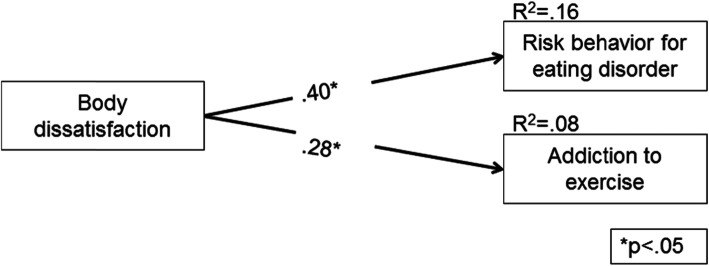
Main results showed the association between BD, addiction to exercise and risk behaviour for EDs Further, individuals dissatisfied with their bodies showed higher level of addiction to exercise and risk behavior for EDs. Furthermore, women showed higher presence of BD than men, and fitness participants reported higher presence of addiction to exercise than crossfit practitioners.
This study revealed that BD seems to be a determinant factor for risk behavior for ED's and addiction to exercise among fitness and crossfit particpants.
本研究调查了巴西健身从业者的身体不满(BD)、运动成瘾与饮食失调(EDs)风险行为之间的关联,此外还根据性别、年龄组和运动方式对变量进行了比较。
参与者为60名健身(n = 44)和CrossFit(n = 16)运动从业者,平均年龄为26.58±7.76岁。通过饮食态度测试-26(EAT-26)、正食症诊断问卷(ORTO-15)、身体形态问卷(BSQ)和运动投入量表(SDE)进行数据收集。通过柯尔莫哥洛夫-斯米尔诺夫检验和独立样本t检验、皮尔逊相关性分析和路径分析进行数据分析(p < .05)。
主要结果显示了BD、运动成瘾与EDs风险行为之间的关联。此外,对自己身体不满意的个体表现出更高水平的运动成瘾和EDs风险行为。此外,女性的BD发生率高于男性,健身参与者报告的运动成瘾发生率高于CrossFit从业者。
本研究表明,BD似乎是健身和CrossFit参与者中EDs风险行为和运动成瘾的决定因素。