Ng Qin Xiang, Lee Dawn Yi Xin, Yau Chun En, Han Ming Xuan, Liew Jacqueline Jin Li, Teoh Seth En, Ong Clarence, Yaow Clyve Yu Leon, Chee Kuan Tsee
Health Services Research Unit, Singapore General Hospital, Singapore, Singapore.
Saw Swee Hock School of Public Health, National University of Singapore and National University Health System, Singapore, Singapore.
Psychopathology. 2024 Mar 1;57(4):1-14. doi: 10.1159/000536379.
Orthorexia nervosa (ON), characterized by a pathological preoccupation with "extreme dietary purity," is increasingly observed as a mental health condition among young adults and the general population. However, its diagnosis is not formally recognized and has remained contentious.
In this systematic review, we attempt to overview previous reviews on ON, focusing on the methodological and conceptual issues with ON. This would serve both as a summary and a way to highlight gaps in earlier research.
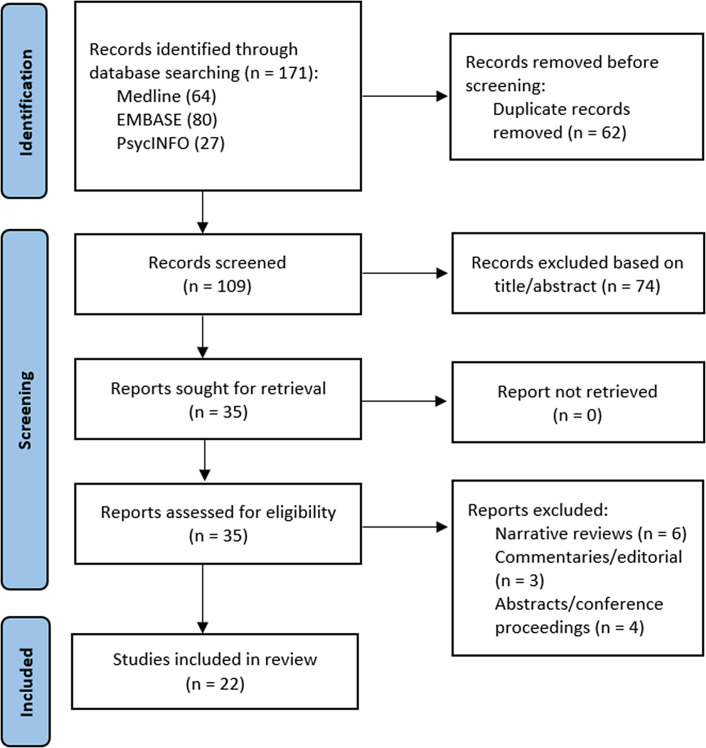
This systematic review took reference from the Preferred Reporting Items for Systematic Reviews and Meta-Analyses (PRISMA) reporting guidelines, and using combinations of the search terms ("orthorexia" OR "orthorexia nervosa" OR "ON") AND ("review" OR "systematic review" OR "meta-analysis"), a literature search was performed on EMBASE, Medline and PsycINFO databases from inception up to October 31, 2023. Articles were included if (1) they were written or translated into English and (2) contained information pertaining to the diagnostic stability or validity of ON, or instruments used to measure ON symptoms and behaviors. Only review articles with a systematic literature search approach were included.
A total of 22 reviews were qualitatively reviewed. Several studies have reported variable prevalence of ON and highlighted the lack of thoroughly evaluated measures of ON with clear psychometric properties, with no reliable estimates. ORTO-15 and its variations such as ORTO-11, ORTO-12 are popularly used, although their use is discouraged. Existing instruments lack specificity for pathology and several disagreements on the conceptualization and hence diagnostic criteria of ON exist.
Previous reviews have consistently highlighted the highly variable (and contradictory) prevalence rates with different instruments to measure ON, lack of stable factor structure and psychometrics across ON measures, paucity of data on ON in clinical samples, and a need for a modern re-conceptualization of ON. The diagnosis of ON is challenging as it likely spans a spectrum from "normal" to "abnormal," and "functional" to "dysfunctional." "Non-pathological" orthorexia is not related to psychopathological constructs in the same way that ON is.
神经性正食症(ON)的特征是对“极端饮食纯净度”的病态关注,在年轻人和普通人群中作为一种心理健康状况越来越多地被观察到。然而,其诊断尚未得到正式认可,仍然存在争议。
在本系统评价中,我们试图概述先前关于神经性正食症的综述,重点关注神经性正食症的方法学和概念性问题。这既可以作为一个总结,也可以作为突出早期研究差距的一种方式。
本系统评价参考了系统评价和Meta分析的首选报告项目(PRISMA)报告指南,并使用检索词(“orthorexia”或“orthorexia nervosa”或“ON”)与(“review”或“systematic review”或“meta-analysis”)的组合,在EMBASE、Medline和PsycINFO数据库中从建库至2023年10月31日进行文献检索。纳入的文章需满足以下条件:(1)文章为英文撰写或已翻译成英文;(2)包含与神经性正食症的诊断稳定性或有效性相关的信息,或用于测量神经性正食症症状和行为的工具。仅纳入采用系统文献检索方法的综述文章。
共对22篇综述进行了定性评价。几项研究报告了神经性正食症的患病率各不相同,并强调缺乏经过充分评估且具有明确心理测量特性的神经性正食症测量方法,没有可靠的估计值。ORTO - 15及其变体如ORTO - 11、ORTO - 12被广泛使用,尽管不鼓励使用。现有工具对病理学缺乏特异性,并且在神经性正食症的概念化以及因此的诊断标准方面存在一些分歧。
先前的综述一直强调,使用不同工具测量神经性正食症时患病率高度可变(且相互矛盾),神经性正食症测量方法缺乏稳定的因子结构和心理测量学特性,临床样本中关于神经性正食症的数据匮乏,以及需要对神经性正食症进行现代的重新概念化。神经性正食症的诊断具有挑战性,因为它可能涵盖从“正常”到“异常”以及从“功能性”到“功能失调性”的范围。“非病理性”正食症与心理病理学结构的关系与神经性正食症不同。