CARAES Neuropsychiatric Hospital, Ndera, Kigali, Rwanda.
Centre Hospitalier Universitaire Kigali (CHUK), Kigali, Rwanda.
PLoS One. 2020 Jun 12;15(6):e0234095. doi: 10.1371/journal.pone.0234095. eCollection 2020.
Patients with epilepsy (PwE) have an increased risk of active and lifetime depression. Two in 10 patients experience depression. Lack of trained psychiatric staff in low- and middle-income countries (LMIC) creates a need for screening tools that enable detection of depression in PwE. We describe the translation, validity and reliability assessment of the Patient Health Questionnaire-9 (PHQ-9) as a screening tool for depression among PwE in Rwanda.
PHQ-9 was translated to Kinyarwanda using translation-back translation and validated by a discussion group. For validation, PwE of ≥15 years of age were administered the PHQ-9 and Hamilton Depression Rating Scale (HDRS) by trained psychiatry staff at Visit 1. A random sample of 20% repeated PHQ-9 and HDRS after 14 days to assess temporal stability and intra-rater reliability. Internal structure, reliability and external validity were assessed using confirmatory factor analysis, reliability coefficients and HDRS-correlation, respectively. Maximal Youden's index was considered for cut-offs.
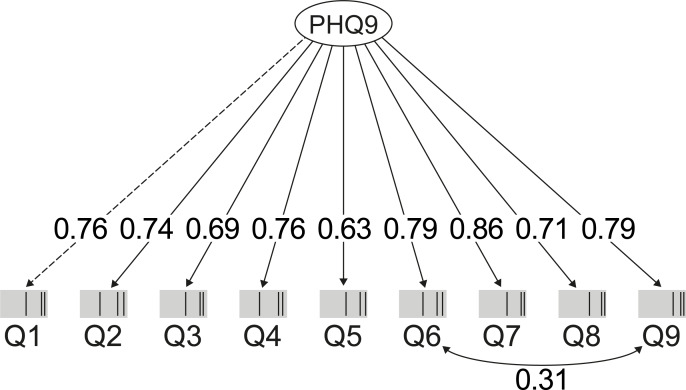
Four hundred and thirty-four PwE, mean age 30.5 years (SD ±13.3), were included of whom 33.6%, 37.9%, 13.4%, and 15.1% had no, mild, moderate and severe depression, respectively. PHQ-9 performed well on a one-factor model (unidimensional model), with factor loadings of 0.63-0.86. Reliability coefficients above 0.80 indicated strong internal consistency. Good temporal stability was observed (0.79 [95% CI: 0.68-0.87]). A strong correlation (R = 0.66, p = 0.01) between PHQ-9 and HDRS summed scores demonstrated robust external validity. The optimal cut-off for the PHQ-9 was similar (≥5) for mild and moderate depression and ≥7 for severe depression.
PHQ-9 validation in Kinyarwanda creates the capacity to screen PwE in Rwanda at scores of ≥5 for mild or moderate and ≥7 for severe depression. The availability of validated tools for screening and diagnosis for depression is a forward step for holistic care in a resource-limited environment.
癫痫患者(PwE)有患活动性和终身抑郁症的风险增加。每 10 名患者中就有 2 名患有抑郁症。在中低收入国家(LMIC),缺乏训练有素的精神科工作人员,这就需要使用筛查工具来检测 PwE 中的抑郁症。我们描述了在卢旺达使用患者健康问卷-9(PHQ-9)作为一种筛查工具来筛查 PwE 中抑郁症的翻译、有效性和可靠性评估。
PHQ-9 通过翻译回译翻译成基尼亚卢旺达语,并由一个讨论小组进行验证。为了验证,年龄≥15 岁的 PwE 在第一次就诊时由经过培训的精神科工作人员进行 PHQ-9 和汉密尔顿抑郁评定量表(HDRS)评估。随机抽取 20%的样本在 14 天后重复进行 PHQ-9 和 HDRS 评估,以评估时间稳定性和内部评分者可靠性。使用验证性因素分析、可靠性系数和 HDRS 相关性分别评估内部结构、可靠性和外部有效性。最大约登指数被认为是截止值。
共纳入 434 名 PwE,平均年龄为 30.5 岁(标准差±13.3),分别有 33.6%、37.9%、13.4%和 15.1%的患者没有、轻度、中度和重度抑郁。PHQ-9 在单因素模型(一维模型)上表现良好,因子负荷为 0.63-0.86。可靠性系数高于 0.80 表明具有很强的内部一致性。观察到良好的时间稳定性(0.79[95%置信区间:0.68-0.87])。PHQ-9 与 HDRS 总和评分之间的强相关性(R = 0.66,p = 0.01)表明具有强大的外部有效性。PHQ-9 的最佳截断值对于轻度和中度抑郁为≥5,对于重度抑郁为≥7。
在基尼亚卢旺达验证 PHQ-9 创造了在卢旺达以≥5 分筛查轻度或中度和≥7 分筛查重度抑郁的能力。在资源有限的环境中,提供经过验证的用于筛查和诊断抑郁症的工具是整体护理的一个进步。