Division of Digital Psychiatry, Beth Israel Deaconess Medical Center, Harvard Medical School, Boston, MA, United States.
Bicycle Health, Boston, MA, United States.
J Med Internet Res. 2020 Aug 27;22(8):e18346. doi: 10.2196/18346.
Despite the emergence of app evaluation tools, there remains no well-defined process receptive to diverse local needs, rigorous standards, and current content. The need for such a process to assist in the implementation of app evaluation across all medical fields is evident. Such a process has the potential to increase stakeholder engagement and catalyze interest and engagement with present-day app evaluation models.
This study aimed to develop and pilot test the Technology Evaluation and Assessment Criteria for Health apps (TEACH-apps).
Tailoring a well-known implementation framework, Replicating Effective Programs, we present a new process to approach the challenges faced in implementing app evaluation tools today. As a culmination of our experience implementing this process and feedback from stakeholders, we present the four-part process to aid the implementation of mobile health technology. This paper outlines the theory, evidence, and initial versions of the process.
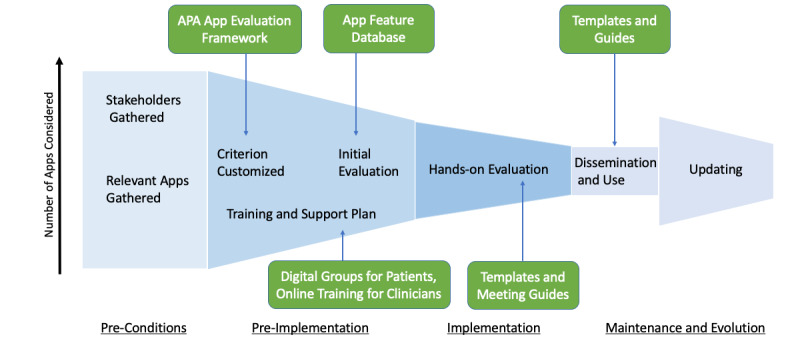
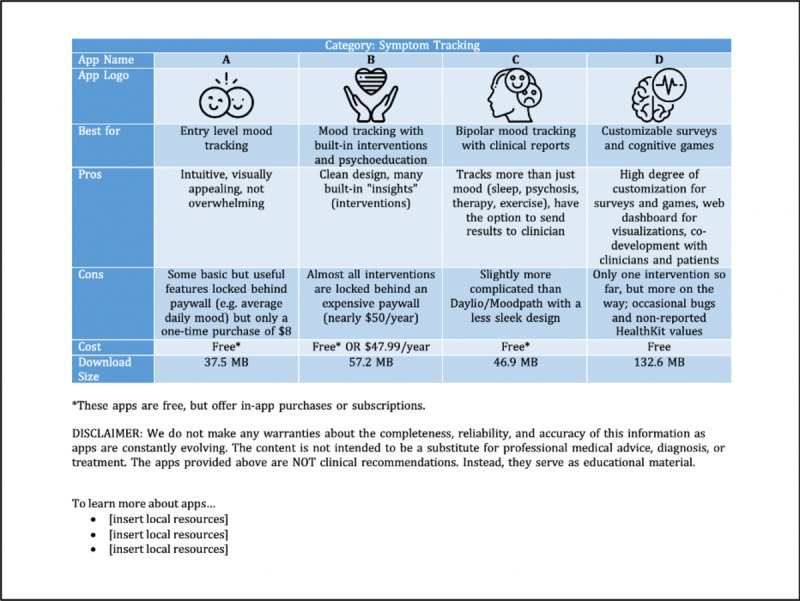
The TEACH-apps process is designed to be broadly usable and widely applicable across all fields of health. The process comprises four parts: (1) preconditions (eg, gathering apps and considering local needs), (2) preimplementation (eg, customizing criteria and offering digital skills training), (3) implementation (eg, evaluating apps and creating educational handouts), and (4) maintenance and evolution (eg, repeating the process every 90 days and updating content). TEACH-apps has been tested internally at our hospital, and there is growing interest in partnering health care facilities to test the system at their sites.
This implementation framework introduces a process that equips stakeholders, clinicians, and users with the foundational tools to make informed decisions around app use and increase app evaluation engagement. The application of this process may lead to the selection of more culturally appropriate and clinically relevant tools in health care.
尽管出现了应用程序评估工具,但仍然没有一个定义明确的流程能够满足各种本地需求、严格的标准和当前的内容。显然,需要这样一个流程来协助在所有医学领域实施应用程序评估。这样的流程有可能增加利益相关者的参与度,并激发他们对当前应用程序评估模型的兴趣和参与度。
本研究旨在开发和试点测试适用于健康类应用程序的技术评估和评估标准(TEACH-apps)。
借鉴一个著名的实施框架——复制有效项目,我们提出了一个新的流程来应对当前实施应用程序评估工具所面临的挑战。作为我们实施这一流程的经验和利益相关者反馈的总结,我们提出了四部分流程来帮助实施移动健康技术。本文概述了该流程的理论、证据和初始版本。
TEACH-apps 流程旨在广泛适用于所有健康领域。该流程包括四个部分:(1)前提条件(例如,收集应用程序并考虑本地需求);(2)实施前(例如,定制标准和提供数字技能培训);(3)实施(例如,评估应用程序并创建教育手册);(4)维护和发展(例如,每 90 天重复该流程并更新内容)。TEACH-apps 已在我们的医院内部进行了测试,并且越来越多的医疗机构有兴趣合作在其场所测试该系统。
这个实施框架引入了一个流程,为利益相关者、临床医生和用户提供了基础工具,使他们能够就应用程序的使用做出明智的决策,并增加应用程序评估的参与度。该流程的应用可能会导致在医疗保健中选择更具文化适应性和更符合临床需求的工具。