Yoon Ye-Seul, Ahn Woo Jung, Ricarte Diadem, Ortiz Darlene, Shin Chan Young, Lee Seung-Jae, Lee He-Jin
Department of Anatomy, Konkuk University, Seoul 05029, Republic of Korea.
Research Institute of Medical Science, Konkuk University, Seoul 05029, Republic of Korea.
Biomol Ther (Seoul). 2021 Jan 1;29(1):83-89. doi: 10.4062/biomolther.2020.081.
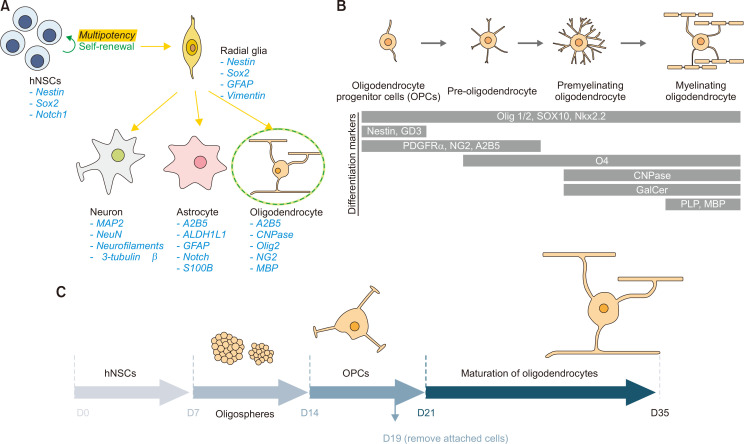
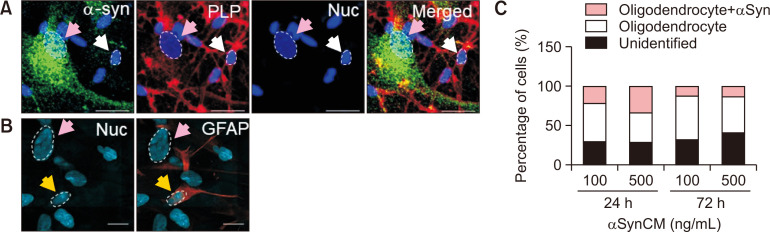
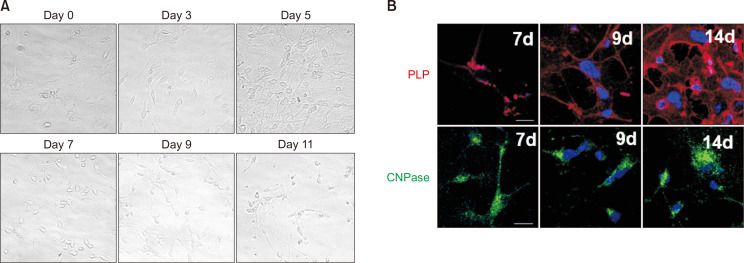
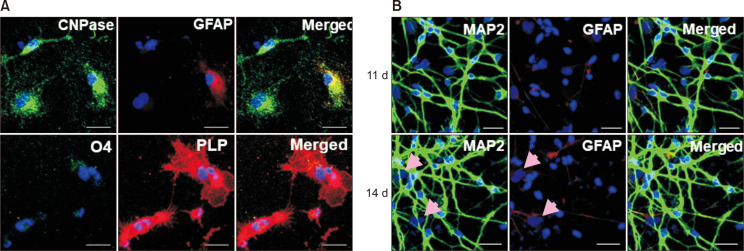
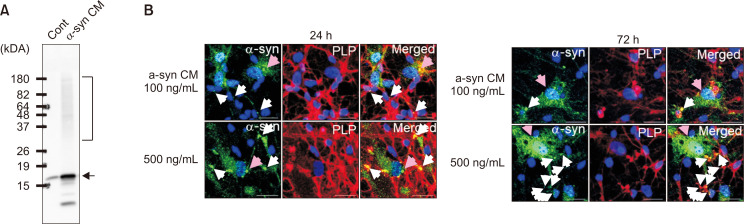
Multiple system atrophy (MSA) is a neurodegenerative disease characterized by presence of α-synuclein-positive inclusions in the cytoplasm of oligodendrocytes. These glial cytoplasmic inclusions (GCIs) are considered an integral part of the pathogenesis of MSA, leading to demyelination and neuronal demise. What is most puzzling in the research fields of GCIs is the origin of α-synuclein aggregates in GCIs, since adult oligodendrocytes do not express high levels of α-synuclein. The most recent leading hypothesis is that GCIs form via transfer and accumulation of α-synuclein from neurons to oligodendrocytes. However, studies regarding this subject are limited due to the absence of proper human cell models, to demonstrate the entry and accumulation of neuronal α-synuclein in human oligodendrocytes. Here, we generated mature human oligodendrocytes that can take up neuronderived α-synuclein and form GCI-like inclusions. Mature human oligodendrocytes are derived from neural stem cells via "oligosphere" formation and then into oligodendrocytes, treating the cells with the proper differentiation factors at each step. In the final cell preparations, oligodendrocytes consist of the majority population, while some astrocytes and unidentified stem cell-like cells were present as well. When these cells were exposed to α-synuclein proteins secreted from neuron-like human neuroblastoma cells, oligodendrocytes developed perinuclear inclusion bodies with α-synuclein immunoreactivity, resembling GCIs, while the stem cell-like cells showed α-synuclein-positive, scattered puncta in the cytoplasm. In conclusion, we have established a human oligodendrocyte model for the study of GCI formation, and the characterization and use of this model might pave the way for understanding the pathogenesis of MSA.
多系统萎缩(MSA)是一种神经退行性疾病,其特征是少突胶质细胞胞质中存在α-突触核蛋白阳性包涵体。这些胶质细胞胞质包涵体(GCIs)被认为是MSA发病机制的一个组成部分,导致脱髓鞘和神经元死亡。在GCIs研究领域最令人困惑的是GCIs中α-突触核蛋白聚集体的起源,因为成年少突胶质细胞不表达高水平的α-突触核蛋白。最近的主要假说是,GCIs通过α-突触核蛋白从神经元向少突胶质细胞的转移和积累而形成。然而,由于缺乏合适的人类细胞模型来证明神经元α-突触核蛋白在人类少突胶质细胞中的进入和积累,关于这个主题的研究有限。在这里,我们生成了能够摄取神经源性α-突触核蛋白并形成类GCI包涵体的成熟人类少突胶质细胞。成熟人类少突胶质细胞通过“寡球”形成从神经干细胞衍生而来,然后分化为少突胶质细胞,在每个步骤用适当的分化因子处理细胞。在最终的细胞制剂中,少突胶质细胞占大多数,同时也存在一些星形胶质细胞和未鉴定的干细胞样细胞。当这些细胞暴露于人类神经母细胞瘤样细胞分泌的α-突触核蛋白时,少突胶质细胞形成了具有α-突触核蛋白免疫反应性的核周包涵体,类似于GCIs,而干细胞样细胞在细胞质中显示α-突触核蛋白阳性的散在点状。总之,我们建立了一个用于研究GCI形成的人类少突胶质细胞模型,该模型的表征和应用可能为理解MSA的发病机制铺平道路。