ISEM, UMR5554, Université de Montpellier, CNRS, IRD, EPHE, Place Eugène Bataillon (cc065), 34095 Montpellier cedex 05, France.
Behavioral Ecology and Sociobiology Unit, German Primate Center, Kellnerweg 4, 37077 Göttingen, Germany.
Sci Adv. 2020 May 27;6(22):eaba3274. doi: 10.1126/sciadv.aba3274. eCollection 2020 May.
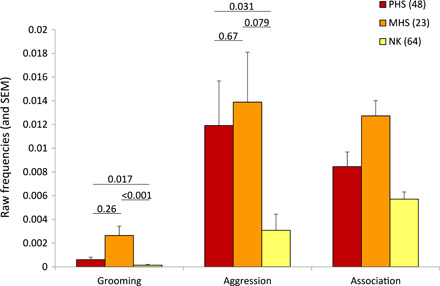
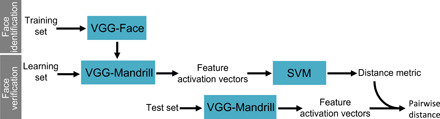
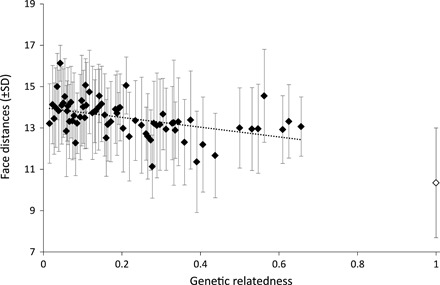
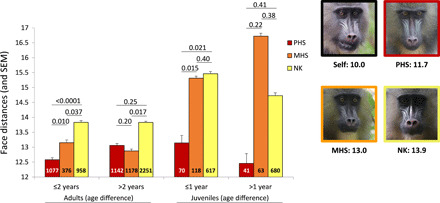
Many animals rely on facial traits to recognize their kin; however, whether these traits have been selected specifically for this function remains unknown. Using deep learning for face recognition, we present the first evidence that interindividual facial resemblance has been selected to signal paternal kinship. Mandrills () live in matrilineal societies, in which females spend their entire lives not only with maternal half-sisters (MHS) but also with paternal half-sisters (PHS). We show that PHS have more differentiated social relationships compared to nonkin, suggesting the existence of kin recognition mechanisms. We further demonstrate that facial resemblance increases with genetic relatedness. However, PHS resemble each other visually more than MHS do, despite both kin categories sharing similar degrees of genetic relatedness. This paternally derived facial resemblance among PHS indicates selection to facilitate kin recognition. This study also highlights the potential of artificial intelligence to study phenotypic evolution.
许多动物依赖面部特征来识别亲属;然而,这些特征是否是专门为这个功能而被选择的,目前还不得而知。我们利用人脸识别的深度学习技术,首次提供了证据表明个体间的面部相似性是为了传递父系亲属关系而被选择的。山魈()生活在母系社会中,雌性不仅一生都与母亲的同父异母姐妹(MHS)生活在一起,而且还与父亲的同父异母姐妹(PHS)生活在一起。我们发现,PHS 与非亲属相比,具有更分化的社会关系,这表明存在亲属识别机制。我们进一步证明,面部相似性与遗传关系密切相关。然而,尽管两个亲属类别都具有相似程度的遗传关系,但 PHS 在视觉上彼此之间的相似性比 MHS 更大。PHS 之间这种来自父亲的面部相似性表明,选择促进了亲属识别。这项研究还突出了人工智能在研究表型进化方面的潜力。