Shirai Shota, Acharya Susant Kumar, Bose Saurabh Kumar, Mallinson Joshua Brian, Galli Edoardo, Pike Matthew D, Arnold Matthew D, Brown Simon Anthony
The MacDiarmid Institute for Advanced Materials and Nanotechnology, School of Physical and Chemical Sciences, Te Kura Matū, University of Canterbury, Christchurch, New Zealand.
Electrical and Electronics Engineering, University of Canterbury, Christchurch, New Zealand.
Netw Neurosci. 2020 Apr 1;4(2):432-447. doi: 10.1162/netn_a_00128. eCollection 2020.
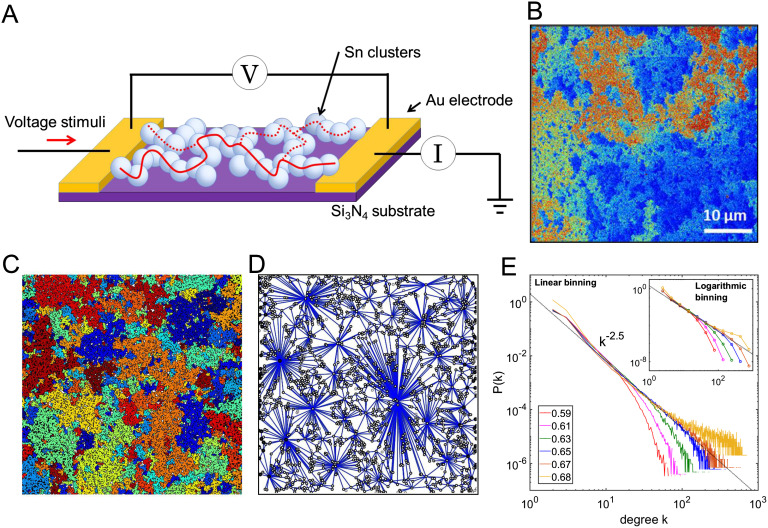
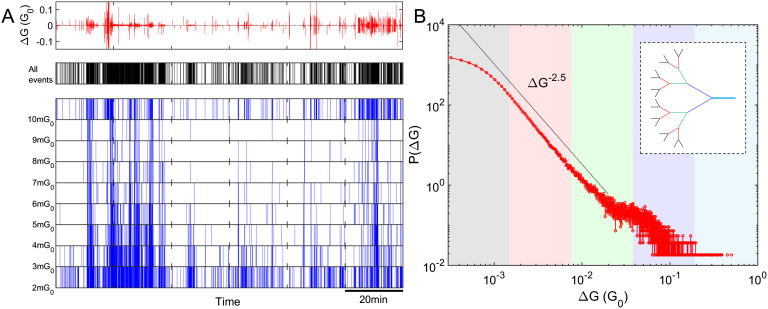
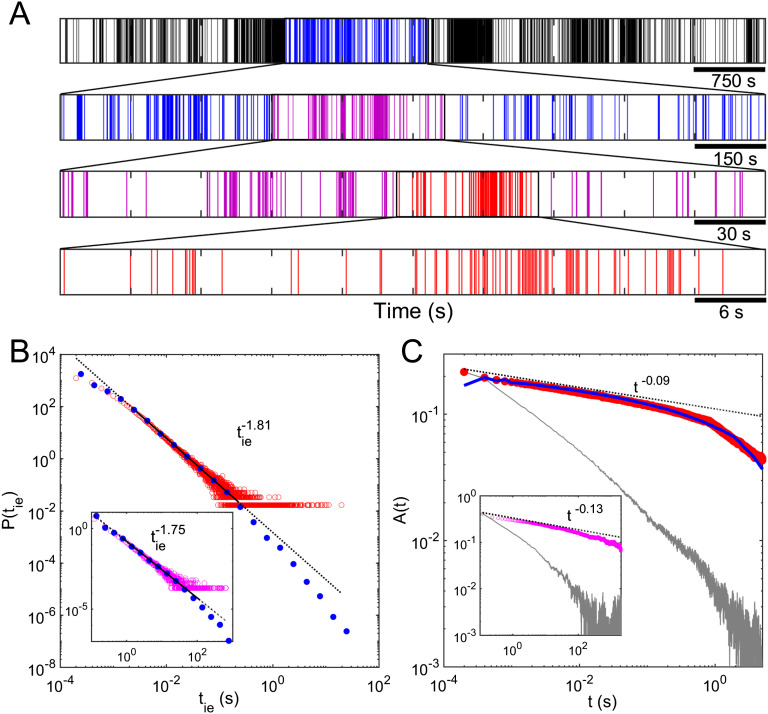
Biological neuronal networks are the computing engines of the mammalian brain. These networks exhibit structural characteristics such as hierarchical architectures, small-world attributes, and scale-free topologies, providing the basis for the emergence of rich temporal characteristics such as scale-free dynamics and long-range temporal correlations. Devices that have both the topological and the temporal features of a neuronal network would be a significant step toward constructing a neuromorphic system that can emulate the computational ability and energy efficiency of the human brain. Here we use numerical simulations to show that percolating networks of nanoparticles exhibit structural properties that are reminiscent of biological neuronal networks, and then show experimentally that stimulation of percolating networks by an external voltage stimulus produces temporal dynamics that are self-similar, follow power-law scaling, and exhibit long-range temporal correlations. These results are expected to have important implications for the development of neuromorphic devices, especially for those based on the concept of reservoir computing.
生物神经网络是哺乳动物大脑的计算引擎。这些网络展现出诸如层次结构、小世界属性和无标度拓扑等结构特征,为无标度动力学和长程时间相关性等丰富时间特征的出现提供了基础。具备神经网络拓扑和时间特征的器件将是朝着构建能够模拟人脑计算能力和能量效率的神经形态系统迈出的重要一步。在此,我们通过数值模拟表明,纳米颗粒的渗流网络展现出类似于生物神经网络的结构特性,然后通过实验表明,外部电压刺激对渗流网络的激发会产生自相似、遵循幂律标度且呈现长程时间相关性的时间动态。这些结果预计将对神经形态器件的发展具有重要意义,尤其是对于那些基于储层计算概念的器件。