School of Traditional Chinese Medicine, Southern Medical University, Guangdong, People's Republic of China.
Tianjin Key Laboratory of Molecular Nuclear Medicine, Institute of Radiation Medicine, Chinese Academy of Medical Sciences and Peking Union Medical College, Tianjin, People's Republic of China.
Emerg Microbes Infect. 2020 Dec;9(1):1609-1617. doi: 10.1080/22221751.2020.1782270.
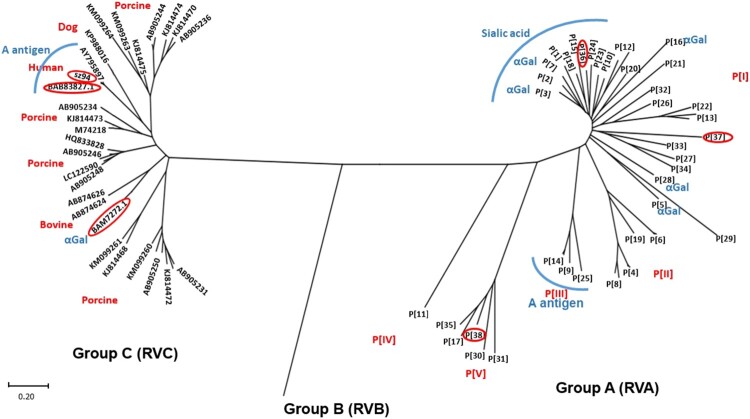
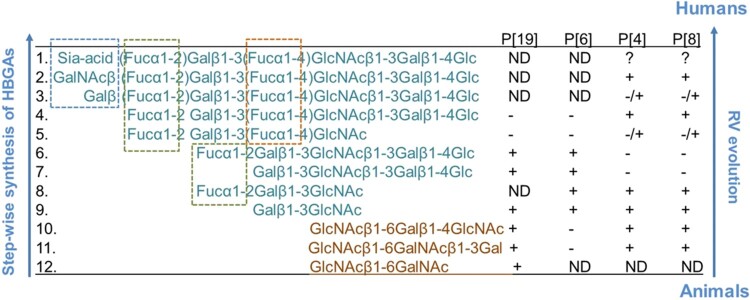
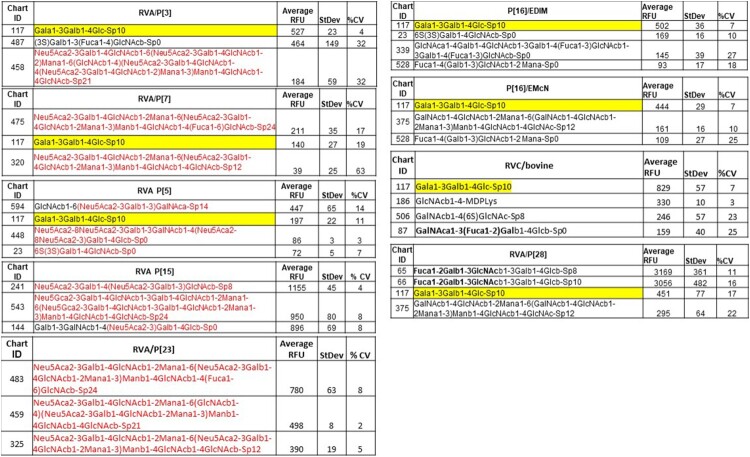
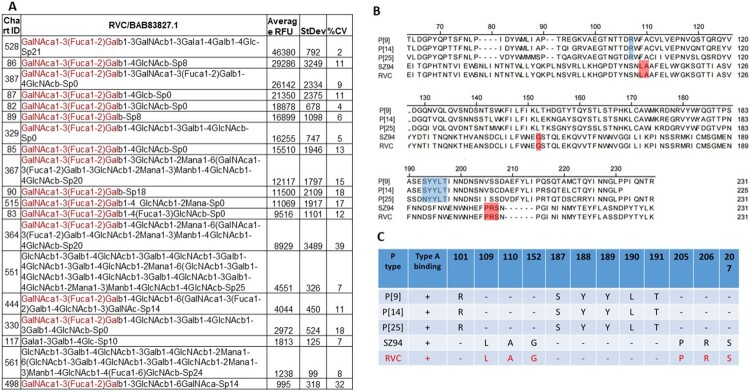
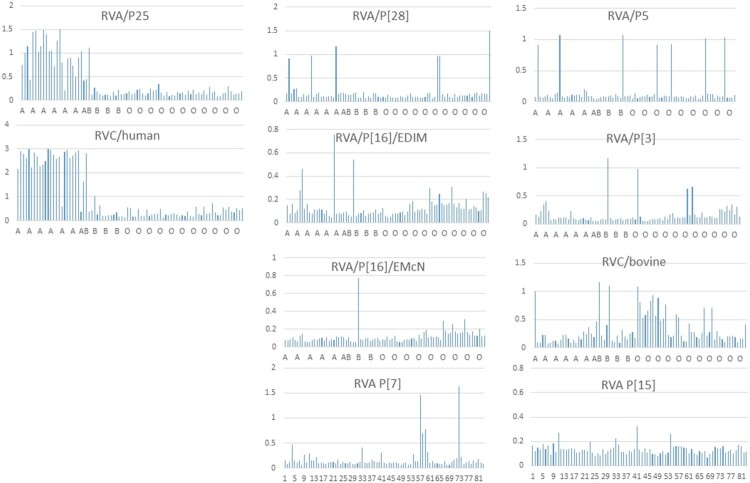
Histo-blood group antigens (HBGAs) have been found to be important host susceptibility factors or receptors for human rotavirus (RVs) with genotype-specific host ranges, impacting the disease patterns, epidemiology, and strategy development against RV diseases in humans. However, how the glycan factors contribute to RV diversity and host ranges to different animal species remains unclear. In this study using recombinant VP8* proteins as probes to perform glycan array analyses of RVs, we observed a wide range of glycan-binding profiles, including those binding to sialic acid-containing glycans, among group A (RVA) and group C (RVC) RVs that mainly infect different animal species. A tri-saccharide glycan Galα1-3Galβ1-4Glc containing a terminal α-Gal was recognised by multiple RVA/RVC genotypes, providing valuable information on RV evolution under selection of the step-wisely synthesised HBGAs in many animals before they were introduced to humans to be human pathogens. Saliva binding studies of VP8* also revealed strain-specific host ranges or species barriers between humans and these animal RV genotypes, further improved our understanding on RV host ranges, disease burdens, epidemiology, and vaccine strategy against RVs.
组织血型抗原(HBGAs)已被发现是人类轮状病毒(RV)的重要宿主易感性因素或受体,具有特定基因型的宿主范围,影响 RV 疾病在人类中的疾病模式、流行病学和策略制定。然而,糖基因素如何导致 RV 多样性和对不同动物物种的宿主范围仍不清楚。在本研究中,我们使用重组 VP8蛋白作为探针,对 RV 进行糖基阵列分析,观察到 A 组(RVA)和 C 组(RVC)RV 之间存在广泛的糖结合谱,包括与含有唾液酸的糖结合,这些 RV 主要感染不同的动物物种。一种含有末端α-Gal 的三糖 Galα1-3Galβ1-4Glc 被多种 RVA/RVC 基因型识别,为 RV 在许多动物中逐步合成 HBGAs 的选择下进化提供了有价值的信息,这些 HBGAs 被引入人类之前是人类病原体。VP8的唾液结合研究还揭示了人类和这些动物 RV 基因型之间的宿主范围或种间屏障的特异性,进一步提高了我们对 RV 宿主范围、疾病负担、流行病学和 RV 疫苗策略的认识。