Aging Institute of University of Pittsburgh and University of Pittsburgh Medical Center, Pittsburgh, PA 15219, USA; Division of Cardiology, Department of Medicine, University of Pittsburgh School of Medicine, Pittsburgh, PA 15219, USA.
Aging Institute of University of Pittsburgh and University of Pittsburgh Medical Center, Pittsburgh, PA 15219, USA.
Cell Host Microbe. 2020 Sep 9;28(3):402-410.e5. doi: 10.1016/j.chom.2020.05.012. Epub 2020 Jun 15.
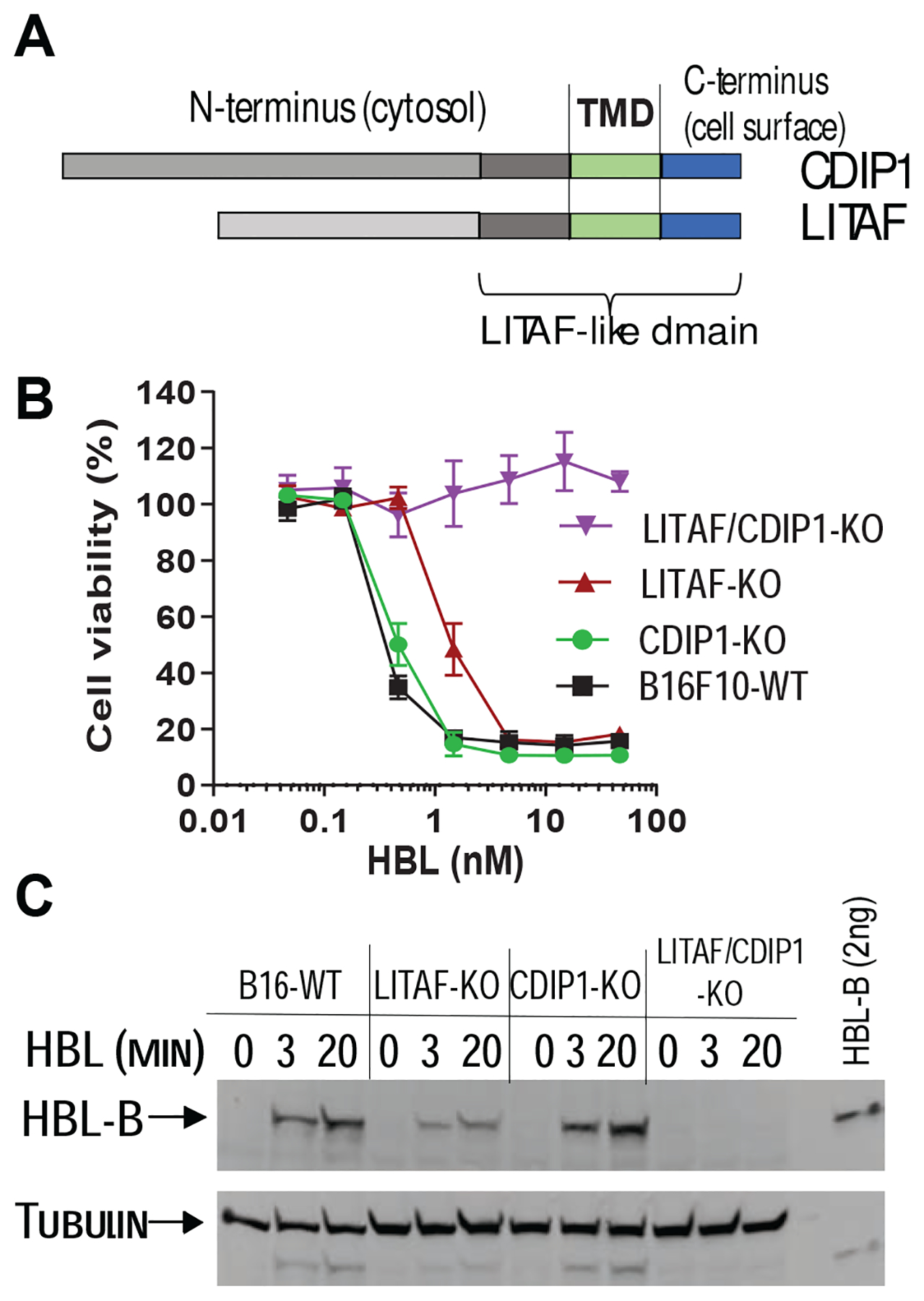
Bacteria and their toxins are associated with significant human morbidity and mortality. While a few bacterial toxins are well characterized, the mechanism of action for most toxins has not been elucidated, thereby limiting therapeutic advances. One such example is the highly potent pore-forming toxin, hemolysin BL (HBL), produced by the gram-positive pathogen Bacillus cereus. However, how HBL exerts its effects and whether it requires any host factors is unknown. Here, we describe an unbiased genome-wide CRISPR-Cas9 knockout screen that identified LPS-induced TNF-α factor (LITAF) as the HBL receptor. Using LITAF-deficient cells, a second, subsequent whole-genome CRISPR-Cas9 screen identified the LITAF-like protein CDIP1 as a second, alternative receptor. We generated LITAF-deficient mice, which exhibit marked resistance to lethal HBL challenges. This work outlines and validates an approach to use iterative genome-wide CRISPR-Cas9 screens to identify the complement of host factors exploited by bacterial toxins to exert their myriad biological effects.
细菌及其毒素与人类发病率和死亡率密切相关。虽然有少数几种细菌毒素已经得到很好的描述,但大多数毒素的作用机制尚未阐明,从而限制了治疗的进展。一种这样的例子是由革兰氏阳性病原体蜡状芽孢杆菌产生的高度有效的成孔毒素溶血素 BL(HBL)。然而,HBL 如何发挥作用以及它是否需要任何宿主因素尚不清楚。在这里,我们描述了一种无偏见的全基因组 CRISPR-Cas9 敲除筛选,该筛选确定脂多糖诱导的 TNF-α 因子 (LITAF) 是 HBL 的受体。使用 LITAF 缺陷细胞,进行了第二次全基因组 CRISPR-Cas9 筛选,确定 LITAF 样蛋白 CDIP1 为第二个替代受体。我们生成了 LITAF 缺陷型小鼠,这些小鼠对致死性 HBL 挑战表现出明显的抗性。这项工作概述并验证了一种使用迭代全基因组 CRISPR-Cas9 筛选来鉴定细菌毒素利用宿主因子发挥其多种生物学效应的方法。