Department of Health Technology and Informatics, The Hong Kong Polytechnic University, Hong Kong, China.
Int J Mol Sci. 2020 Jun 11;21(11):4184. doi: 10.3390/ijms21114184.
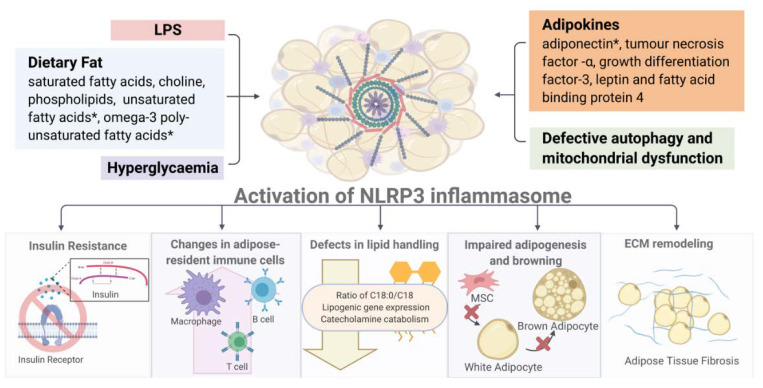
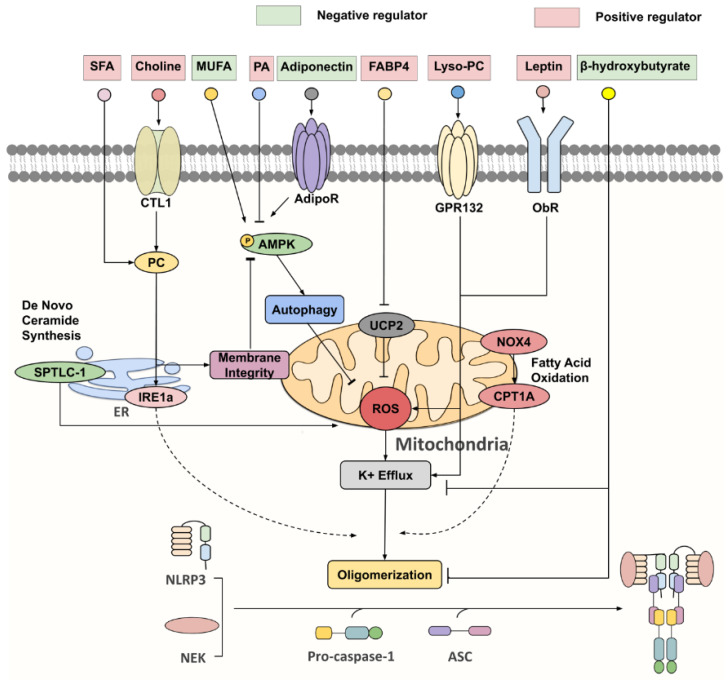
Adipose tissue is an active endocrine and immune organ that controls systemic immunometabolism via multiple pathways. Diverse immune cell populations reside in adipose tissue, and their composition and immune responses vary with nutritional and environmental conditions. Adipose tissue dysfunction, characterized by sterile low-grade chronic inflammation and excessive immune cell infiltration, is a hallmark of obesity, as well as an important link to cardiometabolic diseases. Amongst the pro-inflammatory factors secreted by the dysfunctional adipose tissue, interleukin (IL)-1β, induced by the NLR family pyrin domain-containing 3 (NLRP3) inflammasome, not only impairs peripheral insulin sensitivity, but it also interferes with the endocrine and immune functions of adipose tissue in a paracrine manner. Human studies indicated that NLRP3 activity in adipose tissues positively correlates with obesity and its metabolic complications, and treatment with the IL-1β antibody improves glycaemia control in type 2 diabetic patients. In mouse models, genetic or pharmacological inhibition of NLRP3 activation pathways or IL-1β prevents adipose tissue dysfunction, including inflammation, fibrosis, defective lipid handling and adipogenesis, which in turn alleviates obesity and its related metabolic disorders. In this review, we summarize both the negative and positive regulators of NLRP3 inflammasome activation, and its pathophysiological consequences on immunometabolism. We also discuss the potential therapeutic approaches to targeting adipose tissue inflammasome for the treatment of obesity and its related metabolic disorders.
脂肪组织是一种活跃的内分泌和免疫器官,通过多种途径控制全身免疫代谢。多种免疫细胞群存在于脂肪组织中,其组成和免疫反应随营养和环境条件而变化。脂肪组织功能障碍的特征是无菌性低度慢性炎症和过度的免疫细胞浸润,这是肥胖的标志,也是与代谢性心血管疾病的重要联系。在功能失调的脂肪组织分泌的促炎因子中,NLR 家族吡喃结构域包含 3(NLRP3)炎性小体诱导的白细胞介素(IL)-1β不仅损害外周胰岛素敏感性,而且还以旁分泌方式干扰脂肪组织的内分泌和免疫功能。人体研究表明,脂肪组织中 NLRP3 的活性与肥胖及其代谢并发症呈正相关,并且使用 IL-1β 抗体治疗可改善 2 型糖尿病患者的血糖控制。在小鼠模型中,NLRP3 激活途径或 IL-1β 的遗传或药理学抑制可防止脂肪组织功能障碍,包括炎症、纤维化、脂质处理和脂肪生成缺陷,从而减轻肥胖及其相关代谢紊乱。在这篇综述中,我们总结了 NLRP3 炎性小体激活的正负调节剂及其对免疫代谢的病理生理后果。我们还讨论了针对脂肪组织炎性小体治疗肥胖及其相关代谢紊乱的潜在治疗方法。