Division of Psychology and Mental Health, School of Health Sciences, Manchester Academic Health Sciences Centre, University of Manchester, Coupland Building 1, Oxford Road, Manchester, M13 9PL, UK.
Greater Manchester Mental Health NHS Trust (formerly Manchester Mental Health and Social Care Trust), Manchester, UK.
BMC Psychiatry. 2020 Jun 16;20(1):306. doi: 10.1186/s12888-020-02697-8.
Suicide is a leading cause of death globally. Suicide deaths are elevated in those experiencing severe mental health problems, including schizophrenia. Psychological talking therapies are a potentially effective means of alleviating suicidal thoughts, plans, and attempts. However, talking therapies need to i) focus on suicidal experiences directly and explicitly, and ii) be based on testable psychological mechanisms. The Cognitive AppRoaches to coMbatting Suicidality (CARMS) project is a Randomised Controlled Trial (RCT) which aims to investigate both the efficacy and the underlying mechanisms of a psychological talking therapy for people who have been recently suicidal and have non-affective psychosis.
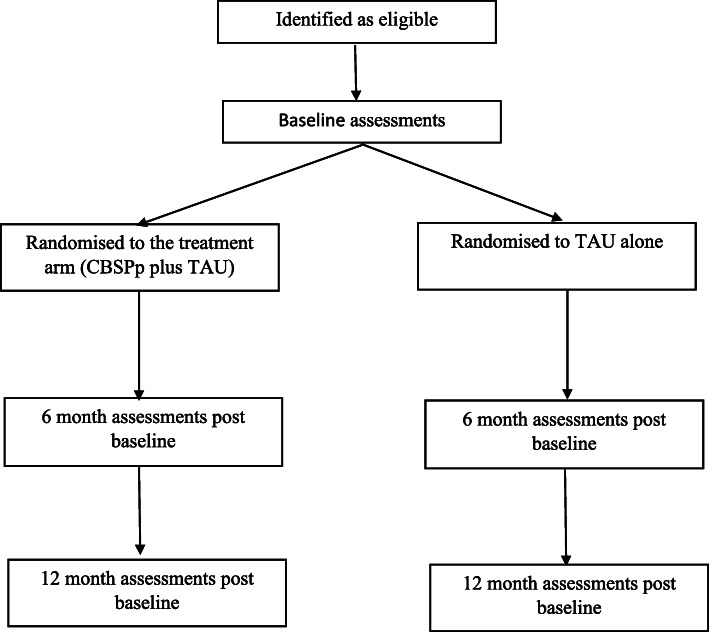
The CARMS trial is a two-armed single-blind RCT comparing a psychological talking therapy (Cognitive Behavioural Suicide Prevention for psychosis [CBSPp]) plus Treatment As Usual (TAU) with TAU alone. There are primary and secondary suicidality outcome variables, plus mechanistic, clinical, and health economic outcomes measured over time. The primary outcome is a measure of suicidal ideation at 6 months after baseline. The target sample size is 250, with approximately 125 randomised to each arm of the trial, and an assumption of up to 25% attrition. Hence, the overall recruitment target is up to 333. An intention to treat analysis will be used with primary stratification based on National Health Service (NHS) recruitment site and antidepressant prescription medication. Recruitment will be from NHS mental health services in the North West of England, UK. Participants must be 18 or over; be under the care of mental health services; have mental health problems which meet ICD-10 non-affective psychosis criteria; and have experienced self-reported suicidal thoughts, plans, and/or attempts in the 3 months prior to recruitment. Nested qualitative work will investigate the pathways to suicidality, experiences of the therapy, and identify potential implementation challenges beyond a trial setting as perceived by numerous stake-holders.
This trial has important implications for countering suicidal experiences for people with psychosis. It will provide definitive evidence about the efficacy of the CBSPp therapy; the psychological mechanisms which lead to suicidal experiences; and provide an understanding of what is required to implement the intervention into services should it be efficacious.
ClinicalTrials.gov (NCT03114917), 14th April 2017. ISRCTN (reference ISRCTN17776666 https://doi.org/10.1186/ISRCTN17776666); 5th June 2017). Registration was recorded prior to participant recruitment commencing.
自杀是全球范围内主要的死亡原因之一。在经历严重精神健康问题的人群中,自杀死亡人数上升,包括精神分裂症。心理谈话疗法是一种缓解自杀念头、计划和尝试的潜在有效方法。然而,谈话疗法需要:i)直接、明确地关注自杀经历,ii)基于可测试的心理机制。认知方法来对抗自杀(CARMS)项目是一项随机对照试验(RCT),旨在调查一种针对最近有自杀念头且患有非情感性精神病的人的心理谈话疗法的疗效和潜在机制。
CARMS 试验是一项双臂单盲 RCT,比较了心理谈话疗法(针对精神病的认知行为自杀预防[CBSPp])加常规治疗(TAU)与单独 TAU。有主要和次要自杀结局变量,以及随时间测量的机制、临床和健康经济学结局。主要结局是基线后 6 个月时自杀意念的测量。目标样本量为 250 例,每组约 125 例随机分配,假设失访率高达 25%。因此,总的招募目标是 333 例。将采用意向治疗分析,主要分层基于国家卫生服务(NHS)招募地点和抗抑郁药物处方。招募将在英国西北部的 NHS 心理健康服务中进行。参与者必须年满 18 岁;在心理健康服务机构的照顾下;有符合 ICD-10 非情感性精神病标准的精神健康问题;并且在招募前 3 个月内有自我报告的自杀念头、计划和/或尝试。嵌套的定性研究将调查自杀的途径、治疗的体验,并确定潜在的实施挑战,这些挑战被众多利益攸关者认为超出了试验环境。
这项试验对对抗精神病患者的自杀经历具有重要意义。它将提供关于 CBSPp 疗法疗效的明确证据;导致自杀经历的心理机制;并提供了解实施干预措施所需的信息,如果该干预措施有效,则应将其纳入服务。
ClinicalTrials.gov(NCT03114917),2017 年 4 月 14 日。ISRCTN(参考 ISRCTN17776666 https://doi.org/10.1186/ISRCTN17776666);2017 年 6 月 5 日)。注册记录在参与者招募开始之前。