Bai Hua, Chen Bing
Department of Hematology, The Affiliated Drum Tower Hospital of Nanjing University Medical School, Nanjing 210008, People's Republic of China.
Onco Targets Ther. 2020 May 18;13:4339-4348. doi: 10.2147/OTT.S249895. eCollection 2020.
Risk stratification in patients with multiple myeloma (MM) remains a challenge. As clinicopathological characteristics have been demonstrated insufficient for exactly defining MM risk, and molecular biomarkers have become the focuses of interests. Prognostic predictions based on gene expression profiles (GEPs) have been the most accurate to this day. The purpose of our study was to construct a risk score based on stemness genes to evaluate the prognosis in MM.
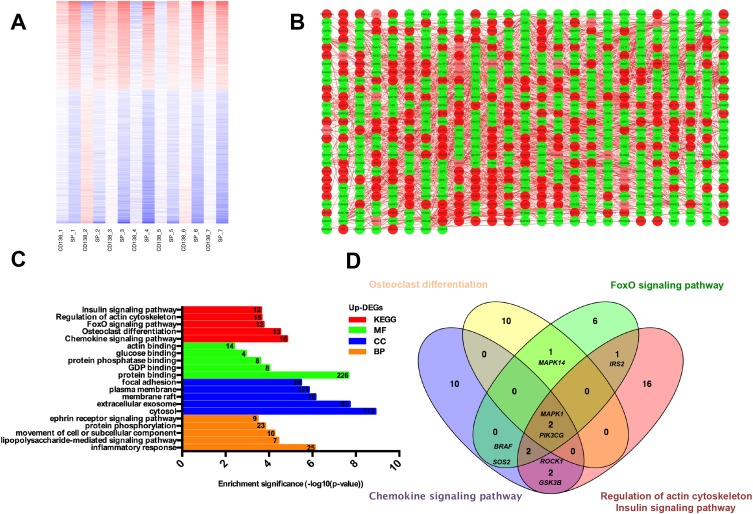
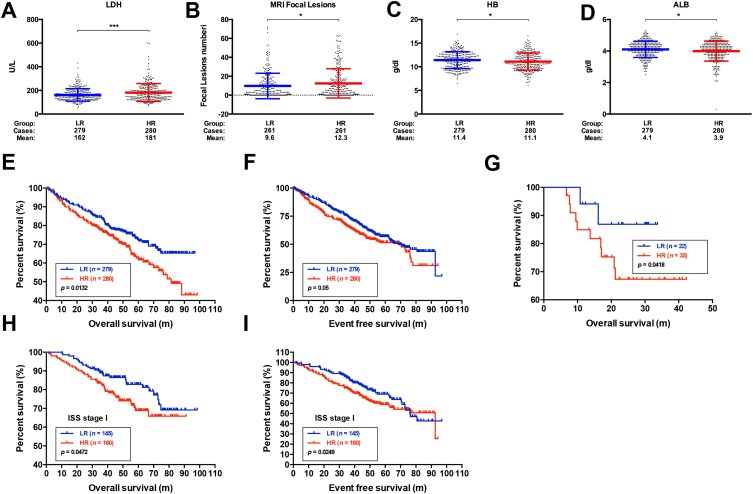
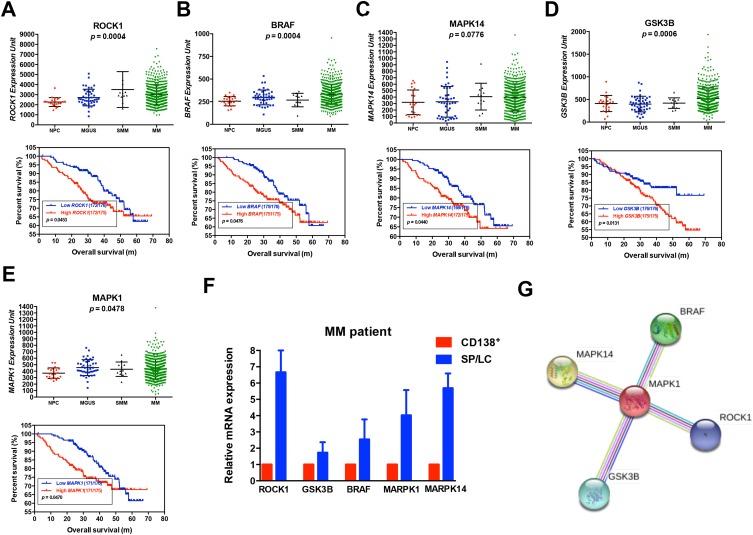
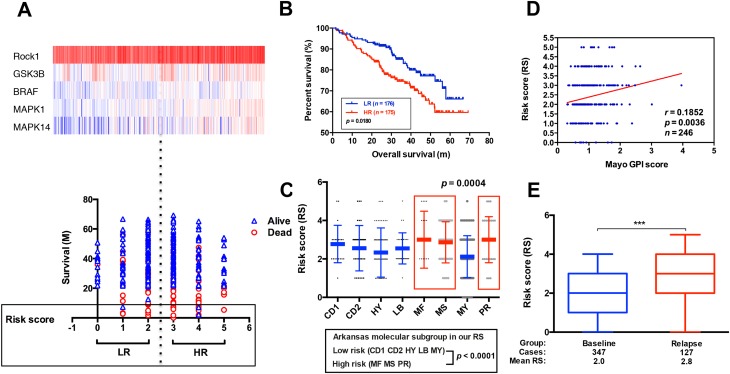
Bioinformatics studies by ingenuity pathway analyses in side population (SP) and non-SP (MP) cells of MM patients were performed. Firstly, co-expression network was built to confirm hub genes associated with the top five Kyoto Encyclopedia of Genes and Genomes pathways. Functional analyses of hub genes were used to confirm the biologic functions. Next, these selective genes were utilized for construction of prognostic model, and this model was validated in independent testing sets. Finally, five stemness genes ( and ) were used to build a MM side population 5 (MMSP5) gene model, which was demonstrated to be forcefully prognostic compared to usual clinical prognostic parameters by multivariate cox analysis. MM patients in MMSP5 low-risk group were significantly related to better prognosis than those in high-risk group in independent testing sets.
Our study provided proof-of-concept that MMSP5 model can be adopted to evaluate recurrence risk and clinical outcome for MM. The MMSP5 model evaluated in different databases clearly indicated novel risk stratification for personalized anti-MM treatments.
多发性骨髓瘤(MM)患者的风险分层仍然是一项挑战。由于临床病理特征已被证明不足以准确界定MM风险,分子生物标志物已成为研究热点。基于基因表达谱(GEP)的预后预测至今最为准确。我们研究的目的是构建一个基于干性基因的风险评分来评估MM的预后。
通过对MM患者的侧群(SP)细胞和非侧群(MP)细胞进行 Ingenuity 通路分析进行生物信息学研究。首先,构建共表达网络以确认与京都基因与基因组百科全书(KEGG)前五条通路相关的枢纽基因。对枢纽基因进行功能分析以确认其生物学功能。接下来,利用这些筛选出的基因构建预后模型,并在独立测试集中进行验证。最后,使用五个干性基因构建了一个MM侧群5(MMSP5)基因模型,通过多变量cox分析证明,与常用的临床预后参数相比,该模型具有很强的预后预测能力。在独立测试集中,MMSP5低风险组的MM患者预后明显优于高风险组。
我们的研究提供了概念验证,即MMSP5模型可用于评估MM的复发风险和临床结局。在不同数据库中评估的MMSP5模型明确显示了用于个性化抗MM治疗的新风险分层。