Vanderbilt-Ingram Cancer Center, Vanderbilt University Medical Center, Nashville, TN.
Department of Medicine, Vanderbilt University Medical Center, Nashville, TN.
Tomography. 2020 Jun;6(2):170-176. doi: 10.18383/j.tom.2020.00002.
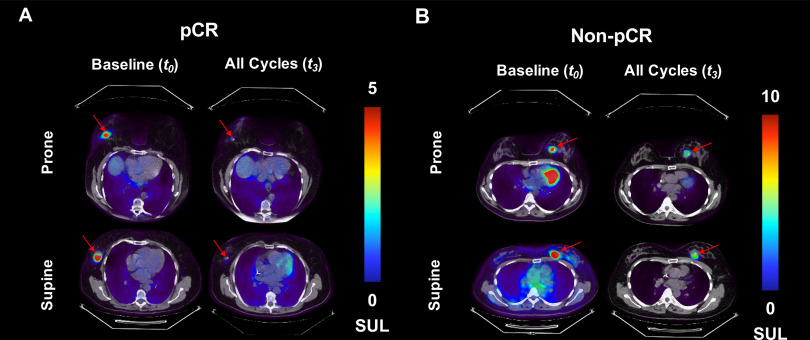
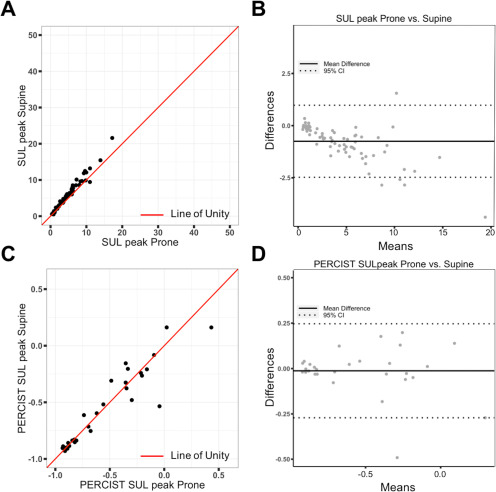
Positron emission tomography (PET) is typically performed in the supine position. However, breast magnetic resonance imaging (MRI) is performed in prone, as this improves visibility of deep breast tissues. With the emergence of hybrid scanners that integrate molecular information from PET and functional information from MRI, it is of great interest to determine if the prognostic utility of prone PET is equivalent to supine. We compared PERCIST (PET Response Criteria in Solid Tumors) measurements between prone and supine FDG-PET in patients with breast cancer and the effect of orientation on predicting pathologic complete response (pCR). In total, 47 patients were enrolled and received up to 6 cycles of neoadjuvant therapy. Prone and supine FDG-PET were performed at baseline ( ; n = 46), after cycle 1 ( ; n = 1) or 2 ( ; n = 10), or after all neoadjuvant therapy ( ; n = 19). FDG uptake was quantified by maximum and peak standardized uptake value () with and without normalization to lean body mass; that is, , , , and . PERCIST measurements were performed for each paired baseline and post-treatment scan. Receiver operating characteristic analysis for the prediction of pCR was performed using logistic regression that included age and tumor size as covariates. and metrics were significantly different between orientation ( < .001), but were highly correlated ( > .98). Importantly, no differences were observed with the PERCIST measurements ( > .6). Overlapping 95% confidence intervals for the receiver operating characteristic analysis suggested no difference at predicting pCR. Therefore, prone and supine PERCIST in this data set were not statistically different.
正电子发射断层扫描(PET)通常在仰卧位进行。然而,由于俯卧位可改善深部乳房组织的可视性,故乳房磁共振成像(MRI)采用俯卧位。随着将 PET 的分子信息与 MRI 的功能信息相结合的混合扫描仪的出现,确定俯卧位 PET 的预后效用是否与仰卧位相当具有重要意义。我们比较了乳腺癌患者俯卧位和仰卧位 FDG-PET 的 PERCIST(实体瘤疗效评价标准)测量值,以及体位对预测病理完全缓解(pCR)的影响。共有 47 名患者入组,并接受了最多 6 个周期的新辅助治疗。在基线时(n = 46)、第 1 周期后(n = 1)、第 2 周期后(n = 10)或所有新辅助治疗后(n = 19)进行了俯卧位和仰卧位 FDG-PET。通过最大和峰值标准化摄取值(SUV)来量化 FDG 摄取,且无需对瘦体重进行归一化,即 、 、 、 。对每对基线和治疗后扫描进行 PERCIST 测量。使用包含年龄和肿瘤大小作为协变量的逻辑回归进行 pCR 预测的受试者工作特征分析。 和 指标在体位之间存在显著差异( <.001),但具有高度相关性( >.98)。重要的是,PERCIST 测量值没有差异( >.6)。接收器操作特征分析的 95%置信区间重叠表明,在预测 pCR 方面没有差异。因此,在该数据集的俯卧位和仰卧位 PERCIST 没有统计学差异。