Mardle Charlotte E, Goddard Layla R, Spelman Bailei C, Atkins Helen S, Butt Louise E, Cox Paul A, Gowers Darren M, Vincent Helen A, Callaghan Anastasia J
School of Biological Sciences and Institute of Biological and Biomedical Sciences, University of Portsmouth, Portsmouth, PO1 2DY, United Kingdom.
Defence Science and Technology Laboratory, Porton Down, Salisbury, United Kingdom.
Biochem Biophys Rep. 2020 Jun 9;23:100773. doi: 10.1016/j.bbrep.2020.100773. eCollection 2020 Sep.
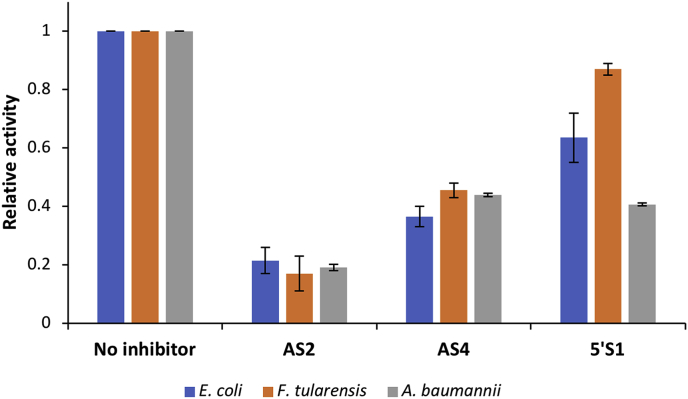
Increasing resistance of bacteria to antibiotics is a serious global challenge and there is a need to unlock the potential of novel antibacterial targets. One such target is the essential prokaryotic endoribonuclease RNase E. Using a combination of high-throughput screening and validation we have identified three novel small molecule inhibitors of RNase E that are active against RNase E from , and . Two of the inhibitors are non-natural small molecules that could be suitable as lead compounds for the development of broad-spectrum antibiotics targeting RNase E. The third small molecule inhibitor is glucosamine-6-phosphate, a precursor of bacterial cell envelope peptidoglycans and lipopolysaccharides, hinting at a novel metabolite-mediated mechanism of regulation of RNase E.
细菌对抗生素的耐药性不断增强是一个严峻的全球挑战,因此有必要挖掘新型抗菌靶点的潜力。其中一个这样的靶点是必需的原核内切核糖核酸酶RNase E。通过高通量筛选和验证相结合的方法,我们鉴定出了三种新型的RNase E小分子抑制剂,它们对来自[具体来源1]、[具体来源2]和[具体来源3]的RNase E具有活性。其中两种抑制剂是非天然小分子,有望作为开发靶向RNase E的广谱抗生素的先导化合物。第三种小分子抑制剂是6-磷酸葡萄糖胺,它是细菌细胞壁肽聚糖和脂多糖的前体,这暗示了一种新型的代谢物介导的RNase E调控机制。