Division of Clinical Epidemiology and Aging Research, German Cancer Research Center (DKFZ), Im Neuenheimer Feld 581, 69120, Heidelberg, Germany.
Medical Faculty Heidelberg, University of Heidelberg, Im Neuenheimer Feld 672, 69120, Heidelberg, Germany.
Clin Epigenetics. 2020 Jun 18;12(1):89. doi: 10.1186/s13148-020-00872-y.
Risk stratification for lung cancer (LC) screening is so far mostly based on smoking history. This study aimed to assess if and to what extent such risk stratification could be enhanced by additional consideration of genetic risk scores (GRSs) and epigenetic risk scores defined by DNA methylation.
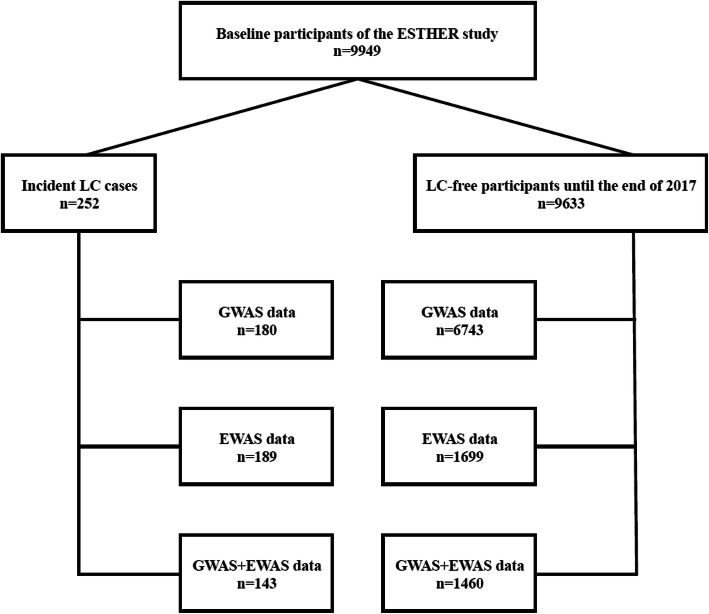
We conducted a nested case-control study of 143 incident LC cases and 1460 LC-free controls within a prospective cohort of 9949 participants aged 50-75 years with 14-year follow-up. Lifetime smoking history was obtained in detail at recruitment. We built a GRS based on 31 previously identified LC-associated single-nucleotide polymorphisms (SNPs) and a DNA methylation score (MRS) based on methylation of 151 previously identified smoking-associated cytosine-phosphate-guanine (CpG) loci. We evaluated associations of GRS and MRS with LC incidence by logistic regression models, controlling for age, sex, smoking status, and pack-years. We compared the predictive performance of models based on pack-years alone with models additionally including GRS and/or MRS using the area under the receiver operating characteristic curve (AUC), net reclassification improvement (NRI), and integrated discrimination improvement (IDI).
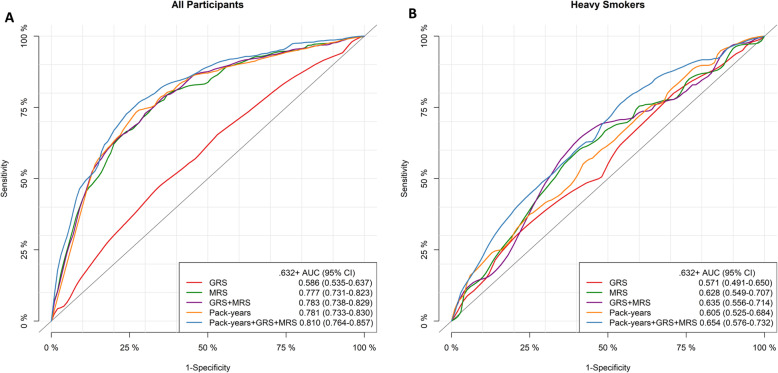
GRS and MRS showed moderate and strong associations with LC risk even after comprehensive adjustment for smoking history (adjusted odds ratio [95% CI] comparing highest with lowest quartile 1.93 [1.05-3.71] and 5.64 [2.13-17.03], respectively). Similar associations were also observed within the risk groups of ever and heavy smokers. Addition of GRS and MRS furthermore strongly enhanced LC prediction beyond prediction by pack-years (increase of optimism-corrected AUC among heavy smokers from 0.605 to 0.654, NRI 26.7%, p = 0.0106, IDI 3.35%, p = 0.0036), the increase being mostly attributable to the inclusion of MRS.
Consideration of MRS, by itself or in combination with GRS, may strongly enhance LC risk stratification.
肺癌(LC)筛查的风险分层迄今为止主要基于吸烟史。本研究旨在评估在多大程度上可以通过考虑遗传风险评分(GRS)和 DNA 甲基化定义的表观遗传风险评分来增强这种风险分层。
我们对 9949 名年龄在 50-75 岁的参与者进行了一项前瞻性队列的嵌套病例对照研究,其中包括 143 例新发 LC 病例和 1460 例 LC 无病例。在招募时详细获得了终生吸烟史。我们基于 31 个先前确定的与 LC 相关的单核苷酸多态性(SNP)构建了 GRS,并基于先前确定的 151 个与吸烟相关的胞嘧啶磷酸鸟嘌呤(CpG)位点的甲基化构建了 MRS。我们使用逻辑回归模型,在控制年龄、性别、吸烟状态和吸烟包年数的情况下,评估了 GRS 和 MRS 与 LC 发病率的相关性。我们使用接收者操作特征曲线(ROC)下的面积(AUC)、净重新分类改善(NRI)和综合判别改善(IDI)来比较仅基于吸烟包年数的模型与额外纳入 GRS 和/或 MRS 的模型的预测性能。
即使在综合调整吸烟史后,GRS 和 MRS 与 LC 风险也存在中度和强关联(最高与最低四分位数比较的调整后比值比[95%CI]分别为 1.93[1.05-3.71]和 5.64[2.13-17.03])。在曾经吸烟者和重度吸烟者的风险组中也观察到类似的关联。GRS 和 MRS 的加入也大大提高了 LC 预测的准确性,超过了吸烟包年数的预测(重度吸烟者的校正 AUC 从 0.605 增加到 0.654,NRI 26.7%,p=0.0106,IDI 3.35%,p=0.0036),这种增加主要归因于 MRS 的纳入。
考虑 MRS 本身或与 GRS 联合使用可能会大大增强 LC 风险分层。