Department of Medicinal Chemistry, University of Washington, Seattle, Washington, USA.
Department of Chemistry, University of Georgia, Athens, Georgia, USA.
mSphere. 2020 Jun 17;5(3):e00339-20. doi: 10.1128/mSphere.00339-20.
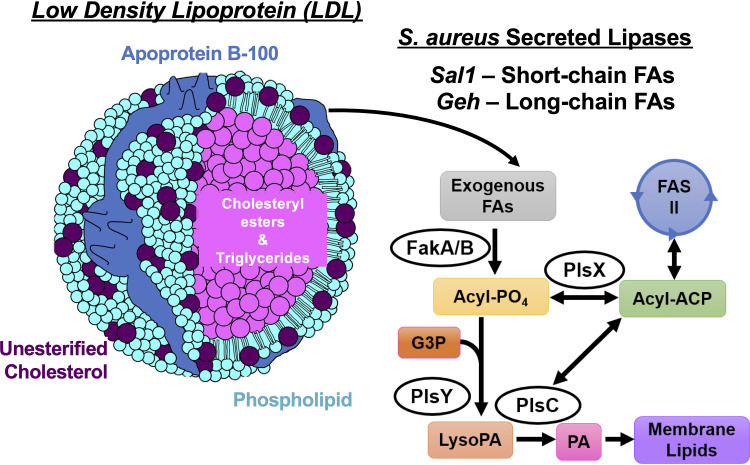
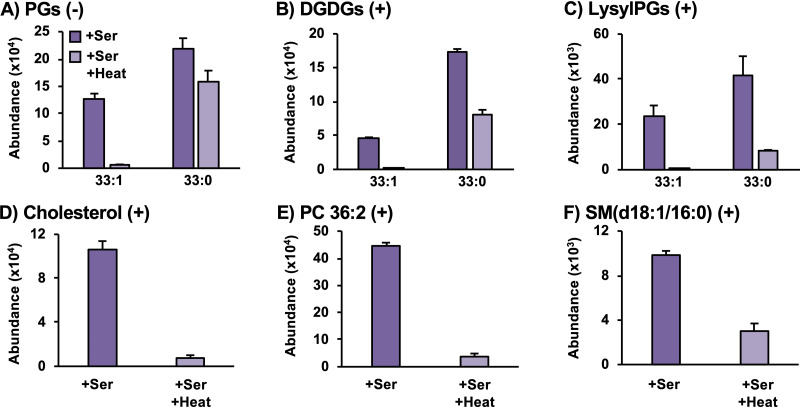
can incorporate exogenous straight-chain unsaturated and saturated fatty acids (SCUFAs and SCFAs, respectively) to replace some of the normally biosynthesized branched-chain fatty acids and SCFAs. In this study, the impact of human serum on the lipidome and cell envelope structure was comprehensively characterized. When was grown in the presence of 20% human serum, typical human serum lipids, such as cholesterol, sphingomyelin, phosphatidylethanolamines, and phosphatidylcholines, were present in the total lipid extracts. Mass spectrometry showed that SCUFAs were incorporated into all major lipid classes, i.e., phosphatidylglycerols, lysyl-phosphatidylglycerols, cardiolipins, and diglucosyldiacylglycerols. Heat-killed retained fewer serum lipids and failed to incorporate SCUFAs, suggesting that association and incorporation of serum lipids with require a living or nondenatured cell. Cytoplasmic membranes isolated from lysostaphin-produced protoplasts of serum-grown cells retained serum lipids, but washing cells with Triton X-100 removed most of them. Furthermore, electron microscopy studies showed that serum-grown cells had thicker cell envelopes and associated material on the surface, which was partially removed by Triton X-100 washing. To investigate which serum lipids were preferentially hydrolyzed by lipases for incorporation, we incubated individual serum lipid classes with and found that cholesteryl esters (CEs) and triglycerides (TGs) are the major donors of the incorporated fatty acids. Further experiments using purified Geh lipase confirmed that CEs and TGs were the substrates of this enzyme. Thus, growth in the presence of serum altered the nature of the cell surface with implications for interactions with the host. Comprehensive lipidomics of grown in the presence of human serum suggests that human serum lipids can associate with the cell envelope without being truly integrated into the lipid membrane. However, fatty acids derived from human serum lipids, including unsaturated fatty acids, can be incorporated into lipid classes that can be biosynthesized by itself. Cholesteryl esters and triglycerides are found to be the major source of incorporated fatty acids upon hydrolysis by lipases. These findings have significant implications for the nature of the cell surface when grown Changes in phospholipid and glycolipid abundances and fatty acid composition could affect membrane biophysics and function and the activity of membrane-targeting antimicrobials. Finally, the association of serum lipids with the cell envelope has implications for the physicochemical nature of the cell surface and its interaction with host defense systems.
可以掺入外源性直链不饱和和饱和脂肪酸(分别为 SCUFA 和 SCFA),以替代一些正常生物合成的支链脂肪酸和 SCFA。在这项研究中,全面表征了人血清对脂质组和细胞包膜结构的影响。当在存在 20%人血清的情况下生长时,总脂质提取物中存在典型的人血清脂质,例如胆固醇,神经鞘磷脂,磷脂酰乙醇胺和磷脂酰胆碱。质谱分析表明,SCUFA 掺入所有主要的脂质类,即磷脂酰甘油,赖氨酸磷酸化磷脂酰甘油,心磷脂和双葡萄糖基二酰基甘油。热灭活的保留较少的血清脂质并且不能掺入 SCUFA,表明与血清脂质的关联和掺入需要活细胞或非变性细胞。从溶葡萄球菌素产生的原生质体分离的细胞质膜保留了血清脂质,但用 Triton X-100 洗涤细胞可除去大部分脂质。此外,电子显微镜研究表明,血清培养的细胞的细胞质膜更厚,表面上有相关物质,用 Triton X-100 洗涤可部分除去。为了研究哪些血清脂质被葡萄球菌属的脂肪酶优先水解以进行掺入,我们将各个血清脂质类与一起孵育,并发现胆固醇酯(CEs)和三酰基甘油(TGs)是掺入脂肪酸的主要供体。使用纯化的 Geh 脂肪酶进行的进一步实验证实,CEs 和 TGs 是该酶的底物。因此,在存在血清的情况下生长会改变细胞表面的性质,从而影响与宿主的相互作用。在存在人血清的情况下生长的全面脂质组学表明,人血清脂质可以与细胞包膜结合,而无需真正整合到脂质膜中。但是,衍生自人血清脂质的脂肪酸,包括不饱和脂肪酸,可以掺入本身可以生物合成的脂质类中。通过脂肪酶水解发现,CEs 和 TGs 是掺入脂肪酸的主要来源。这些发现对于在生长时葡萄球菌属细胞表面的性质具有重要意义。磷脂和糖脂丰度和脂肪酸组成的变化可能会影响膜生物物理学和功能以及靶向膜的抗菌药物的活性。最后,血清脂质与细胞包膜的关联会影响细胞表面的物理化学性质及其与宿主防御系统的相互作用。