Laboratory of Regenerative Orthopaedics, Department of Orthopaedic and Trauma Surgery, Campus Bio-Medico University of Rome, Via Alvaro del Portillo 200, 00128 Rome, Italy.
Department of Endocrinology and Diabetes, Campus Bio-Medico University of Rome, Via Alvaro del Portillo 200, 00128 Rome, Italy.
Cells. 2020 Jun 17;9(6):1478. doi: 10.3390/cells9061478.
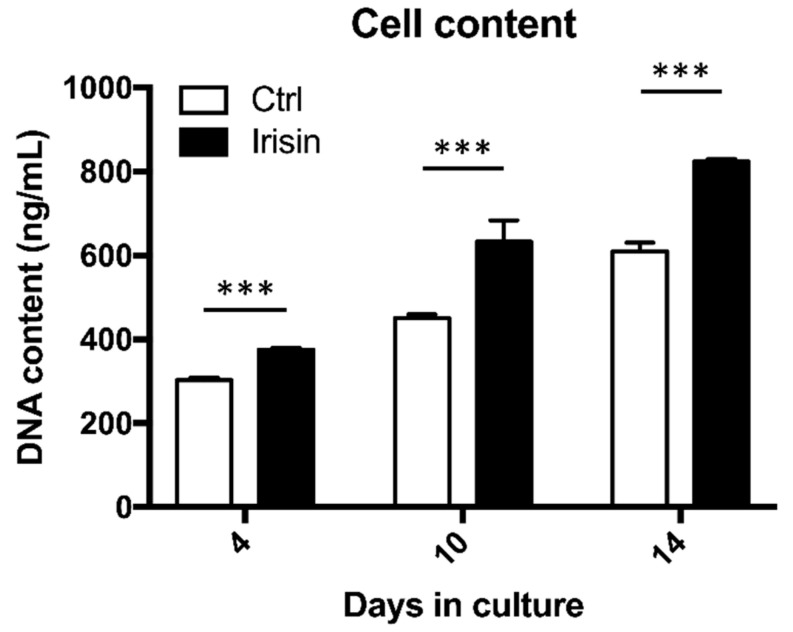
Physical exercise favors weight loss and ameliorates articular pain and function in patients suffering from osteoarthritis. Irisin, a myokine released upon muscle contraction, has demonstrated to yield anabolic effects on different cell types. This study aimed to investigate the effect of irisin on human osteoarthritic chondrocytes (hOAC) in vitro. Our hypothesis was that irisin would improve hOAC metabolism and proliferation. Cells were cultured in growing media and then exposed to either phosphate-buffered saline (control group) or human recombinant irisin (experimental group). Cell proliferation, glycosaminoglycan content, type II/X collagen gene expression and protein quantification as well as p38/extracellular signal-regulated kinase (ERK) mitogen-activated protein kinase (MAPK), protein kinase B (Akt), c-Jun N-terminal kinase (JNK), and nuclear factor kappa-light-chain-enhancer of activated B cells (NFκB) involvement were evaluated. Furthermore, gene expression of interleukin (IL)-1 and -6, matrix metalloproteinase (MMP)-1 and -13, inducible nitric oxide synthase (iNOS), and tissue inhibitor of matrix metalloproteinases (TIMP)-1 and -3 were investigated following irisin exposure. Irisin increased hOAC cell content and both type II collagen gene expression and protein levels, while decreased type X collagen gene expression and protein levels. Moreover, irisin decreased IL-1, IL-6, MMP-1, MMP-13 and iNOS gene expression, while increased TIMP-1 and TIMP-3 levels. These effects seemed to be mediated by inhibition of p38, Akt, JNK and NFκB signaling pathways. The present study suggested that irisin may stimulate hOAC proliferation and anabolism inhibiting catabolism through p38, Akt, JNK, and NFκB inactivation in vitro, demonstrating the existence of a cross-talk between muscle and cartilage.
体育锻炼有利于减肥,并改善关节炎患者的关节疼痛和功能。鸢尾素是一种肌肉收缩时释放的肌肉因子,已被证明对不同的细胞类型具有合成代谢作用。本研究旨在探讨鸢尾素对人骨性关节炎软骨细胞(hOAC)的体外作用。我们的假设是,鸢尾素会改善 hOAC 的代谢和增殖。细胞在生长培养基中培养,然后暴露于磷酸盐缓冲液(对照组)或人重组鸢尾素(实验组)中。评估细胞增殖、糖胺聚糖含量、II 型/X 型胶原基因表达和蛋白定量以及丝裂原激活蛋白激酶(MAPK)p38/细胞外信号调节激酶(ERK)、蛋白激酶 B(Akt)、c-Jun N-末端激酶(JNK)和核因子 kappa-轻链增强子的 B 细胞(NFκB)参与。此外,还研究了鸢尾素暴露后白细胞介素(IL)-1 和 -6、基质金属蛋白酶(MMP)-1 和 -13、诱导型一氧化氮合酶(iNOS)以及基质金属蛋白酶组织抑制剂(TIMP)-1 和 -3 的基因表达。鸢尾素增加了 hOAC 细胞含量和 II 型胶原基因表达和蛋白水平,同时降低了 X 型胶原基因表达和蛋白水平。此外,鸢尾素降低了 IL-1、IL-6、MMP-1、MMP-13 和 iNOS 的基因表达,同时增加了 TIMP-1 和 TIMP-3 的水平。这些作用似乎是通过抑制 p38、Akt、JNK 和 NFκB 信号通路介导的。本研究表明,鸢尾素可能通过体外抑制 p38、Akt、JNK 和 NFκB 的失活,刺激 hOAC 的增殖和合成代谢,抑制分解代谢,从而在肌肉和软骨之间存在一种交叉对话。