Centre for Brain Development and Repair, Institute for Stem Cell Biology and Regenerative Medicine, Bangalore, 560065, India.
The University of Trans-Displinary Health Sciences and Technology, Bangalore, 560064, India.
Mol Autism. 2020 Jun 19;11(1):52. doi: 10.1186/s13229-020-00351-4.
Fragile X syndrome (FXS), a neurodevelopmental disorder, is a leading monogenetic cause of intellectual disability and autism spectrum disorder. Notwithstanding the extensive studies using rodent and other pre-clinical models of FXS, which have provided detailed mechanistic insights into the pathophysiology of this disorder, it is only relatively recently that human stem cell-derived neurons have been employed as a model system to further our understanding of the pathophysiological events that may underlie FXS. Our study assesses the physiological properties of human pluripotent stem cell-derived cortical neurons lacking fragile X mental retardation protein (FMRP).
Electrophysiological whole-cell voltage- and current-clamp recordings were performed on two control and three FXS patient lines of human cortical neurons derived from induced pluripotent stem cells. In addition, we also describe the properties of an isogenic pair of lines in one of which FMR1 gene expression has been silenced.
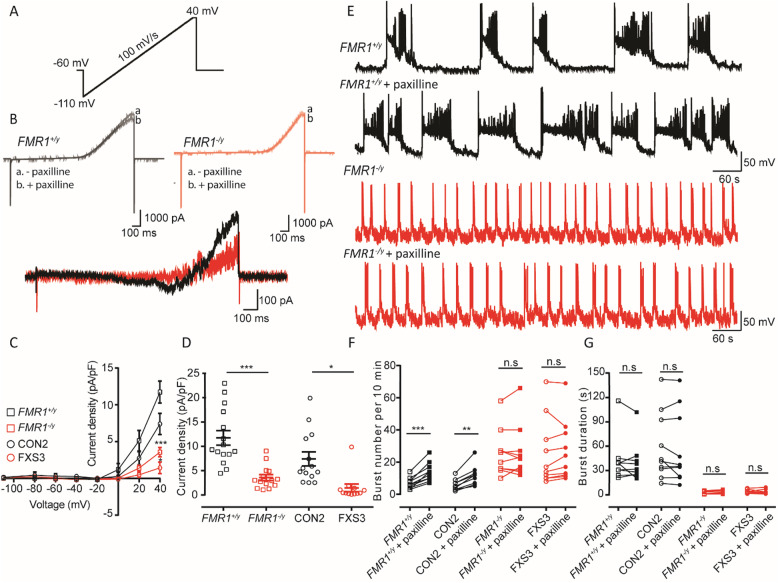
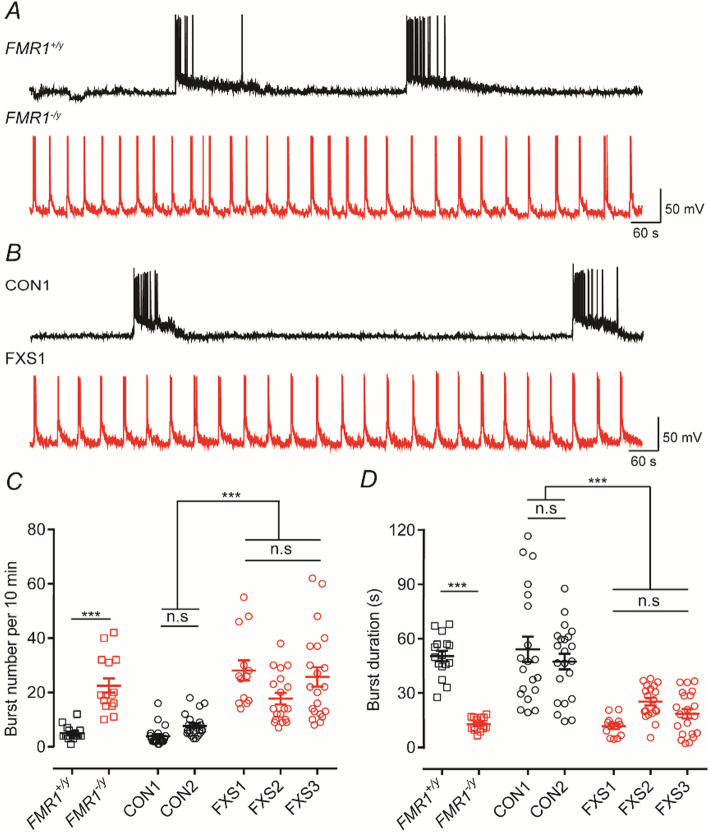
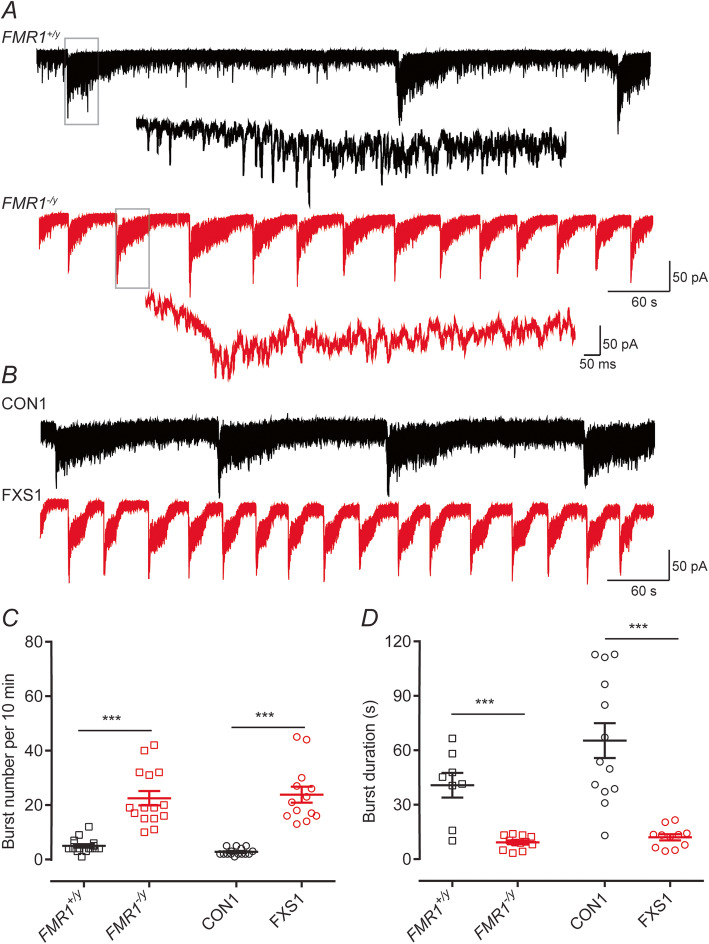
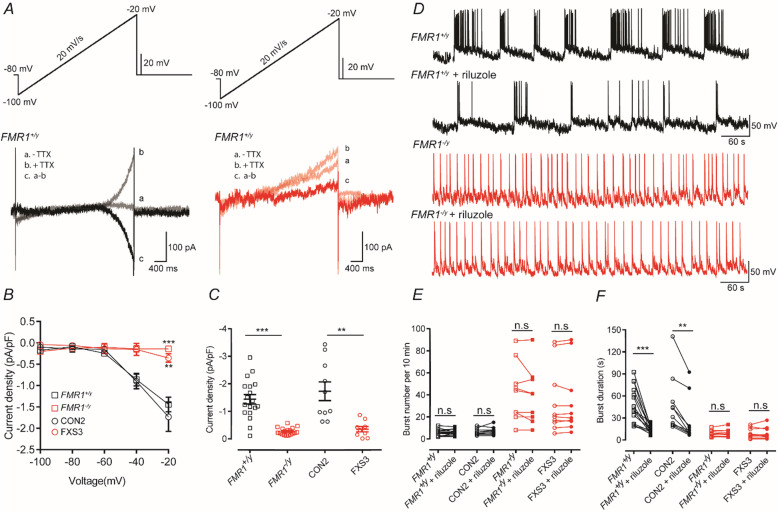
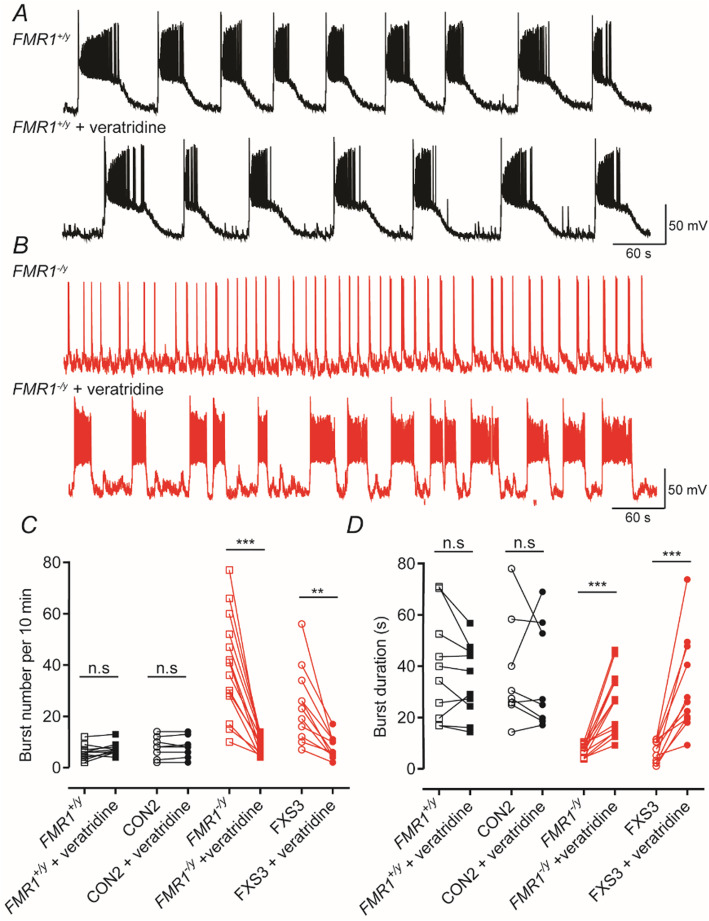
Neurons lacking FMRP displayed bursts of spontaneous action potential firing that were more frequent but shorter in duration compared to those recorded from neurons expressing FMRP. Inhibition of large conductance Ca-activated K currents and the persistent Na current in control neurons phenocopies action potential bursting observed in neurons lacking FMRP, while in neurons lacking FMRP pharmacological potentiation of voltage-dependent Na channels phenocopies action potential bursting observed in control neurons. Notwithstanding the changes in spontaneous action potential firing, we did not observe any differences in the intrinsic properties of neurons in any of the lines examined. Moreover, we did not detect any differences in the properties of miniature excitatory postsynaptic currents in any of the lines.
Pharmacological manipulations can alter the action potential burst profiles in both control and FMRP-null human cortical neurons, making them appear like their genetic counterpart. Our studies indicate that FMRP targets that have been found in rodent models of FXS are also potential targets in a human-based model system, and we suggest potential mechanisms by which activity is altered.
脆性 X 综合征(FXS)是一种神经发育障碍,是智力障碍和自闭症谱系障碍的主要单基因病因。尽管使用啮齿动物和其他 FXS 临床前模型进行了广泛的研究,这些研究为该疾病的病理生理学提供了详细的机制见解,但直到最近,人类干细胞衍生的神经元才被用作模型系统,以进一步了解可能导致 FXS 的病理生理事件。我们的研究评估了缺乏脆性 X 智力低下蛋白(FMRP)的人类多能干细胞衍生皮质神经元的生理特性。
对源自诱导多能干细胞的两个对照和三个 FXS 患者系的人类皮质神经元进行电生理学全细胞电压和电流钳记录。此外,我们还描述了其中一条线的一对同基因系的特性,其中 FMR1 基因表达已被沉默。
缺乏 FMRP 的神经元显示自发动作电位爆发的爆发更频繁,但持续时间更短与表达 FMRP 的神经元记录的相比。在对照神经元中抑制大电导钙激活的钾电流和持续的钠电流可模拟缺乏 FMRP 的神经元中观察到的动作电位爆发,而在缺乏 FMRP 的神经元中,电压依赖性钠通道的药理学增强可模拟在对照神经元中观察到的动作电位爆发。尽管自发动作电位爆发发生变化,但我们在检查的任何系中均未观察到神经元固有特性的任何差异。此外,我们没有在任何系中检测到微小兴奋性突触后电流的任何差异。
药理学处理可以改变对照和 FMRP 缺失的人类皮质神经元中的动作电位爆发谱,使它们看起来与其遗传对应物相似。我们的研究表明,在 FXS 啮齿动物模型中发现的 FMRP 靶标也是基于人类的模型系统中的潜在靶标,我们提出了改变活性的潜在机制。