School of Biological Sciences, University of Manchester, Manchester, UK.
School of Psychology, Cardiff University, Cardiff, UK.
Sleep. 2020 Dec 14;43(12). doi: 10.1093/sleep/zsaa111.
Cortical slow oscillations (SOs) and thalamocortical sleep spindles hallmark slow wave sleep and facilitate memory consolidation, both of which are reduced with age. Experiments utilizing auditory closed-loop stimulation to enhance these oscillations showed great potential in young and older subjects. However, the magnitude of responses has yet to be compared between these age groups. We examined the possibility of enhancing SOs and performance on different memory tasks in a healthy middle-aged population using this stimulation and contrast effects to younger adults.
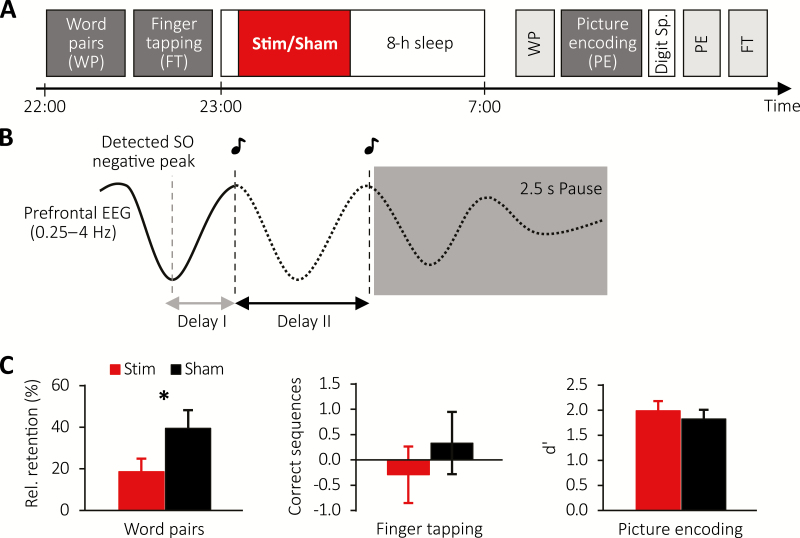
In a within-subject design, 17 subjects (55.7 ± 1.0 years) received auditory stimulation in synchrony with SO up-states, which was compared to a no-stimulation sham condition. Overnight memory consolidation was assessed for declarative word-pairs and procedural finger-tapping skill. Post-sleep encoding capabilities were tested with a picture recognition task. Electrophysiological effects of stimulation were compared to a previous younger cohort (n = 11, 24.2 ± 0.9 years).
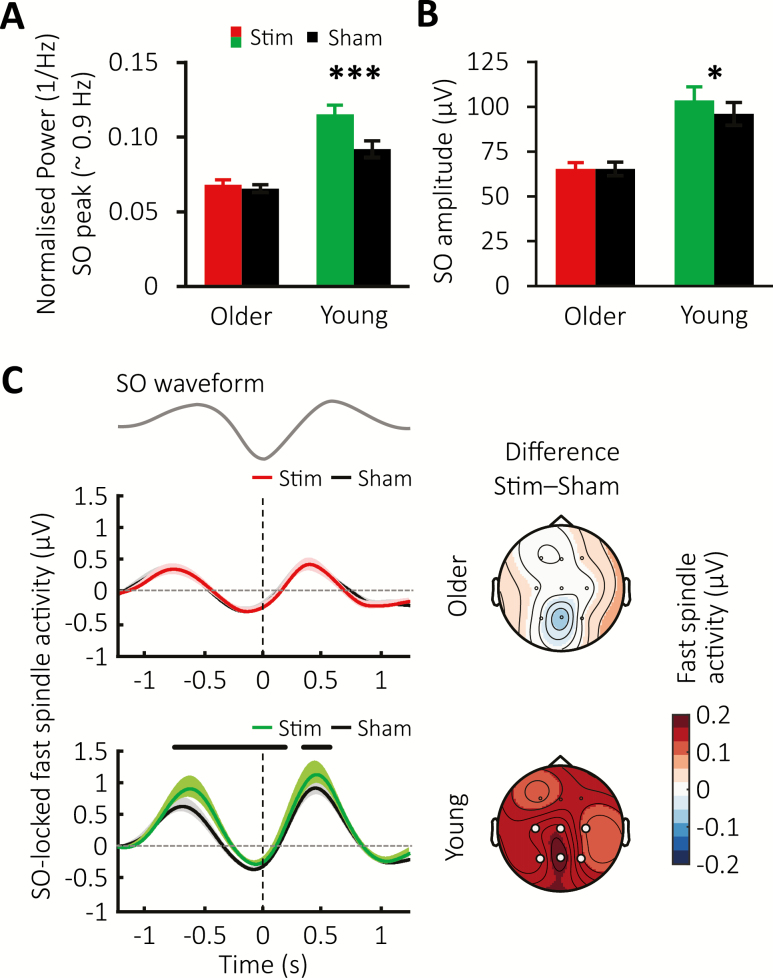
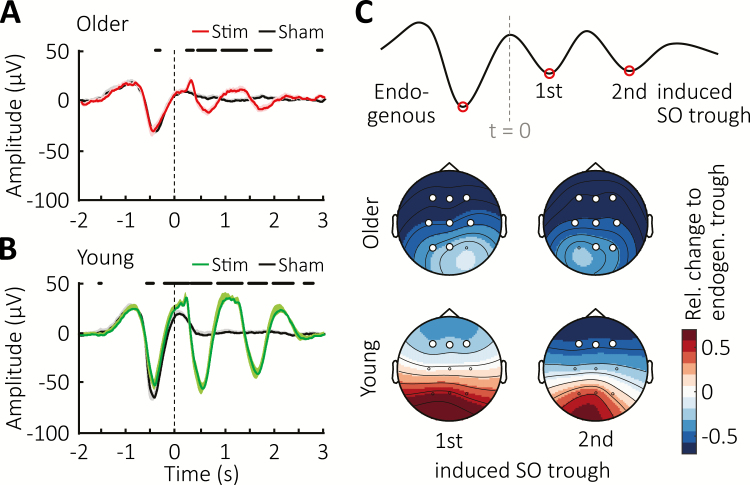
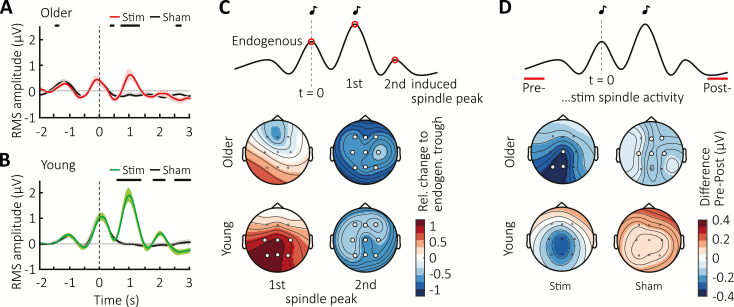
Overnight retention and post-sleep encoding performance of the older cohort revealed no beneficial effect of stimulation, which contrasts with the enhancing effect the same stimulation protocol had in our younger cohort. Auditory stimulation prolonged endogenous SO trains and induced sleep spindles phase-locked to SO up-states in the older population. However, responses were markedly reduced compared to younger subjects. Additionally, the temporal dynamics of stimulation effects on SOs and spindles differed between age groups.
Our findings suggest that the susceptibility to auditory stimulation during sleep drastically changes with age and reveal the difficulties of translating a functional protocol from younger to older populations.
皮质慢波振荡(SOs)和丘脑皮质睡眠纺锤波是慢波睡眠的标志,有助于记忆巩固,而这两者都会随着年龄的增长而减少。利用听觉闭环刺激来增强这些振荡的实验在年轻和老年受试者中显示出了巨大的潜力。然而,这些年龄组之间的反应幅度尚未进行比较。我们利用这种刺激以及与年轻成年人的对比效应,研究了在健康中年人群中增强 SOs 和不同记忆任务表现的可能性。
在一项单被试设计中,17 名受试者(55.7±1.0 岁)在 SO 上升状态下同步接受听觉刺激,与无刺激假条件进行比较。使用单词配对和手指敲击程序性任务来评估整夜记忆巩固情况。使用图片识别任务测试睡眠后编码能力。将刺激的电生理效应与以前的年轻队列(n=11,24.2±0.9 岁)进行比较。
与刺激在我们的年轻队列中产生的增强效果相反,老年队列的整夜保留和睡眠后编码性能没有显示出刺激的有益效果。听觉刺激延长了内源性 SO 列车,并在老年人群中诱导了与 SO 上升状态锁相的睡眠纺锤波。然而,与年轻受试者相比,反应明显减少。此外,刺激对 SO 和纺锤波的影响的时间动态在年龄组之间有所不同。
我们的发现表明,睡眠期间对听觉刺激的敏感性随着年龄的增长而急剧变化,并揭示了将功能方案从年轻人群转化为老年人群的困难。