Michalczyk Anna, Pełka-Wysiecka Justyna, Kucharska-Mazur Jolanta, Wroński Michał, Misiak Błażej, Samochowiec Jerzy
Department of Psychiatry, Pomeranian Medical University, 26 Broniewskiego Street, 71-460 Szczecin, Poland.
Department of Genetics, Wroclaw Medical University, 1 Marcinkowskiego Street, 50-368 Wroclaw, Poland.
Ann Gen Psychiatry. 2020 Jun 17;19:39. doi: 10.1186/s12991-020-00289-0. eCollection 2020.
The clinical course of schizophrenia varies among patients and is difficult to predict. Some patient populations present persistent negative symptoms, referred to as the deficit syndrome. Compared to relatives of non-deficit schizophrenia patients, family members of this patient population are at an increased risk of developing schizophrenia. Therefore, the aim of this study was to search for genetic underpinnings of the deficit syndrome in schizophrenia.
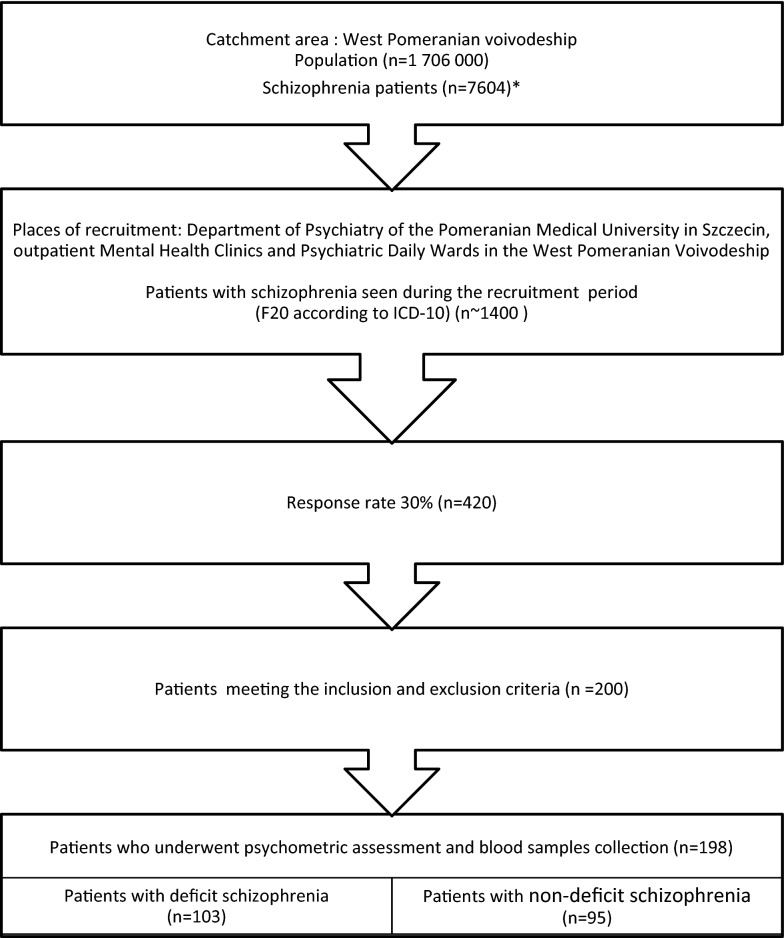
Three SNPs, i.e., rs1799732 and rs6276 located within DRD2, and rs1800497 within ANKK1, were identified in the DNA samples of 198 schizophrenia probands, including 103 patients with deficit (DS) and 95 patients with non-deficit schizophrenia (NDS). Results: No significant differences concerning any of the analyzed polymorphisms were found between DS and NDS patients. However, significant links were observed between family history of schizophrenia and the deficit syndrome, G/G genotype and rs6276 G allele. In a separate analysis, we identified significant differences in frequencies of rs6276 G allele between DS and NDS patients with family history of schizophrenia. No significant associations were found between DRD2 and ANKK1 SNPs and the age of onset or schizophrenia symptom severity.
The results of our preliminary study fail to provide evidence of associations between DRD2 and ANKK1 polymorphisms with the deficit syndrome or schizophrenia symptom severity, but suggest potential links between rs6276 in DRD2 and the deficit syndrome in patients with hereditary susceptibility to schizophrenia. However, further studies are necessary to confirm this observation.
精神分裂症的临床病程在患者之间存在差异且难以预测。一些患者群体表现出持续性阴性症状,即缺陷综合征。与非缺陷型精神分裂症患者的亲属相比,该患者群体的家庭成员患精神分裂症的风险更高。因此,本研究的目的是寻找精神分裂症缺陷综合征的遗传基础。
在198例精神分裂症先证者的DNA样本中鉴定出三个单核苷酸多态性(SNP),即位于DRD2内的rs1799732和rs6276,以及位于ANKK1内的rs1800497,其中包括103例缺陷型(DS)患者和95例非缺陷型精神分裂症(NDS)患者。结果:DS和NDS患者之间在任何分析的多态性方面均未发现显著差异。然而,观察到精神分裂症家族史与缺陷综合征、G/G基因型和rs6276 G等位基因之间存在显著关联。在一项单独分析中,我们发现有精神分裂症家族史的DS和NDS患者之间rs6276 G等位基因频率存在显著差异。未发现DRD2和ANKK1 SNPs与发病年龄或精神分裂症症状严重程度之间存在显著关联。
我们初步研究的结果未能提供DRD2和ANKK1多态性与缺陷综合征或精神分裂症症状严重程度之间存在关联的证据,但表明DRD2中的rs6276与精神分裂症遗传易感性患者的缺陷综合征之间可能存在联系。然而,需要进一步研究来证实这一观察结果。