Wu Jiansong, Niu Qiang, Yuan Jie, Xu Xiaodan, Cao Liuxia
Department of Infectious Diseases, General Hospital of the Peoples' Liberation Army Rocket Force, Beijing 100088, P.R. China.
Oncol Lett. 2020 Jul;20(1):235-247. doi: 10.3892/ol.2020.11534. Epub 2020 Apr 15.
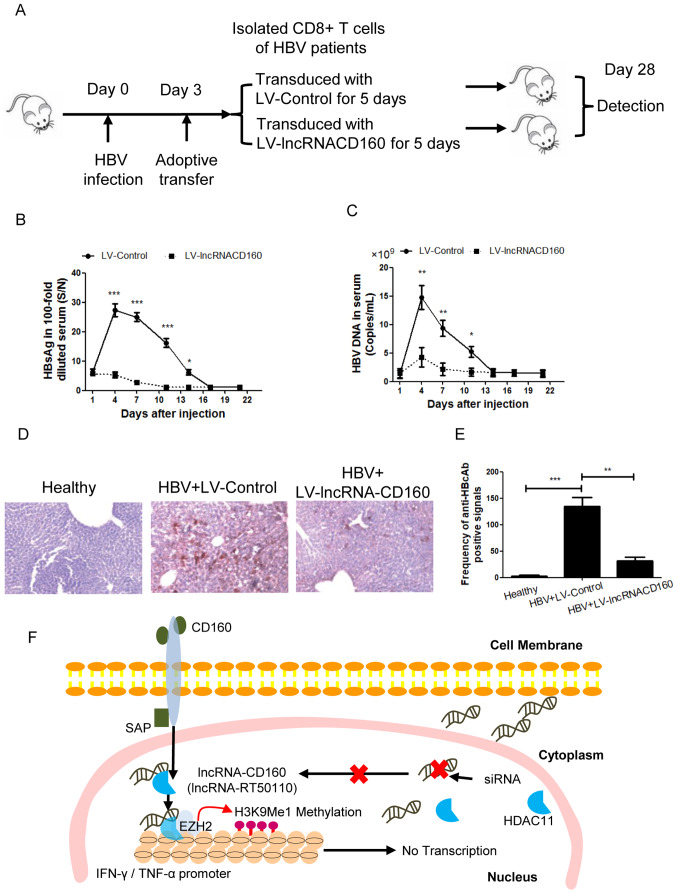
The transfer and development of chronic hepatitis B virus (HBV) infection is associated with the T cell immune response, therefore investigating the key regulators of cell immune response is needed to improve chronic HBV treatment. Blood samples from patients with chronic HBV infection were used to confirm the correlation between HBV infection stage and CD160 receptor expression levels in CD8 T cells, the CD8 T cells are used to research the mechanism of T cell immune response modulation, moreover, C3H/HeN mice with reduced CD160 expression levels were used to investigate the association between long non-coding (lnc)RNA-CD160 and HBV infection. Long non-coding (lnc)RNA-CD160 and histone-modification enzyme gene histone deacetylase 11 (HDAC11) expression levels were negatively associated with CD160 expression. lncRNA-CD160 can inhibit the secretion of IFN-γ and TNF-α through HDAC11 recruitment and bind to HDAC11 to form a complex on the promoters of IFN-γ and TNF-α. The HDAC11, IFN-γ and TNF-α form a complex and enhance the methylation of H3K9Me1, chromatin changes into the heterochromatin and the transcription of IFN-γ and TNF-α is blocked; moreover, the HDAC11/IFN-γ/TNF-α complex can also inhibit the secretion of IFN-γ and TNF-α in CD160 CD8 T cells and suppresses the function of CD8 T cells. Furthermore, small interfering RNA targeting lncRNA-CD160 can block HBV infection progression. lncRNA-CD160 acts as an immune suppressive factor and is expressed at a high level in peripheral blood CD8 T cells of HBV infected patients. Furthermore, high expression levels of lncRNA-CD160 can contribute to the inhibition of IFN-γ and TNF-α secretion in CD8 T cells and decrease the immune response of CD8 T cells. Therefore, lncRNA-CD160 may become a new target for immunotherapy of chronic HBV infection in the future and may provide a new therapeutic strategy for the treatment of HBV infection.
慢性乙型肝炎病毒(HBV)感染的转移和发展与T细胞免疫反应相关,因此需要研究细胞免疫反应的关键调节因子以改善慢性HBV治疗。采用慢性HBV感染患者的血液样本,以证实HBV感染阶段与CD8 T细胞中CD160受体表达水平之间的相关性,利用CD8 T细胞研究T细胞免疫反应调节机制,此外,采用CD160表达水平降低的C3H/HeN小鼠研究长链非编码(lnc)RNA-CD160与HBV感染之间的关联。长链非编码(lnc)RNA-CD160和组蛋白修饰酶基因组蛋白去乙酰化酶11(HDAC11)的表达水平与CD160表达呈负相关。lncRNA-CD160可通过募集HDAC11抑制IFN-γ和TNF-α的分泌,并与HDAC11结合在IFN-γ和TNF-α启动子上形成复合物。HDAC11、IFN-γ和TNF-α形成复合物并增强H3K9Me1的甲基化,染色质转变为异染色质,IFN-γ和TNF-α的转录被阻断;此外,HDAC11/IFN-γ/TNF-α复合物还可抑制CD160 CD8 T细胞中IFN-γ和TNF-α的分泌,并抑制CD8 T细胞的功能。此外,靶向lncRNA-CD160的小干扰RNA可阻断HBV感染进程。lncRNA-CD160作为一种免疫抑制因子,在HBV感染患者外周血CD8 T细胞中高表达。此外,lncRNA-CD160的高表达水平可导致CD8 T细胞中IFN-γ和TNF-α分泌的抑制,并降低CD8 T细胞的免疫反应。因此,lncRNA-CD160未来可能成为慢性HBV感染免疫治疗的新靶点,并可能为HBV感染的治疗提供新的治疗策略。